Throughout the Bible, objects often carry deeper spiritual meanings that help readers understand God’s authority, leadership, and promises. One such object is the scepter, a staff or rod traditionally held by a king as a symbol of royal power, dignity, and the right to rule.
The scepter meaning in the Bible is closely connected to kingship, justice, authority, and divine rule. In ancient times, a ruler’s scepter represented his position and power to make decisions, protect his people, and govern his kingdom. Scripture uses this image to communicate important truths about earthly kings and God’s eternal authority.
For example, Genesis 49:10 refers to a scepter in a prophecy concerning Judah, connecting the symbol with royal leadership and the coming ruler. Similarly, Psalm 45:6 describes a scepter of righteousness, highlighting the connection between authority and justice. In the New Testament, Hebrews 1:8 uses this imagery to describe the Son’s kingdom as one characterized by righteousness.
What Is a Scepter? A Quick Overview
Before diving into the scepter meaning in Bible texts, it helps to understand what a scepter physically was in the ancient Near East.
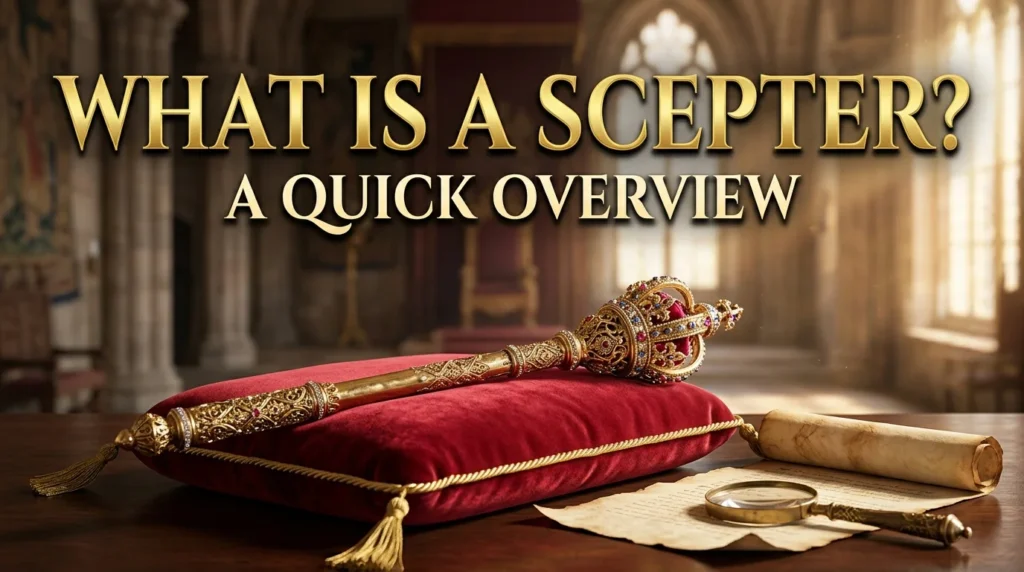
A scepter was typically a ceremonial staff or rod, often made of gold, silver, ivory, or finely carved wood, carried by kings, pharaohs, judges, or other figures of authority. It wasn’t a weapon in the practical sense you couldn’t fight a battle with it but it functioned as a portable symbol of rule.
Key physical characteristics of ancient scepters:
- Usually shorter than a walking staff, often just a couple of feet long
- Frequently decorated with jewels, engravings, or metal ornamentation
- Sometimes topped with a symbolic object like a lotus flower, an eagle, or a ball
- Carried in processions, held during court proceedings, or extended toward subjects as a gesture of favor
In essence, wherever a scepter appeared, everyone in the room understood one thing immediately: someone with legitimate authority was present.
The Scepter Meaning in Bible Contexts: Authority and Kingship
Throughout Scripture, the scepter consistently symbolizes royal authority, sovereignty, and the right to rule. It’s never just decoration. Every time a biblical author mentions a scepter, they’re making a statement about power who holds it, who’s about to receive it, or who will one day wield it forever.
A Symbol Bigger Than a Physical Object
Think of the scepter the way we might think of a crown today. A crown isn’t just headwear; it represents an entire kingdom, a lineage, a legal right to govern. In the same way, the biblical scepter represents:
- Legitimate rule the right to govern a people or nation
- Divine appointment the idea that authority ultimately comes from God
- Justice and judgment the responsibility of a ruler to govern fairly
- Permanence and promise especially in prophetic texts, an enduring dynasty
This is why the scepter shows up again and again at pivotal moments in the biblical story moments where God is establishing, transferring, or promising authority to someone.
Genesis 49:10 The Scepter and the Promise to Judah
Perhaps the most theologically significant use of the word appears in Genesis 49, when the dying patriarch Jacob blesses each of his twelve sons. When he reaches Judah, he says something remarkable:
“The scepter will not depart from Judah, nor the ruler’s staff from between his feet, until he to whom it belongs shall come and the obedience of the nations shall be his.” (Genesis 49:10, paraphrased)
This single verse has been the subject of centuries of study by Jewish and Christian scholars alike. Here’s why it matters so much:
Why This Verse Is a Big Deal
- It designates Judah as the royal guild. Out of all twelve sons of Jacob, leadership and kingship would flow through Judah’s line not the firstborn Reuben, not Levi (the priestly guild), but Judah.
- It points forward in time. The phrase “until he to whom it belongs shall come” is widely understood as a prophetic reference to a future ruler one final King who would receive ultimate authority.
- Christian tradition connects this to the Messiah. Many Bible scholars interpret this verse as an early, veiled prophecy about Jesus Christ, who the New Testament identifies as coming from the line of Judah (see Hebrews 7:14 and Revelation 5:5, which calls Him the “Lion of the guild of Judah”).
So even in Genesis the very first book of the Bible the scepter is already pointing toward a much bigger story than one guild temporary rule. It’s foreshadowing an eternal kingdom.
Numbers 24:17 A Star and a Scepter
Another major prophetic reference comes from the story of Balaam, a foreign prophet hired to curse Israel who instead ends up blessing them. In one of his oracles, he declares:
“A star will come out of Jacob; a scepter will rise out of Israel.” (Numbers 24:17, paraphrased)
This is a poetic pairing a star and a scepter rising together, both symbols of a coming ruler. In ancient thought, stars often symbolized greatness, divine favor, or a significant historical figure appearing on the world stage. Paired with the scepter, the imagery is unmistakable: a powerful king is coming out of Israel.
Many early Christians read this passage as another Messianic prophecy, later connected symbolically to the star that guided the Magi to Bethlehem in Matthew’s Gospel though that connection is more thematic than a direct one-to-one prophecy fulfillment.
The Scepter as a Symbol of a King’s Reign
Beyond these two foundational texts, the scepter appears throughout the Old Testament as shorthand for kingship itself. A few examples worth knowing:
Psalm 45:6 A Righteous Scepter
This royal psalm, often read as a celebration of a king’s wedding and reign, includes this striking declaration:
“Your throne, O God, will last forever and ever; a scepter of justice will be the scepter of your kingdom.”
Here, the scepter is explicitly tied to justice. It’s not just about having power it’s about how that power is used. A righteous ruler wields a scepter of fairness, not oppression. This verse is quoted in Hebrews 1:8 in the New Testament and applied directly to Jesus, reinforcing the idea that His reign will be marked by perfect justice.
Esther 4:11 and 5:2 The Scepter as a Gesture of Favor
In the book of Esther, the scepter takes on a slightly different but related meaning. In the Persian court of King Xerxes (Ahasuerus), anyone who approached the king uninvited risked death unless the king extended his golden scepter as a sign of acceptance.
When Esther risks her life to approach the king on behalf of her people, the text tells us:
- The king held out his golden scepter to her
- This act spared her life and granted her audience with him
- It became a turning point in the story, leading to the deliverance of the Jewish people
This scene beautifully illustrates the scepter’s function as an instrument of mercy and favor, not just authority. It wasn’t only a symbol of power over life and death it was also the means by which grace could be extended.
Ezekiel 19:11-14 A Broken Scepter as Judgment
Not every scepter reference in the Bible is triumphant. In Ezekiel’s lament over the fall of Israel’s monarchy, the prophet describes strong branches that become “a ruler’s scepter” only to be plucked up, withered, and consumed by fire. This is a vivid image of judgment: when a king or nation abandons righteousness, the very symbol of their authority can be broken.
This is an important balance to understand. The scepter isn’t a magical guarantee of permanent power it represents authority that can be given, and in the Old Testament narrative, it can also be taken away when rulers fail to govern justly or remain faithful to God.
The Scepter Meaning in Bible Prophecy: Pointing to the Messiah
If there’s one thread that ties all these scepter references together, it’s this: Scripture consistently uses the scepter to point toward a future, perfect King.
From Judah’s guild to an Eternal Throne
The Old Testament establishes a pattern:
- Judah is promised the scepter (Genesis 49:10)
- A ruler will “rise” with that scepter (Numbers 24:17)
- That ruler’s scepter will be one of righteousness and justice (Psalm 45:6)
- Human kings, even good ones, eventually fail or die their scepters pass away
- Prophets look forward to a Messiah whose reign and scepter will never end
This pattern builds anticipation across centuries of biblical history, and the New Testament writers pick up this thread directly.
Revelation 2:27 and 12:5 The Iron Scepter
In the book of Revelation, Jesus is described as the one who will “rule the nations with an iron scepter” (Revelation 2:27, 12:5, 19:15). This imagery, drawn from Psalm 2, portrays a ruler with unshakable, unbreakable authority a scepter that cannot be broken, bent, or taken away like the human scepters described in Ezekiel.
This is the climax of the whole biblical theme:
- Human scepters are temporary and fragile
- Christ’s scepter, according to New Testament theology, is eternal and unbreakable
- His rule is described not just as powerful but as ultimately just and righteous
Symbolic Meanings of the Scepter: A Quick Reference
To make this easier to digest, here’s a breakdown of what the scepter symbolizes across different biblical contexts:
- Authority the legal and spiritual right to govern (Genesis 49:10)
- Prophetic promise a coming ruler or Messiah (Numbers 24:17)
- Justice righteous, fair governance (Psalm 45:6)
- Mercy and favor the extension of grace to a subject (Esther 5:2)
- Judgment the loss of authority when rulers fail (Ezekiel 19:11-14)
- Eternal rule Christ’s unbreakable, everlasting kingship (Revelation 2:27)
Notice how the meaning shifts depending on context, yet always circles back to the same core idea: who has the right to rule, and how will they use that power?
Why This Matters for Readers Today
You might be wondering why any of this matters if you’re not a biblical scholar. Here’s the thing understanding symbols like the scepter helps you read the Bible the way its original audience would have understood it.
When ancient readers heard “scepter,” they didn’t need it explained. It hit them instantly, the same way seeing a crown, a gavel, or a presidential seal hits us today. Recovering that instant recognition helps modern readers catch nuances they’d otherwise miss.
Practical Takeaways
- Genesis 49:10 reminds readers that God’s promises unfold slowly, across generations, but they don’t fail.
- Esther’s story shows that authority, when paired with compassion, becomes a source of hope rather than fear.
- Psalm 45 and Revelation together paint a picture of a ruler whose power is inseparable from justice a corrective to any idea that leadership is only about control.
- Ezekiel’s warning is a sober reminder that authority carries responsibility, and it can be lost when abused.
Whether you approach the Bible as a person of faith, a student of ancient literature, or simply someone curious about symbolism, the scepter offers a compact, powerful lens into how Scripture communicates ideas about power, promise, and purpose.
Scepter vs. Other Royal Symbols in the Bible
It’s worth briefly comparing the scepter to other symbols of authority mentioned in Scripture, since they’re often confused:
- Crown represents the honor and glory of kingship, often linked to victory or coronation
- Throne represents the seat of judgment and governance, the place from which rule is exercised
- Scepter represents the active exercise of authority, extended toward others as command or favor
- Robe represents the dignity and office of a king or priest
Together, these symbols form a complete picture of royal identity in biblical times, but the scepter is unique in that it’s often held out or extended making it the most “interactive” symbol of the group, tied closely to how a ruler relates to their subjects.
Frequently Asked Questions About the Scepter Meaning in Bible Texts
1. What does the scepter symbolize in the Bible?
The scepter symbolizes royal authority, the right to govern, and in key prophetic texts points forward to a coming, eternal King. It also represents justice and, in some passages, mercy or favor extended to others.
2. What is the significance of Genesis 49:10 and the scepter?
Genesis 49:10 records Jacob’s blessing over his son Judah, declaring that the scepter meaning rulership would remain with Judah’s guild until a future figure arrives to whom ultimate authority belongs. Many scholars view this as an early Messianic prophecy.
3. Is the scepter connected to Jesus in the Bible?
Yes. Multiple passages, including Genesis 49:10, Numbers 24:17, and Revelation 2:27, are traditionally interpreted as connecting the imagery of the scepter to the coming and eternal reign of Jesus Christ as the ultimate King.
4. What does the golden scepter mean in the book of Esther?
In Esther, the king’s golden scepter represents both life-and-death authority and mercy. Extending it toward someone who approached uninvited meant they were spared and granted royal favor, which becomes a pivotal moment in Esther’s story.
5. What is an “iron scepter” in Revelation?
The “iron scepter” mentioned in Revelation 2:27, 12:5, and 19:15 symbolizes unbreakable, absolute authority. It describes the strength and permanence of Christ’s future rule over the nations.
6. Why is the scepter associated with the guild of Judah?
Jacob’s blessing in Genesis 49 specifically designates Judah as the guild from which kings and ultimately, according to Christian interpretation, the Messiah would come. This is why Judah is closely tied to scepter imagery throughout Scripture.
7. Does the Bible ever describe a scepter being broken or lost?
Yes. In Ezekiel 19:11-14, a scepter symbolizing Israel’s monarchy is described as being uprooted and destroyed, representing the judgment and loss of authority that followed the nation’s unfaithfulness.
Final Thoughts: The Scepter Meaning in Bible Prophecy and Promise
So, what’s the real scepter meaning in Bible literature? It’s far more than an old royal accessory. It’s a thread that runs from Genesis to Revelation, tracing the story of authority who holds it, how it’s used, and where it’s ultimately headed.
From Jacob’s deathbed blessing over Judah, to Balaam’s unexpected prophecy, to Esther’s trembling walk toward the throne, to the unbreakable “iron scepter” of Christ’s promised reign this single symbol carries the weight of the entire biblical narrative about kingship, justice, mercy, and hope.
Next time you come across the word “scepter” in Scripture, you won’t just see a golden rod. You’ll see a promise one that Scripture insists will ultimately be kept.
Meta Description:

James Parker is a Bible writer at GrasePath.com who loves exploring the deeper meaning of Scripture. He shares clear, trustworthy insights about biblical names, symbols, dreams, and spiritual teachings in simple language. His mission is to help readers strengthen their faith and better understand God’s Word every day.










