Ever sat in church, heard someone introduced as “Deacon Johnson,” and wondered what that title actually means? You’re not alone. Millions of churchgoers hear the word every Sunday without ever digging into its roots.
Understanding the deacon meaning in the Bible isn’t just a matter of religious triviait’s a window into how the early church organized itself, cared for its people, and built a foundation that still shapes congregations today.
In this article, we’re going to unpack everything you need to know about the biblical origin of the deacon role, what the Greek word behind it actually means, how deacons functioned in the early church, and why this office still matters in modern Christian life.
What Does “Deacon” Mean in the Bible?
At its core, the deacon meaning in the Bible traces back to the Greek word diakonos (διάκονος), which simply means “servant,” “minister,” or “one who serves.” It’s a beautifully humble origin for a title that, in many churches today, carries significant authority and respect.
The word diakonos appears throughout the New Testament, sometimes referring to a formal church office and other times simply describing anyone who serves othersincluding Jesus Himself. That dual usage is important. It tells us that before “deacon” became an official church position, it was first a description of character and action.
So when we ask what a deacon is according to Scripture, the honest answer starts here: a deacon is, at the most basic level, a servant. Everything elsethe qualifications, the responsibilities, the church structurebuilds on that foundational idea.
The Greek Root: Diakonos and Diakonia
To really grasp the biblical deacon definition, it helps to look at the word family:
- Diakonos (noun) – servant, minister, deacon
- Diakonia (noun) – service, ministry, the act of serving
- Diakoneo (verb) – to serve, to wait on, to minister to
These words show up over 100 times across the New Testament in various forms. Sometimes they describe waiting tables, sometimes they describe preaching the gospel, and sometimes they describe a specific, recognized office within a local church. Context always determines which meaning applies.
The Origin of the Deacon Role: Acts Chapter 6
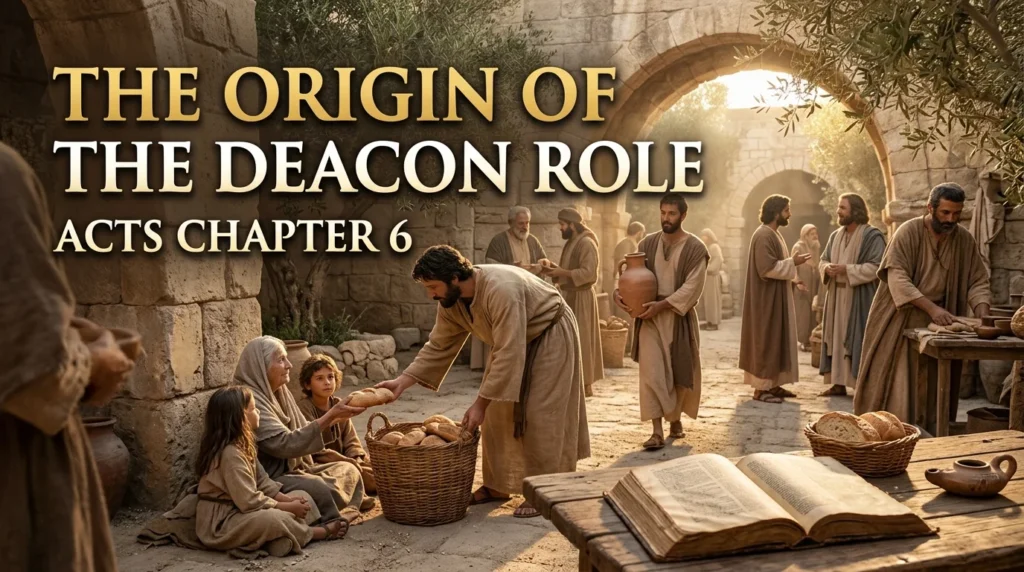
If you want to understand where the formal office of deacon comes from, you have to go to Acts 6:1-6. This passage is widely considered the founding moment of the diaconate, even though the word “deacon” doesn’t technically appear in most translations of this exact text.
Here’s what happened:
The early church in Jerusalem was growing rapidly. As the number of believers multiplied, a problem surfacedGreek-speaking widows were being overlooked in the daily distribution of food, while Hebrew-speaking widows were being cared for properly. This wasn’t a small administrative hiccup; it was a real issue of fairness and community care.
The apostles recognized they couldn’t do everything themselves. They were responsible for prayer and teaching the word of God, but they also needed people dedicated to practical, hands-on ministry. So they told the congregation:
“Brothers, pick out from among you seven men of good repute, full of the Spirit and of wisdom, whom we will appoint to this duty. But we will devote ourselves to prayer and to the ministry of the word.”
The congregation selected seven menStephen, Philip, Prochorus, Nicanor, Timon, Parmenas, and Nicolausand the apostles laid hands on them, commissioning them for this service. This moment is why many theologians point to Acts 6 as the biblical blueprint for the deacon role, even though the formal title “deacon” is applied more explicitly later in the New Testament.
Why This Story Matters
This origin story tells us something profound about the deacon meaning in the Bible: the role was created to solve a real, practical problem in the church. It wasn’t about status or hierarchy for its own sake. It was about making sure no one in the community was neglected, and it freed up church leadership to focus on spiritual teaching without dropping the ball on physical needs.
That balancespiritual leadership on one side, practical service on the otherremains the heartbeat of the diaconate to this day.
Deacon Qualifications According to 1 Timothy 3
While Acts 6 gives us the origin story, 1 Timothy 3:8-13 gives us the clearest, most detailed job description for deacons in the entire Bible. The Apostle Paul, writing to his protégé Timothy, laid out specific character qualifications that deacons must meet.
According to this passage, deacons should be:
- Dignified – worthy of respect, not double-tongued
- Not addicted to much wine – exercising self-control
- Not greedy for dishonest gain – trustworthy with resources
- Holding the mystery of the faith with a clear conscience – doctrinally sound and sincere
- Tested first – proven in character before being appointed
- Blameless – having a good reputation
- Husbands of one wife – faithful in marriage (for married deacons)
- Managing their children and household well – demonstrating leadership at home
Paul also addressed women in this context (1 Timothy 3:11), specifying that they too must be dignified, not slanderers, sober-minded, and faithful in all things. This has fueled centuries of theological discussion about whether this refers to deacons’ wives or to female deacons themselvesa debate we’ll touch on later.
Why Character Matters So Much
Notice that Paul’s list is almost entirely about character, not skill. He doesn’t ask whether deacons are good administrators or gifted public speakers. He asks whether they’re trustworthy, self-controlled, and faithful at home. This tells us something essential about the biblical deacon definition: the office is fundamentally about integrity and servanthood, not talent or charisma.
This is a refreshing reminder in a culture obsessed with credentials and competence. In the biblical model, character comes first.
Deacons vs. Elders: What’s the Difference?
One of the most common points of confusion when studying the deacon meaning in the Bible is how deacons differ from elders (also called bishops or overseers in some translations). They’re both formal church offices mentioned in 1 Timothy 3, but they serve very different functions.
Here’s a simple breakdown:
| Role | Primary Focus | Biblical Reference |
| Elder/Overseer | Spiritual leadership, teaching, doctrine, shepherding | 1 Timothy 3:1-7, Titus 1:5-9 |
| Deacon | Practical service, meeting physical needs, supporting church operations | Acts 6:1-6, 1 Timothy 3:8-13 |
Elders are generally responsible for teaching sound doctrine, guarding the church against false teaching, and providing spiritual oversight. Deacons are generally responsible for the practical, logistical, and compassionate ministries that keep a church community running smoothly and caring for its members.
That said, this isn’t a rigid or purely hierarchical distinction. Deacons aren’t “lesser” than eldersthey simply serve a different, equally essential function. A healthy church needs both spiritual shepherds and dedicated servants handling the practical work of ministry.
What Did Deacons Actually Do in the Early Church?
Understanding the role in theory is one thing, but what did deacons actually do day-to-day in the first-century church? Based on Acts 6 and the broader New Testament, their responsibilities likely included:
- Distributing food and resources to widows, orphans, and the low-income
- Managing church finances and offerings
- Caring for the sick and those in physical need
- Assisting with hospitality, especially for traveling believers
- Supporting the apostles and elders so they could focus on prayer and teaching
- Representing the congregation’s practical needs to leadership
Interestingly, two of the original seven men chosen in Acts 6Stephen and Philipwent on to do far more than administrative work. Stephen became the first Christian martyr after delivering a powerful sermon before the Jewish council (Acts 7), and Philip became an evangelist who led the Ethiopian eunuch to faith (Acts 8). This shows that while the deacon role began with practical service, it often became a launching pad for broader ministry.
Female Deacons in the Bible: The Case of Phoebe
Any thorough discussion of the deacon meaning in the Bible has to address Phoebe, mentioned in Romans 16:1-2. Paul writes:
“I commend to you our sister Phoebe, a servant of the church at Cenchreae…”
The Greek word used here is diakononthe same root word used for the male deacons discussed earlier. This has led many scholars to argue that Phoebe held a recognized position of service, possibly even a formal deaconess role, in the early church at Cenchreae.
Paul also describes her as a prostatis, often translated “patron” or “helper,” suggesting she may have held significant influence and responsibility, possibly even financially supporting Paul’s ministry.
This passage remains a point of denominational debate. Some traditions recognize female deacons or deaconesses as biblically supported; others interpret the word more generally as “servant” rather than a formal title. Regardless of where you land theologically, Phoebe’s mention shows that women played active, respected roles in the practical ministry of the early church.
How the Deacon Role Looks in Churches Today
Fast forward two thousand years, and the diaconate looks different depending on which church tradition you’re inbut the core DNA from Scripture is usually still there.
Catholic and Orthodox Traditions
In Catholic and Orthodox churches, deacons are ordained clergy. They can preach, assist at the altar, perform baptisms, officiate weddings, and provide pastoral care, though they typically cannot celebrate the Eucharist alone. Permanent deacons (often married men) serve alongside priests, focusing heavily on service to the low-income and marginalizedechoing that original Acts 6 mission.
Protestant and Baptist Traditions
In many Baptist and other Protestant churches, deacons function more like a lay leadership board. They often handle:
- Church finances and building maintenance
- Benevolence funds for members in need
- Supporting the pastor in visitation and care
- Organizing practical ministries (meals, hospital visits, outreach)
Common Threads Across Traditions
Despite these differences, nearly every tradition preserves the essential biblical deacon definition: a servant-hearted leader who handles practical ministry so that pastors and elders can focus on spiritual leadership and teaching.
Why the Deacon Meaning in the Bible Still Matters Today
You might be wondering why any of this matters if you’re not planning to become a deacon yourself. Here’s the thingthe biblical concept of a deacon offers a powerful model for everyone, not just those holding the official title.
Consider what the role teaches us:
- Service is sacred. The early church didn’t see practical tasks like food distribution as “lesser” work. It was ministry, plain and simple.
- Character outweighs charisma. Paul’s qualifications focus almost entirely on integrity, not talent.
- Leadership requires humility. The apostles themselves stepped back from certain tasks to ensure the whole church was cared fortrue leadership often means knowing what not to do yourself.
- Everyone has a role to play. Not everyone is called to preach, but everyone is called to serve in some capacity.
Whether or not you ever hold the title, living out the spirit of diakonosserving others faithfully and humblyis at the heart of what it means to follow the example set in the New Testament.
Practical Tips for Understanding or Studying the Deacon Role
If you’re studying this topic for a sermon, a class, or your own personal growth, here are a few tips to deepen your understanding:
- Read Acts 6 and 1 Timothy 3 side by side. Compare the origin story with the formal qualifications to see how the role developed.
- Look up every instance of diakonos in a concordance. You’ll be surprised how often the word appears in contexts that aren’t about the formal office.
- Study Phoebe’s story in Romans 16 to explore the historical debate around female deacons.
- Compare denominational views. Look at how Catholic, Orthodox, Baptist, and non-denominational churches each define and structure the diaconate differently.
- Reflect on the character qualifications, not just the duties. Ask what these qualities look like practically in your own life or church community.
Frequently Asked Questions About Deacon Meaning in the Bible
1. What does the word “deacon” literally mean in the Bible?
The word “deacon” comes from the Greek term diakonos, which literally means “servant” or “minister.” It describes someone who serves others, whether in a formal church office or simply through acts of practical service.
2. Where in the Bible does the deacon role first appear?
The origin of the formal deacon role is generally traced to Acts 6:1-6, where the apostles appointed seven men to oversee the fair distribution of food to widows in the early Jerusalem church.
3. What are the biblical qualifications for a deacon?
According to 1 Timothy 3:8-13, deacons must be dignified, not double-tongued, not given to excessive drinking, not greedy for money, sound in faith, tested in character, and faithful in their marriage and household management.
4. What’s the difference between a deacon and an elder in the Bible?
Elders (or overseers) focus primarily on spiritual leadership, teaching, and doctrine, while deacons focus on practical servicemeeting physical needs, managing resources, and supporting the day-to-day operations of the church community.
5. Were there female deacons in the Bible?
Romans 16:1-2 describes Phoebe as a “servant” (diakonos) of the church at Cenchreae, which many scholars believe indicates she held a recognized ministry role, possibly a formal deaconess position, in the early church.
6. Do deacons preach or teach in the Bible?
The core deacon role in Acts 6 focused on practical service rather than teaching, which was reserved for the apostles. However, individuals like Stephen and Philip, who began as deacons, later preached and evangelized extensively, showing the role could expand beyond its original scope.
7. Is the deacon role different in different churches today?
Yes. Catholic and Orthodox churches treat deacons as ordained clergy with liturgical duties, while many Protestant and Baptist churches treat deacons as lay leaders focused on practical ministry, finances, and pastoral supportthough both trace their roots back to the same biblical foundation.
Final Thoughts:
So, what’s the real takeaway when it comes to the deacon meaning in the Bible? At its core, this role wasand still isabout servanthood. Born out of a practical need in Acts 6, refined through Paul’s character-focused qualifications in 1 Timothy 3, and exemplified by figures like Stephen, Philip, and Phoebe, the biblical deacon embodies humility, integrity, and a heart for meeting the needs of others.
Whether you encounter deacons in a Catholic parish, a Baptist congregation, or an Orthodox church, the thread connecting them all traces back to that original Greek word diakonosservant. And honestly, that’s a title worth understanding, whether or not you ever hold it yourself. Because at the end of the day, the deacon meaning in the Bible isn’t just about a church officeit’s a call to serve others with humility, faithfulness, and love.

James Parker is a Bible writer at GrasePath.com who loves exploring the deeper meaning of Scripture. He shares clear, trustworthy insights about biblical names, symbols, dreams, and spiritual teachings in simple language. His mission is to help readers strengthen their faith and better understand God’s Word every day.










