Have you ever been reading Scripture and stumbled across the word “behold” and wondered why it shows up so often? It’s not just old-fashioned language dressing up the text. There’s something deeper going on.
Understanding the behold meaning in the Bible opens a window into how God gets our attention, how writers signal that something life-changing is about to happen, and how we’re meant to slow down and truly pay attention to sacred moments.
If you’ve skimmed past “behold” a hundred times without giving it a second thought, this article is going to change that. We’re going to dig into where the word comes from, what it means in Hebrew and Greek, why biblical authors used it so deliberately, and how understanding it can deepen your own reading of Scripture.
What Does “Behold” Actually Mean?
At its simplest, “behold” means “look” or “see.” But that definition barely scratches the surface. In everyday English, we might say “look at that” in a casual, throwaway way. “Behold,” on the other hand, carries weight. It’s a command, an invitation, and sometimes even a warning all rolled into one word.
Think of it this way: if “look” is a gentle tap on the shoulder, “behold” is someone grabbing your face and turning it toward something you absolutely cannot afford to miss.
In the Bible, this word functions as an attention-grabbing device. Writers used it to signal:
- A sudden or unexpected event
- A divine appearance or revelation
- A moment of dramatic importance
- A shift in the story that changes everything
So when you see “behold” in Scripture, your brain should automatically switch into high-alert mode. Something significant is happening.
The Original Languages: Hebrew and Greek Roots
To really understand the behold meaning in the Bible, we need to step back into the original languages the text was written in Hebrew for the Old Testament and Greek for the New Testament.
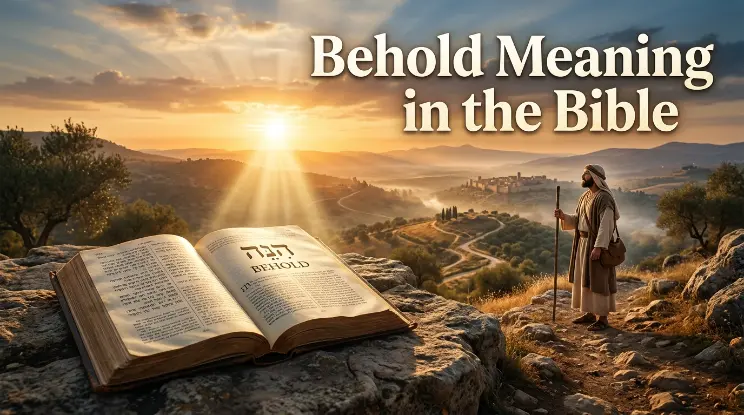
Hebrew: “Hinneh” (הִנֵּה)
In the Old Testament, the Hebrew word most often translated as “behold” is hinneh. This little interjection appears over a thousand times throughout the Hebrew Bible. It doesn’t have a direct one-to-one English equivalent, which is part of why translators have wrestled with how to render it over the centuries.
Hinneh functions almost like a spotlight. It tells the reader, “Pay close attention right here.” It’s used to:
- Introduce a new character or event
- Highlight God’s direct intervention
- Mark a moment of surprise or awe
- Draw emotional or theological emphasis to a scene
For example, in Genesis 1:29, God says, “Behold, I have given you every plant yielding seed.” The word isn’t decorative it’s God pointing directly at His provision, making sure Adam and Eve (and us, as readers) don’t miss the generosity behind the statement.
Greek: “Idou” (ἰδού)
In the New Testament, the Greek equivalent is idou. Like hinneh, it’s an imperative form that essentially means “look!” or “see!” It shows up constantly in the Gospels, especially in moments involving angels, miracles, and prophetic fulfillment.
One of the most famous examples is in Luke 2:10, when the angel tells the shepherds, “Behold, I bring you good news of great joy.” That single word primes the shepherds and us for a message that will change human history.
Why Biblical Writers Used “Behold” So Often
You might wonder, why not just say “look” or “see” like normal speech? Why this elevated, almost theatrical word choice?
There are a few solid reasons.
1. It Signals Divine Activity
Many “behold” moments in Scripture involve God doing something speaking, appearing, intervening, or revealing His plan. The word acts like a flashing sign that says, “God is at work here.”
2. It Creates Emotional Weight
Ancient texts were often read aloud in community settings, not silently in private like we do today. “Behold” would have functioned almost like a dramatic pause, cueing listeners to lean in and absorb what came next.
3. It Marks Turning Points
Many pivotal moments in the biblical narrative are introduced with “behold.” Angelic announcements, miraculous births, prophetic visions, and moments of judgment or salvation are frequently marked by this word, almost like a narrative bookmark.
4. It Invites Personal Reflection
“Behold” isn’t just descriptive it’s participatory. It invites the reader to stop, engage, and respond internally to what’s being revealed, rather than just passively absorbing information.
Key Examples of “Behold” in the Bible
Let’s look at some real, powerful examples to see the behold meaning in the Bible in action.
Genesis 1:31 The Goodness of Creation
“And God saw everything that he had made, and behold, it was very good.” Here, “behold” underscores the completeness and beauty of creation. It’s God’s own exclamation of satisfaction, and the text invites us to share in that wonder.
Isaiah 7:14 The Promise of Immanuel
“Behold, the virgin shall conceive and bear a son, and shall call his name Immanuel.” This is one of the most quoted messianic prophecies in Scripture. The word “behold” here signals a promise of monumental, world-altering significance the coming of the Messiah.
Matthew 1:23 Fulfillment of Prophecy
The New Testament echoes Isaiah’s prophecy directly: “Behold, the virgin shall conceive and bear a son.” This repetition ties Old and New Testament together, showing continuity in God’s redemptive plan.
Revelation 21:5 Making All Things New
“Behold, I am making all things new.” Near the very end of Scripture, this word appears again, this time pointing toward ultimate restoration and hope. It’s a bookend to Genesis, framing the entire biblical story with moments of divine declaration.
Luke 1:38 Mary’s Response to the Angel
Mary responds to Gabriel’s announcement with, “Behold, I am the servant of the Lord.” Here, the word isn’t spoken by God or an angel, but by a human being surrendering to God’s plan. It shows that “behold” can also express human submission and faith, not just divine revelation.
The Deeper Symbolic Meaning of “Behold”
Beyond the literal translation, “behold” carries symbolic and spiritual weight that’s worth unpacking.
A Call to Attentiveness
In a world full of distractions (and honestly, the ancient world had its own version of distractions too), “behold” is a call to focus. It’s Scripture’s way of saying, “Don’t let this moment slip past you unnoticed.”
A Marker of Sacred Space
Many “behold” moments occur at thresholds the beginning of a covenant, the birth of a promised child, a prophetic vision, or a divine appearance. It often marks the boundary between the ordinary and the sacred.
An Invitation to Faith
When angels or God Himself say “behold,” it’s often followed by something that requires a response of faith. Mary had to believe. The shepherds had to go and see. We, as readers, are invited into that same posture of trust.
How Understanding “Behold” Enriches Bible Study
Once you understand the behold meaning in the Bible, your reading experience shifts. Here’s how you can apply this insight practically.
- Slow down when you see it. Don’t rush past “behold” treat it as a cue to pause and reflect.
- Ask what’s being revealed. Every time this word appears, something significant is being unveiled. Ask yourself what that is and why it matters.
- Trace it across Scripture. Following “behold” moments from Genesis to Revelation reveals a beautiful thread of divine revelation running through the entire Bible.
- Read it aloud. Since ancient texts were meant to be heard, try reading “behold” passages out loud to feel the emphasis the original audience would have experienced.
- Compare translations. Some modern translations replace “behold” with “look” or “see,” or omit it altogether. Comparing versions like the KJV, ESV, and NIV can help you appreciate the nuance of the original word choice.
Behold in Different Bible Translations
It’s worth noting that not every translation handles “behold” the same way, and this affects how modern readers encounter the word.
- King James Version (KJV): Uses “behold” extensively, staying close to the literal Hebrew and Greek structure.
- English Standard Version (ESV): Retains “behold” in many key passages, balancing literal accuracy with readability.
- New International Version (NIV): Often replaces “behold” with more contemporary phrasing like “look” or simply omits it for smoother modern English.
- New American Standard Bible (NASB): Known for its literal translation style, frequently preserving “behold” throughout both testaments.
If you want to catch every instance of this word and its emphasis, translations like the KJV, ESV, or NASB tend to preserve it more faithfully than paraphrase-style translations.
Common Misunderstandings About “Behold”
Let’s clear up a few misconceptions.
Myth 1: “Behold” is just old English filler. Not true. While it does sound archaic to modern ears, it’s a deliberate translation choice reflecting a real, purposeful word in the original languages.
Myth 2: It only appears in dramatic, miraculous moments. While “behold” often introduces major events, it also appears in quieter, everyday statements like God pointing out the goodness of creation or provision of food.
Myth 3: Modern translations that drop “behold” are less accurate. This isn’t necessarily true either. Translation is about balancing literal accuracy with readability. Dropping “behold” doesn’t erase its meaning; the translators are simply making a stylistic choice to convey the same emphasis differently.
Why This Word Still Matters Today
You might be thinking, “Okay, but why does this matter for my life right now?” Great question.
Understanding the behold meaning in the Bible isn’t just an academic exercise. It’s a reminder that Scripture is full of intentional, carefully chosen language meant to draw us into deeper engagement with the text. Every time you see this word, it’s an invitation to stop scrolling, stop rushing, and actually look at what God is showing you.
In a culture that moves fast and rewards multitasking, “behold” is almost countercultural. It asks you to be fully present, fully attentive, fully open to what’s being revealed. That’s a powerful spiritual discipline, whether you’re studying ancient prophecy or simply trying to notice God’s presence in your everyday life.
Final Thoughts
The behold meaning in the Bible goes far beyond a simple synonym for “look.” It’s a literary and theological signal, rooted in the Hebrew hinneh and Greek idou, designed to grab attention, mark sacred moments, and invite readers into deeper reflection. From the goodness of creation in Genesis to the promise of renewal in Revelation, “behold” threads through Scripture as a consistent call to pay attention to what God is doing.
So the next time you’re reading your Bible and come across this word, don’t skim past it. Pause. Take a breath. And truly behold what’s being shown to you.
FAQ: Behold Meaning in the Bible
1. What is the simplest definition of “behold” in the Bible?
“Behold” essentially means “look” or “pay attention,” but it carries added emphasis, signaling that something important or significant is about to be revealed.
2. What is the Hebrew word for “behold”?
The Hebrew word is hinneh (הִנֵּה), which appears over a thousand times in the Old Testament to draw attention to important moments.
3. What is the Greek word for “behold”?
In the New Testament, the Greek word is idou (ἰδού), frequently used in the Gospels, especially around angelic announcements and miraculous events.
4. Why do older Bible translations use “behold” so much?
Older translations like the King James Version stay close to the original Hebrew and Greek sentence structure, which naturally preserves words like “behold” more often than modern paraphrase translations.
5. Do modern Bible translations still use “behold”?
Some do, like the ESV and NASB, while others, like the NIV, often replace it with simpler modern phrasing such as “look” or “see.”
6. What are some famous Bible verses that use “behold”?
Notable examples include Genesis 1:31, Isaiah 7:14, Luke 2:10, Matthew 1:23, and Revelation 21:5, each marking a significant moment in the biblical narrative.
7. Why should Christians pay attention to the word “behold” when reading Scripture?
Because it’s a built-in cue from the original authors telling readers to slow down and focus. Recognizing it can deepen personal Bible study and help readers catch important theological themes they might otherwise miss.

Hi, I’m Daniel Foster, a writer at GrasePath.com. I enjoy exploring the deeper meanings of biblical words, names, symbols, and verses to help readers better understand Scripture. My goal is to present accurate, easy-to-read, and well-researched content that makes the Bible more accessible for everyone. Through every article, I strive to provide clear explanations, meaningful insights, and trustworthy information to support your faith and Bible study journey.