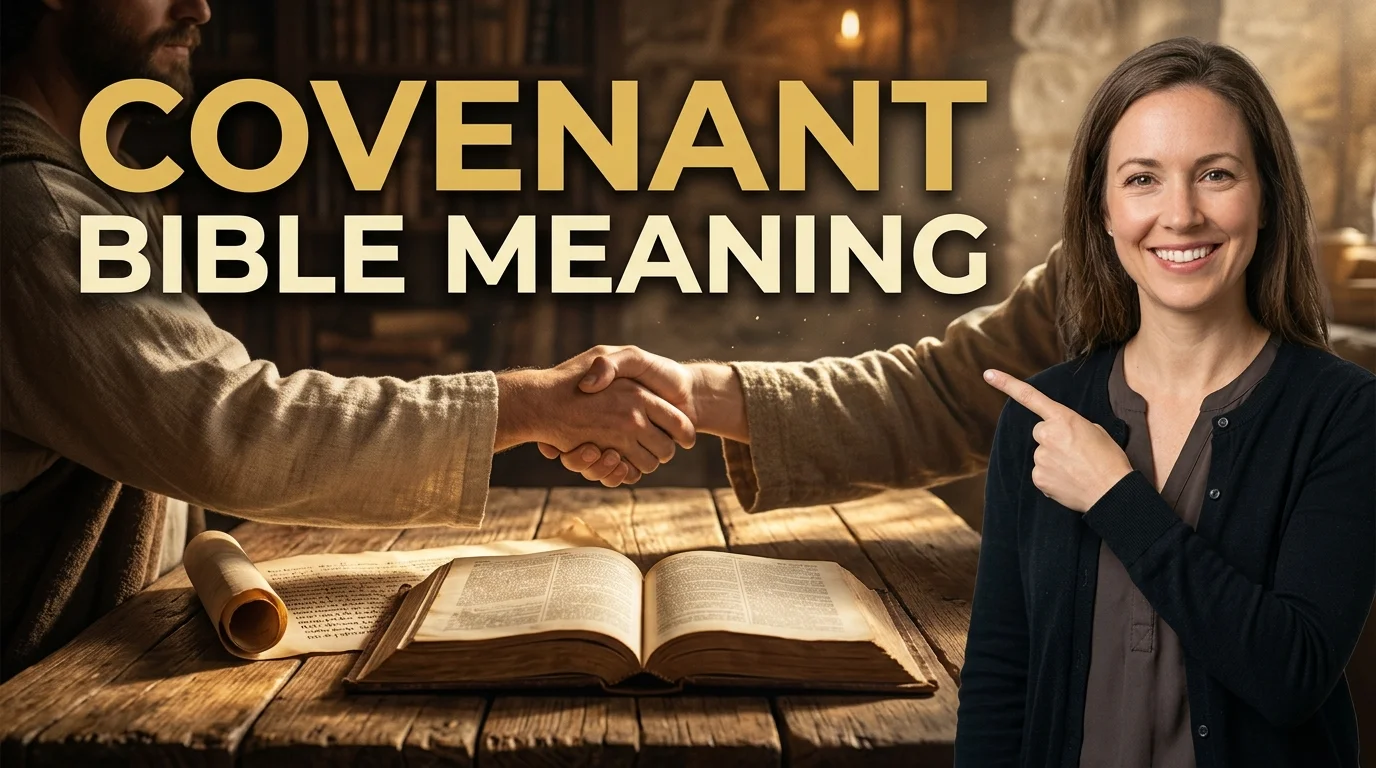
Throughout the Bible, relationships between God and His people are often described through promises, commitments, and special agreements. One important word used to explain these relationships is covenant. In the Bible, a covenant is a sacred agreement or binding promise that establishes a relationship between God and people.
Unlike an ordinary agreement, a biblical covenant carries deep spiritual significance because it reflects God’s faithfulness, love, promises, and expectations. Scripture describes several important covenants, including God’s promise to Noah never again to destroy the earth with a flood (Genesis 9:8–17), His covenant with Abraham (Genesis 12:1–3; 17:1–8), and the covenant God made with Israel through Moses (Exodus 19–24).
The Bible also teaches about the new covenant through Jesus Christ, whose sacrifice provides forgiveness and a new relationship with God (Luke 22:20; Hebrews 8:6–13). These examples show how covenants shape the biblical story and reveal God’s commitment to His promises. Understanding the covenant Bible meaning can help readers recognize the connection between God’s promises, human responsibility, faith, and obedience. It also provides a clearer understanding of how the Old and New Testaments connect and why the concept of covenant remains central to Christian belief.
What Does Covenant Mean in the Bible?
At its core, the covenant bible meaning refers to a formal, binding agreement between two parties usually God and human beings that involves promises, responsibilities, and consequences. Unlike a modern business contract, a biblical covenant isn’t just about legal terms. It’s relational. It’s personal. Meant to last.
The Hebrew word most often translated as “covenant” is berith, and in the New Testament, the Greek word is diatheke. Both words carry the idea of a solemn pact something sealed, sworn, and often confirmed with a sign or a ceremony.
Here’s a simple way to think about it:
- A contract is transactional. You do this, I do that, and once it’s fulfilled, it’s over.
- A covenant is relational. It’s built on ongoing loyalty, and it often continues even when one side struggles to keep their part.
That difference matters a lot when you’re trying to understand why God’s covenants in the Bible are described with such emotional language love, faithfulness, jealousy, mercy, and even heartbreak. These aren’t cold legal documents. They’re relationships with real stakes.
Why the Word “Covenant” Appears So Often in Scripture
The Bible uses the word covenant nearly 300 times. That’s not an accident. The entire structure of Scripture is often divided into two main sections the Old Covenant (or Old Testament) and the New Covenant (or New Testament) precisely because covenants are the organizing framework of God’s relationship with humanity.
Every major turning point in biblical history involves a covenant:
- God’s covenant with Noah after the flood
- God’s covenant with Abraham, promising descendants and land
- God’s covenant with Israel at Mount Sinai through Moses
- God’s covenant with David, promising an eternal throne
- The New Covenant established through Jesus Christ
Each of these covenants builds on the one before it, creating a continuous story of God reaching out to humanity even when humanity doesn’t always hold up its end of the deal.
The Different Types of Covenants in the Bible
Not all biblical covenants work the same way. Scholars typically group them into a few categories, and understanding these categories makes the covenant bible meaning much clearer.
1. Unconditional Covenants
These are promises God makes that don’t depend on human behavior. God commits to fulfilling them no matter what.
Example: The Noahic Covenant (Genesis 9). After the flood, God promised never to destroy the earth with a flood again. This promise wasn’t conditional on anything Noah or his descendants would do it was a pure, unilateral promise, sealed with the sign of the rainbow.
2. Conditional Covenants
These covenants come with an “if-then” structure. Blessings are promised, but only if the human party keeps their part of the agreement.
Example: The Mosaic Covenant (Exodus 19–24). God told Israel that if they obeyed His commandments, they would be His treasured possession. Obedience brought blessing; disobedience brought consequences. This is one of the clearest conditional covenants in Scripture.
3. Covenants of Promise
Some covenants function more like royal grants a king rewarding faithful service with land, descendants, or a lasting legacy.
Example: The Abrahamic Covenant (Genesis 15, 17). God promised Abraham that he would become the father of many nations, that his descendants would inherit land, and that through him, all nations would be blessed. This promise was later confirmed through circumcision as a physical sign.
Major Covenants in the Bible Explained
Let’s walk through the biggest covenants in Scripture one by one. This is where the covenant bible meaning really comes alive, because each one reveals something different about God’s character and His plan for humanity.
The Adamic Covenant
Right at the beginning, in the Garden of Eden, we see the first covenant-like relationship. God gave Adam and Eve instructions, a purpose (to tend the garden), and one clear boundary (don’t eat from the tree of the knowledge of good and evil). When that boundary was broken, consequences followed but so did a promise of future redemption, often called the protoevangelium, or “first gospel,” found in Genesis 3:15.
The Noahic Covenant
After the flood wiped out nearly all life on earth, God made a covenant with Noah, his family, and every living creature. The sign of this covenant was the rainbow a visual reminder that God would never again destroy the earth by flood.
Key takeaway: This covenant shows God’s mercy and patience, even after humanity’s failures.
The Abrahamic Covenant
This is arguably one of the most important covenants in the entire Bible. God called Abraham out of his homeland and promised:
- Numerous descendants (as many as the stars)
- A specific land (Canaan)
- A blessing that would extend to all nations through his family line
This covenant sets up the entire story of Israel as a nation and points forward to the coming of Jesus Christ, who Christians believe fulfills the promise of blessing to “all nations.”
The Mosaic Covenant
Given at Mount Sinai, this covenant established Israel as God’s chosen nation, bound by the Law (Torah). It included the Ten Commandments and a detailed system of worship, sacrifice, and community life.
This covenant was conditional blessings for obedience, consequences for disobedience and it shaped Israel’s identity for centuries.
The Davidic Covenant
God promised King David that his throne would be established forever. While this initially referred to his royal lineage, it later became a foundational promise pointing toward the coming Messiah someone from David’s line who would reign eternally.
The New Covenant
This is where everything comes together. Introduced in Jeremiah 31:31-34 and fulfilled through Jesus Christ in the New Testament, the New Covenant is different from all the others because it’s written on the heart, not just on stone tablets.
Key features of the New Covenant:
- Forgiveness of sins through Jesus’ sacrifice
- A personal, internal relationship with God (not just external rules)
- Access to God for all people, not just one nation
- The Holy Spirit living within believers
Understanding the covenant bible meaning ultimately leads you here to the idea that God’s plan was always moving toward a deeper, more personal relationship with humanity, not just a rulebook to follow.
Why Covenants Matter: The Bigger Picture
So why should any of this matter to someone reading the Bible today? A few reasons stand out.
1. Covenants Reveal God’s Character
Every covenant in Scripture shows a different side of who God is His mercy after the flood, His faithfulness to Abraham, His holiness at Sinai, His justice and grace throughout Israel’s history, and ultimately His love through Jesus Christ.
2. Covenants Provide Structure to the Bible’s Story
Without understanding covenants, the Bible can feel like a disconnected collection of stories. Once you see the covenant framework, everything from Genesis to Revelation starts to feel like one continuous, unfolding narrative.
3. Covenants Explain Christian Theology
Many core Christian beliefs grace, salvation, the role of Jesus, communion (the Lord’s Supper), and even baptism are deeply tied to covenant theology. When Jesus said, “This cup is the new covenant in my blood” (Luke 22:20), He was directly connecting His sacrifice to the entire covenant tradition that came before Him.
4. Covenants Offer Personal Assurance
For many believers, understanding that God’s promises are covenantal not just casual brings a deep sense of security. A covenant implies commitment. It implies that God isn’t going anywhere, even when His people struggle.
Real-Life Applications of Covenant Thinking
Understanding the covenant bible meaning isn’t just an academic exercise. It can shape how people think about relationships, commitments, and faith in everyday life.
- Marriage: Many faith traditions describe marriage as a covenant, not just a contract a lifelong commitment built on mutual loyalty, not convenience.
- Community and church life: Covenant thinking encourages long-term commitment to a community, rather than treating relationships as disposable.
- Personal faith: Recognizing that God’s promises are covenantal can offer comfort during hard seasons, reminding believers that God’s faithfulness doesn’t depend on their perfection.
- Trust and integrity: Covenant language encourages people to keep their word, even when it’s difficult, because covenants are about faithfulness over convenience.
Common Misunderstandings About Biblical Covenants
Because the concept is so old and layered, a few misunderstandings tend to pop up again and again.
- Misunderstanding #1: A covenant is just an old-fashioned word for “contract.” Not quite. Contracts are transactional; covenants are relational and often unconditional in nature.
- Misunderstanding #2: The Old Covenant was replaced because it failed. The Old Covenant wasn’t a failure it served its purpose in revealing sin, establishing Israel’s identity, and pointing toward the need for a deeper solution, which came through the New Covenant.
- Misunderstanding #3: Covenants are only an Old Testament idea. Covenants continue into the New Testament, most importantly through the New Covenant established by Jesus.
- Misunderstanding #4: All biblical covenants work the same way. As we covered earlier, some are conditional, some are unconditional, and some function more like royal grants. They’re not one-size-fits-all.
Tips for Studying Covenants in the Bible
If you want to dig deeper into the covenant bible meaning on your own, here are a few practical tips:
- Read covenant passages in context. Don’t isolate a single verse read the surrounding chapters to understand the full agreement being made.
- Look for covenant signs. Rainbows, circumcision, the Sabbath, and communion are all physical signs tied to specific covenants.
- Track the progression. Notice how each covenant builds on the previous one, moving toward the ultimate fulfillment in Jesus Christ.
- Compare Old and New Testament language. Passages like Jeremiah 31 and Hebrews 8 directly compare the old and new covenants, which can offer powerful insight.
- Use a study Bible or concordance. These tools can help you trace every instance of “covenant” throughout Scripture for a fuller picture.
Conclusion:
At its heart, the covenant bible meaning is about relationship, promise, and faithfulness. From Noah to Abraham, from Moses to David, and ultimately to Jesus Christ, the story of the Bible is a story of God committing Himself to His people again and again, even when they fall short.
Understanding these covenants doesn’t just help you make sense of ancient history it offers a framework for understanding love, loyalty, and commitment that still applies today. Whether you’re studying Scripture for personal growth, academic research, or spiritual guidance, grasping the covenant bible meaning gives you a clearer lens through which to read the entire biblical narrative.
Frequently Asked Questions About Covenant Bible Meaning
What is the simplest definition of covenant in the Bible?
A covenant in the Bible is a solemn, binding agreement usually between God and people built on promises, responsibilities, and mutual faithfulness, rather than a simple transaction.
How many covenants are there in the Bible?
While scholars categorize them differently, most agree there are around six major covenants: the Adamic, Noahic, Abrahamic, Mosaic, Davidic, and the New Covenant established through Jesus Christ.
What is the difference between the Old Covenant and the New Covenant?
The Old Covenant, given through Moses, was based on external law and animal sacrifice for atonement. The New Covenant, established through Jesus, offers forgiveness through His sacrifice and a personal, internal relationship with God through the Holy Spirit.
Why did God make covenants with people in the Bible?
Covenants demonstrate God’s desire for an ongoing relationship with humanity, revealing His character mercy, justice, faithfulness, and love while giving people a clear framework for how to relate to Him.
What is the sign of the Abrahamic covenant?
The sign of the Abrahamic covenant was circumcision, which served as a physical, lasting mark of the promise God made to Abraham and his descendants.
Is the New Covenant only for Christians?
The New Covenant, as described in the New Testament, is presented as open to all people, not limited to one ethnic or national group, which is a significant shift from earlier covenants tied specifically to Israel.
How does understanding covenants help when reading the Bible?
Recognizing the covenant structure helps readers see the Bible as one connected story rather than isolated events, making it easier to understand why certain laws, promises, and practices exist and how they all point toward Jesus Christ.

James Parker is a Bible writer at GrasePath.com who loves exploring the deeper meaning of Scripture. He shares clear, trustworthy insights about biblical names, symbols, dreams, and spiritual teachings in simple language. His mission is to help readers strengthen their faith and better understand God’s Word every day.