Have you ever looked at the six-pointed star on the Israeli flag and wondered what it actually means or whether it even appears in Scripture at all? You’re not alone. Millions of people search for the star of David meaning bible connection every year, hoping to understand where this iconic symbol came from and why it carries such deep spiritual weight for Jewish people around the world.
Here’s the surprising part: the Star of David isn’t explicitly described in the Bible the way you might expect. There’s no verse that says “and God commanded them to draw a six-pointed star.” Yet the symbol’s name, history, and meaning are woven into biblical tradition in ways that are far more fascinating than most people realize.
In this article, we’re going to unpack everything the biblical roots, the historical journey, the spiritual symbolism, and the modern significance of the Star of David. Whether you’re a curious learner, a student of religious history, or someone exploring Jewish heritage, you’ll walk away with a clear, well-rounded understanding of this timeless emblem.
What Is the Star of David?
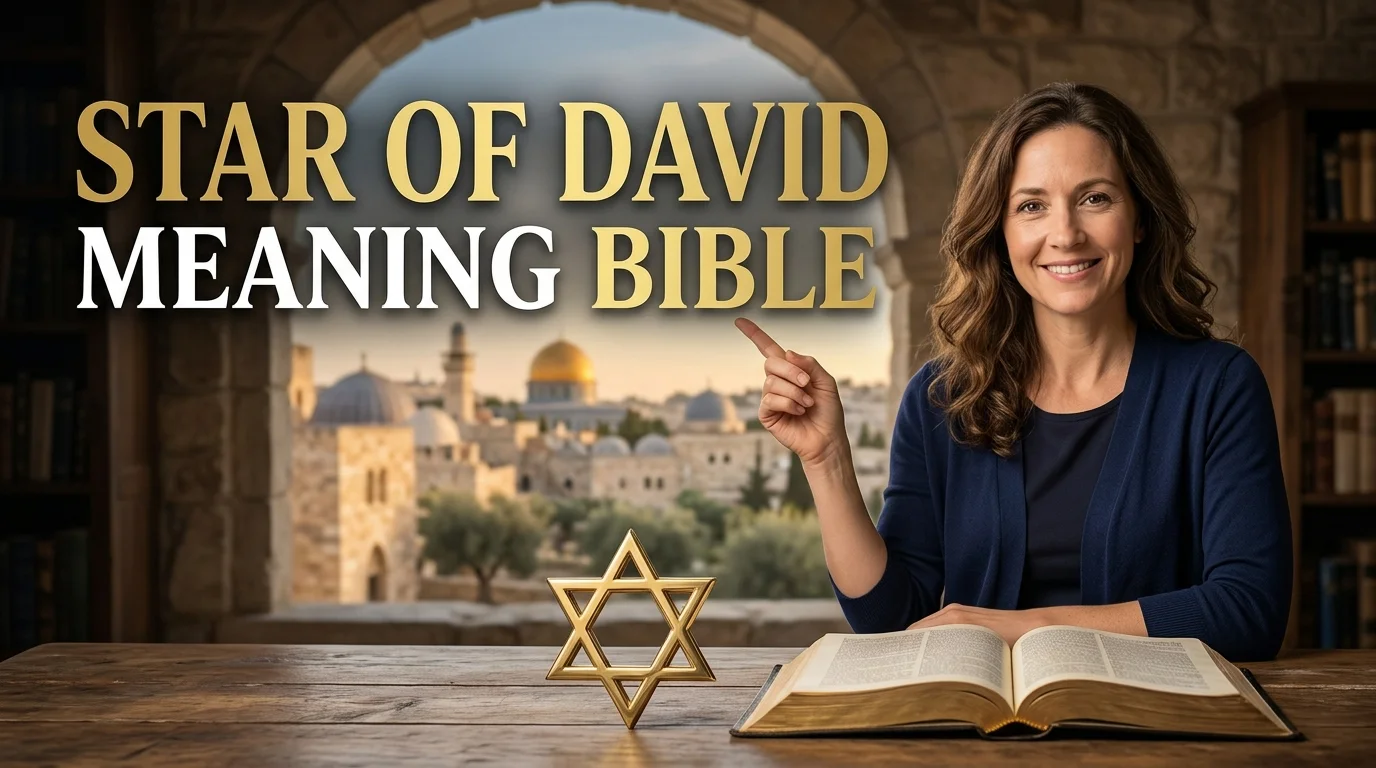
The Star of David, known in Hebrew as the Magen David (מגן דוד), literally translates to “Shield of David.” It’s a hexagram a six-pointed star formed by overlapping two equilateral triangles, one pointing upward and one pointing downward.
At first glance, it looks simple: two triangles, six points, one unified shape. But that simplicity is exactly why it has become such a powerful and recognizable symbol across Jewish culture, Israeli identity, and religious tradition.
Today, you’ll see the Star of David:
- On the flag of Israel
- On synagogue walls and Torah scroll covers
- On jewelry worn as a symbol of faith
- On gravestones and memorials
- In religious artwork and Judaica
But here’s the twist that surprises most people when they dig into the star of David meaning bible origins the symbol isn’t actually named or described anywhere in the Hebrew Scriptures.
So Why Is It Called the “Star of David” If It’s Not in the Bible?
Great question. The name comes from the legendary King David, the shepherd-turned-king who ruled ancient Israel and is one of the most celebrated figures in biblical history. According to Jewish folklore that developed centuries after the biblical period, King David’s shield was reportedly designed in the shape of this six-pointed star hence “Shield of David.”
However, historians and biblical scholars generally agree that this connection to King David is a later legendary tradition, not something recorded in the original biblical text. The star as a specific symbol tied to Judaism didn’t gain widespread recognition until the Middle Ages, roughly 2,000 years after King David’s reign.
This doesn’t make the symbol any less meaningful it just means its meaning developed and deepened over time, much like many powerful traditions do.
The Biblical Roots: What Scripture Actually Says About King David
To really understand the spiritual weight behind the Star of David, we need to look at who King David was in the Bible, since the entire symbol is named in his honor.
King David’s Role in Biblical History
David appears throughout the Old Testament as:
- The young shepherd who defeated Goliath with a sling and a stone
- The anointed king of Israel, chosen by the prophet Samuel
- The author of many Psalms, expressing deep faith, struggle, and worship
- An ancestor in the messianic lineage, which is why “Son of David” becomes such an important title later in Jewish and Christian tradition
David wasn’t just a political ruler he became a symbol of divine favor, courage, faithfulness, and the promise of an eternal kingdom. When God made a covenant with David, promising that his throne would be established forever, David’s name became forever linked with hope, legacy, and divine protection.
So when later generations wanted a symbol representing protection, faith, and Jewish identity, it made sense that they would eventually attach it to the memory of David the king whose story represented God’s covenant faithfulness to His people.
The Concept of “Shield” in Biblical Language
The word “Magen” (shield) appears frequently throughout the Hebrew Bible, often used to describe God Himself as a protector of His people. For example, the Psalms many of which are attributed to David repeatedly describe God as a shield:
- A shield that guards against enemies
- A shield that provides safety in times of fear
- A shield representing divine trust and refuge
This is important because it shows why the phrase “Shield of David” resonates so strongly. It’s not just about a physical shield David may have carried into battle it’s a symbolic connection between David’s trust in God and the protective imagery found throughout biblical poetry.
Historical Origins of the Hexagram Symbol
Now let’s dig into where the six-pointed star itself actually came from, because its history is much older and more diverse than most people expect.
Ancient Use of the Hexagram
The hexagram shape has been found in various ancient cultures, long before it became associated with Judaism specifically:
- Mesopotamian artifacts feature six-pointed star patterns used decoratively
- Islamic art and architecture used the hexagram as a geometric design element
- Medieval European alchemy used the symbol to represent the balance of elements fire and water, or opposing forces in harmony
This means the shape wasn’t originally “Jewish” in the way we think of it today. It was a widely used geometric design across multiple civilizations, valued for its symmetry and symbolic balance.
How It Became a Jewish Symbol
The Star of David’s specific connection to Jewish identity solidified gradually:
- Medieval Period Jewish communities in Europe began using the hexagram on seals, buildings, and manuscripts, though it wasn’t yet the dominant Jewish symbol (that role was often filled by the menorah instead).
- 17th Century Prague The Jewish community of Prague adopted the star as an official symbol, using it on their community flag, which historians consider one of the earliest formal uses of the symbol as a distinctly Jewish emblem.
- 19th Century As Jewish communities across Europe sought a unifying visual symbol (similar to how the cross represents Christianity), the Star of David gained popularity as the symbol of Jewish identity.
- 20th Century The Zionist movement formally adopted the Star of David, and it was placed at the center of the Israeli flag when the State of Israel was established in 1948.
So while the star of david meaning bible connection is rooted in legend and later tradition rather than direct scripture, its rise as a global symbol of Jewish identity is very much rooted in real, traceable history.
Symbolic Meaning of the Two Triangles
One of the most beautiful aspects of the Star of David is the symbolism found in its geometric structure. The two overlapping triangles carry meaning that resonates deeply with spiritual and philosophical themes.
Upward Triangle: Reaching Toward Heaven
The upward-pointing triangle is often interpreted as representing:
- Humanity’s connection to the divine
- Prayers and aspirations rising upward toward God
- The soul’s yearning for spiritual growth
Downward Triangle: God’s Presence Coming to Earth
The downward-pointing triangle is often interpreted as representing:
- God’s blessings descending toward humanity
- Divine presence dwelling among people
- The idea that spirituality isn’t just about reaching up it’s also about God reaching down
Unity of Opposites
Together, the two triangles create a symbol of balance:
- Heaven and earth
- Spirit and matter
- Giving and receiving
- Male and female energies (in some mystical interpretations)
This interplay is part of why the symbol feels so profound even to people who aren’t deeply religious. It visually represents the idea of connection between the physical world and something greater than ourselves.
The Star of David in Jewish Mysticism (Kabbalah)
If you want to go one level deeper into the star of david meaning bible and spiritual tradition, Kabbalistic thought offers rich interpretations of the hexagram.
In Jewish mysticism, the six points of the star are sometimes associated with:
- The six directions of physical space north, south, east, west, up, and down representing God’s presence in every dimension of existence
- The six days of creation, with the center of the star symbolizing the seventh day, the Sabbath, a day of rest and divine completeness
- Protection from negative spiritual forces, which is why the symbol was historically used in amulets and protective inscriptions
This mystical layer adds depth to why the star became more than a decorative shape it became a symbol believed to carry spiritual protection and cosmic balance.
The Star of David vs. Other Biblical Symbols
To fully appreciate the star’s meaning, it helps to compare it to other well-known biblical and Jewish symbols.
| Symbol | Meaning | Biblical Basis |
| Star of David | Protection, Jewish identity, divine covenant | Legendary tradition tied to King David |
| Menorah | Light, divine presence, wisdom | Directly described in Exodus 25 |
| Ark of the Covenant | God’s presence among His people | Central Old Testament artifact |
| Torah Scroll | God’s law and guidance | Central to Jewish worship and identity |
Notice that unlike the menorah, which has clear, direct biblical instructions for its creation, the Star of David’s significance grew organically through centuries of tradition rather than a single scriptural command. This is actually part of what makes it such a compelling case study in how religious symbols evolve over time.
Why the Star of David Still Matters Today
Modern use of the Star of David goes far beyond religious ceremony. It has become:
- A symbol of national identity for the State of Israel
- A sign of resilience, especially given its painful history of being forced upon Jewish people as a mark of persecution during the Holocaust, later reclaimed as a proud symbol of survival and strength
- A personal expression of faith, worn as jewelry by people connecting to their heritage
- A universal symbol of hope, recognized even by people outside the Jewish faith as representing endurance, unity, and spiritual depth
This transformation from a geometric shape used across ancient cultures, to a symbol of persecution, to a proud emblem of nationhood and faith is part of what makes its story so powerful.
Common Misconceptions About the Star of David
Let’s clear up a few myths people often believe:
- Myth: The Star of David is explicitly mentioned in the Bible. Reality: It is not directly named or described in Scripture. Its connection to David is based on later tradition.
- Myth: The symbol has always represented Judaism exclusively. Reality: The hexagram shape was used by multiple cultures historically before becoming specifically associated with Jewish identity.
- Myth: The six points represent the twelve guilds of Israel. Reality: This is a common misunderstanding. The twelve guilds are more commonly associated with other symbols, such as the twelve stones on the high priest’s breastplate.
- Myth: Only religious Jewish people use the symbol. Reality: Many secular Jewish people and even non-Jewish people use or display the symbol as a mark of solidarity, heritage appreciation, or cultural interest.
Real-Life Applications and Examples
Understanding the star of david meaning bible background can enrich the way you view everyday encounters with the symbol:
- Visiting Israel You’ll see the star on the flag flying over government buildings, embassies, and public squares.
- Attending a Jewish wedding The symbol may appear on the chuppah (wedding canopy) or on invitations as a mark of tradition.
- Jewelry and gifts Necklaces featuring the Star of David are popular as bar mitzvah or bat mitzvah gifts, symbolizing entry into Jewish religious adulthood.
- Memorial sites The symbol frequently appears on gravestones, honoring Jewish heritage and faith.
- Holocaust remembrance Because Jewish people were forced to wear the star during Nazi persecution, the symbol today also carries the weight of remembrance and the promise of “never again.”
Tips for Understanding Symbolic Meaning in Scripture
If you’re exploring religious symbolism more broadly, here are a few helpful principles:
- Not every meaningful symbol has a direct, single Bible verse behind it some meanings develop through centuries of interpretation and tradition.
- Historical context matters just as much as scriptural text when understanding how a symbol gained significance.
- Symbols often carry layered meanings historical, spiritual, cultural, and personal all at once.
- It’s okay for a symbol’s meaning to evolve over time while still holding deep spiritual value.
Frequently Asked Questions
Is the Star of David actually mentioned in the Bible?
No, the Star of David as a specific symbol is not explicitly named or described in the Hebrew Bible. Its association with King David comes from later Jewish legend and tradition rather than direct scriptural text.
What does the Star of David symbolize spiritually?
It’s often understood to represent divine protection, the connection between heaven and earth, and God’s covenant relationship with His people. The two triangles are commonly interpreted as symbolizing the relationship between humanity reaching toward God and God’s presence reaching toward humanity.
Why is it called the “Shield of David”?
According to Jewish folklore, King David’s shield was said to be shaped like a six-pointed star. Over time, the name “Shield of David” (Magen David) became attached to the hexagram symbol, even though historians consider this connection legendary rather than historically documented.
Does the Star of David represent the twelve guilds of Israel?
Not typically. While some modern interpretations attempt to connect the six points to various biblical concepts, the twelve guilds of Israel are more traditionally represented by other symbols, such as the twelve stones on the high priest’s breastplate described in the Book of Exodus.
When did the Star of David become the main symbol of Judaism?
It gained significant popularity starting in the 17th century, particularly through its use by the Jewish community in Prague, and became widely adopted as the primary symbol of Jewish identity during the 19th and 20th centuries, especially through the Zionist movement.
Is the Star of David only a religious symbol?
Not exclusively. While it holds deep religious and spiritual meaning, it also functions as a national symbol (on the Israeli flag), a cultural symbol of Jewish heritage, and a historical symbol of resilience following its forced use during the Holocaust.
What’s the difference between the Star of David and the menorah?
The menorah has direct, explicit biblical instructions for its design, found in the Book of Exodus. The Star of David, on the other hand, developed its meaning gradually through historical tradition rather than a specific biblical command, making their origins quite different even though both are important Jewish symbols today.
Final Thoughts:
At the end of the day, understanding the star of david meaning bible connection isn’t about finding one single verse that explains everything. It’s about appreciating how a simple geometric shape traveled through centuries of history, absorbed spiritual meaning from Jewish mysticism, became attached to the legendary legacy of King David, and eventually transformed into one of the most recognized symbols of faith, identity, and resilience in the world today.
You view it as a religious emblem, a national symbol, or a personal expression of heritage, the Star of David carries a story far richer than its simple six points might suggest. It reminds us that some of the most powerful symbols in human history aren’t defined by a single origin they’re shaped by generations of faith, tradition, and meaning layered together over time.

Hi, I’m Daniel Foster, a writer at GrasePath.com. I enjoy exploring the deeper meanings of biblical words, names, symbols, and verses to help readers better understand Scripture. My goal is to present accurate, easy-to-read, and well-researched content that makes the Bible more accessible for everyone. Through every article, I strive to provide clear explanations, meaningful insights, and trustworthy information to support your faith and Bible study journey.