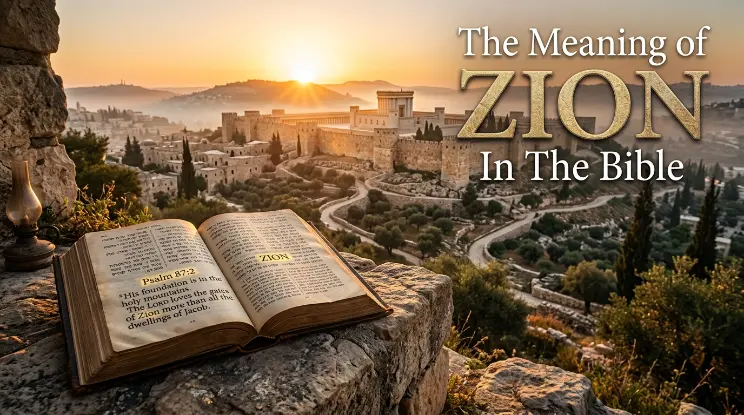
Zion is one of the most meaningful and frequently used place names in the Bible. At first, Zion referred to a specific hill or stronghold in Jerusalem, but its meaning gradually became much broader. In Scripture, Zion can represent Jerusalem, God’s dwelling place, His people, and the spiritual hope of God’s kingdom. The word appears throughout both the Old and New Testaments, often in passages connected with worship, salvation, restoration, and God’s presence.
The meaning of Zion develops as the biblical story unfolds. It begins as a physical location associated with Jerusalem and King David, but the prophets often use Zion as a poetic picture of God’s relationship with His people. For example, Zion is described as a place where God reigns, where His people gather, and from which His salvation and righteousness are proclaimed. Isaiah, the Psalms, and other biblical books use the name in several different ways.
For Christians, Zion can also point toward spiritual restoration and the future hope of God’s people. The New Testament continues this imagery, including references to heavenly or spiritual Zion. Understanding these different uses helps reveal why Zion carries such deep significance throughout the Bible.
What Does Zion Mean in the Bible? A Quick Overview
At its most basic level, Zion originally referred to a specific hill in ancient Jerusalem. Over time, though, the term grew to represent much more. Here’s a quick breakdown before we dive deeper:
- Literal meaning: A fortified hill in Jerusalem, originally a Jebusite stronghold conquered by King David.
- Expanded meaning: A poetic name for the entire city of Jerusalem.
- Spiritual meaning: The dwelling place of God, His chosen people, and His kingdom.
- Prophetic meaning: A symbol of restoration, hope, and the future glory of God’s people.
- New Testament meaning: A picture of the heavenly Jerusalem and the eternal presence of God.
So when you come across “Zion” in Scripture, the meaning depends heavily on context sometimes it’s talking about real estate, and other times it’s talking about something far bigger than geography.
The Origin of the Word Zion
The name Zion (in Hebrew, Tsiyon) first appears in the Bible in 2 Samuel 5:7, describing the stronghold that King David captured from the Jebusites:
“David captured the fortress of Zion which is the City of David.”
Scholars aren’t entirely certain about the original meaning of the Hebrew word itself. Some believe it may relate to a term meaning “fortress” or “citadel,” while others suggest it could be connected to a word for “dry place” or “sunny ridge,” referring to the elevated, rocky terrain. Either way, the earliest use of Zion was purely geographic it described a specific, physical location in ancient Jerusalem, a hill on the southeastern side of the city near the Gihon Spring.
Once David made Jerusalem his capital and moved the Ark of the Covenant there, Zion took on a much deeper significance. It wasn’t just a military stronghold anymore. It became associated with God’s presence, His covenant with Israel, and the seat of David’s kingdom.
Zion as the City of David
After capturing the fortress, David renamed it the “City of David,” and this is where Zion’s identity as more than a hilltop begins. The location became the political and spiritual center of Israel. Here’s why that mattered so much:
- It housed the royal palace of King David.
- It later became the site where Solomon built the Temple (though technically slightly north on Mount Moriah, the whole area came to be called Zion).
- It symbolized God’s choice of Jerusalem as His special dwelling place among His people.
As Jerusalem expanded, the name Zion expanded with it. By the time of the prophets, “Zion” was often used interchangeably with “Jerusalem” as a whole, and sometimes even as a stand-in for the entire nation of Israel.
Zion and the Temple Mount
It’s worth clarifying a common point of confusion: today, “Mount Zion” is sometimes used to refer to the Temple Mount, but in ancient times, the biblical Zion was actually a separate, smaller hill to the south. Over centuries, as the city grew and shifted, the name “Zion” migrated in popular usage to include the Temple area and eventually the whole city. This is a great example of how biblical geography and biblical symbolism don’t always line up perfectly on a modern map and that’s okay, because the deeper meaning matters more than pinpointing exact coordinates.
Zion in the Psalms: A Place of Worship and Praise
If you want to see how beloved and central Zion became to Israelite faith, look no further than the Psalms. The word appears dozens of times, almost always tied to worship, God’s presence, and deep emotional connection.
Some key themes include:
- Zion as God’s chosen dwelling place Psalm 132:13 describes the Lord choosing Zion as His resting place, His desired home.
- Zion as a source of blessing Many psalms describe blessings flowing out from Zion to the rest of Israel and the world.
- Zion as an object of longing Psalm 137, written during the Babylonian exile, captures the ache of being separated from Zion: “By the rivers of Babylon, there we sat down, yea, we wept, when we remembered Zion.”
- Zion as beauty and strength Psalm 48 calls Zion “beautiful in elevation,” a joy to the whole earth.
This emotional, worshipful connection to Zion is part of why the word carries so much weight even today. It wasn’t just a location it was home, identity, and the visible sign of God’s covenant faithfulness.
Zion in the Prophetic Books: Judgment and Restoration
The prophets used Zion in two major ways: as a place that could face judgment when the people turned away from God, and as a symbol of hope and future restoration when God would renew His covenant.
Zion Under Judgment
Prophets like Isaiah, Jeremiah, and Micah didn’t shy away from warning that Zion could suffer consequences for the nation’s disobedience. Isaiah 1:8 pictures “the daughter of Zion” left desolate like a shelter in a vineyard, a vivid image of vulnerability and loss. Micah even predicted that Zion would be “plowed as a field” due to corrupt leadership (Micah 3:12).
These warnings weren’t about God abandoning Zion forever they were meant to call the people back to faithfulness.
Zion as a Symbol of Hope and Restoration
On the flip side, the prophets also used Zion as the centerpiece of some of the most hopeful, beautiful promises in the entire Old Testament. Consider these examples:
- Isaiah 2:3 envisions the nations streaming to Zion to learn God’s ways, saying “the law will go out from Zion.”
- Isaiah 51:11 promises that “the ransomed of the Lord will return and come to Zion with singing.”
- Zechariah 9:9 calls on the “daughter of Zion” to rejoice because her king is coming a verse later connected to Jesus’ entry into Jerusalem.
This dual use judgment followed by restoration is a pattern that runs throughout the prophetic books. Zion becomes a symbol of both accountability and unshakable hope, showing that God’s relationship with His people was never static; it was a living, ongoing story of correction and renewal.
The Symbolic and Spiritual Meaning of Zion
By this point, it’s clear that Zion means far more than a physical hill. Let’s break down the layers of symbolic meaning that developed over time.
1. Zion as God’s Dwelling Place
Throughout Scripture, Zion represents the idea that God chooses to dwell among His people. This wasn’t true of the pagan gods surrounding Israel, who were often thought to be distant or tied only to nature. The God of Israel chose a specific place to be present with His people first the Tabernacle, then the Temple in Zion.
2. Zion as the People of God
Sometimes “Zion” doesn’t refer to a place at all, but to the people themselves. Phrases like “daughter of Zion” personify the community of believers, almost like referring to a beloved child. This usage reminds readers that Zion isn’t just bricks and stone it’s about relationship.
3. Zion as a Symbol of Security and Refuge
Because of its elevated, fortified location, Zion also became a metaphor for spiritual security. Psalm 125:1 says, “Those who trust in the Lord are like Mount Zion, which cannot be shaken but endures forever.” This comparison paints a beautiful picture: just as a mountain stands firm through storms, those who trust in God find that same unshakable stability.
4. Zion as a Picture of the Future Kingdom
Especially in the prophetic and apocalyptic literature, Zion becomes shorthand for the ultimate, restored kingdom of God a place of peace, justice, and divine presence that will one day be fully realized.
Zion in the New Testament
You might assume Zion disappears once you move into the New Testament, but it actually takes on an even more expansive, spiritual meaning.
Mount Zion and the Heavenly Jerusalem
In Hebrews 12:22-23, the author writes that believers “have come to Mount Zion and to the city of the living God, the heavenly Jerusalem.” This passage takes the earthly, physical Zion and transforms it into a spiritual reality the gathering place of God’s people, angels, and the redeemed, both now and in eternity.
Zion and Jesus as the Cornerstone
Both Romans 9:33 and 1 Peter 2:6 quote Isaiah, describing a “stone in Zion” that becomes either a stumbling block or a foundation, depending on one’s response. This stone is understood to represent Jesus Christ Himself the cornerstone of faith, placed symbolically in Zion, the historic center of God’s presence among His people.
Zion in the Book of Revelation
Revelation 14:1 describes the Lamb standing on Mount Zion with 144,000 redeemed believers, a powerful image tying together the earthly history of Zion with its ultimate, eternal fulfillment. Here, Zion becomes a picture of victory, worship, and the culmination of God’s redemptive plan.
Why the Meaning of Zion in the Bible Still Matters Today
You might be wondering why should any of this matter for modern readers? Here are a few reasons this ancient concept still resonates:
- It reminds us that faith is relational, not just theoretical. Zion represents God’s desire to dwell with people, not distant religious rules.
- It offers a picture of hope during hard seasons. Just as the prophets promised restoration after judgment, Zion reminds believers that difficult chapters aren’t the end of the story.
- It connects Old and New Testament themes. Understanding Zion helps readers see the unity of Scripture, from David’s fortress to the heavenly city described in Revelation.
- It’s used in worship and hymns today. Songs like “We’re Marching to Zion” and countless others draw directly from this rich biblical imagery, connecting modern believers to a centuries-old tradition.
- It symbolizes stability and refuge. In a world that often feels shaky and uncertain, the image of Zion as an unshakable mountain offers real spiritual comfort.
Common Misunderstandings About Zion
Because the word Zion shows up in so many contexts religious, cultural, political, and even musical it’s easy to mix up its meanings. Here are a few clarifications:
- Zion is not the same as the modern State of Israel, although the political movement known as Zionism drew its name from this biblical concept and connects to the idea of a Jewish homeland.
- Zion is not always literal. As we’ve seen, it often functions symbolically, representing God’s people or His kingdom rather than a strict geographic point.
- Zion is not exclusive to one religious tradition’s interpretation. Judaism, Christianity, and Rastafarianism (among others) have each developed their own theological or cultural understanding of Zion, though the biblical roots remain shared.
Key Bible Verses About Zion Worth Knowing
If you want to study this topic further, here are some foundational verses to explore:
- 2 Samuel 5:7 The capture of the stronghold of Zion
- Psalm 48:1-2 Zion’s beauty and significance
- Psalm 125:1 Zion as a symbol of unshakable trust
- Psalm 137:1 Longing for Zion during exile
- Isaiah 2:3 The law going out from Zion
- Isaiah 51:11 The promise of joyful return to Zion
- Zechariah 9:9 The coming king and the daughter of Zion
- Hebrews 12:22 Coming to the heavenly Mount Zion
- Revelation 14:1 The Lamb standing on Mount Zion
Reading these passages in order gives you a beautiful, sweeping view of how the meaning of Zion developed from a captured hilltop to an eternal symbol of God’s presence and promise.
Frequently Asked Questions About the Meaning of Zion in the Bible
1. What is the literal meaning of Zion in the Bible?
Literally, Zion refers to a hill in ancient Jerusalem that King David captured from the Jebusites and made into his royal stronghold, later known as the City of David.
2. Is Zion the same as Jerusalem?
Not exactly, but the two are closely linked. Zion originally referred to a specific hill within Jerusalem, but over time it became a poetic and symbolic name for the entire city, and sometimes for Israel as a whole.
3. What does Mount Zion represent spiritually?
Spiritually, Mount Zion represents God’s chosen dwelling place, the security and stability found in trusting God, and especially in the New Testament the heavenly Jerusalem where believers will ultimately gather with God.
4. Why is Zion important in the Psalms?
Zion appears frequently in the Psalms as a symbol of worship, blessing, longing, and God’s faithfulness. It represents the emotional and spiritual heart of Israelite faith, tied closely to praise and communal identity.
5. What does “daughter of Zion” mean in Scripture?
“Daughter of Zion” is a poetic personification used throughout the prophetic books, referring to the people of Jerusalem or Israel as a whole, often expressing tenderness, warning, or hope depending on the context.
6. How is Zion used in the New Testament?
In the New Testament, Zion takes on a more spiritual and eternal meaning, representing the heavenly Jerusalem, the gathering of believers, and imagery connected to Jesus Christ as the cornerstone of faith.
7. Does Zion have any connection to modern Israel or Zionism?
Yes, indirectly. The term Zionism, which refers to the modern political movement supporting a Jewish homeland, draws its name from the biblical concept of Zion, though the political movement is a modern development distinct from the ancient biblical meaning.
Final Thoughts:
So, what’s the true meaning of Zion in the Bible? As we’ve seen, it’s not a single, simple answer and that’s part of what makes it so fascinating. Zion begins as a literal fortress captured by King David, grows into a poetic name for Jerusalem, deepens into a symbol of God’s presence and covenant faithfulness, and ultimately points forward to the eternal, heavenly city described in the New Testament.
Whether you encounter Zion in a psalm of praise, a prophetic warning, or a vision of the world to come, the underlying message stays consistent: God desires to dwell with His people, to offer them refuge and stability, and to bring restoration even after seasons of judgment. That’s a message that has echoed across thousands of years and it’s one that continues to offer comfort, hope, and meaning for readers today.

James Parker is a Bible writer at GrasePath.com who loves exploring the deeper meaning of Scripture. He shares clear, trustworthy insights about biblical names, symbols, dreams, and spiritual teachings in simple language. His mission is to help readers strengthen their faith and better understand God’s Word every day.