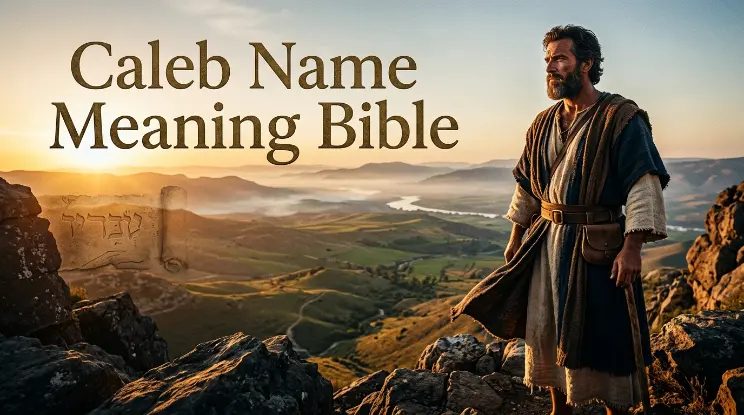
If you’ve landed here searching for caleb name meaning bible, you’re probably either expecting a baby, curious about a name you’ve heard at church, or just fascinated by how much history can hide inside four simple letters.
Whatever brought you here, you’re in for a treat. Caleb isn’t just a pleasant-sounding name it’s attached to one of the boldest, most faithful characters in the entire Old Testament, and its meaning carries a weight that most parents don’t discover until they dig a little deeper.
In this guide, we’re going to unpack everything: where the name comes from, what it actually means in Hebrew, who the biblical Caleb was, why his story still resonates thousands of years later, and why so many parents today are choosing this name for their sons. Grab a cup of coffee, because we’re going deep.
What Does Caleb Mean? A Quick Overview
Before we dive into the biblical narrative, let’s answer the core question straight away.
The name Caleb comes from the Hebrew word Kaleb (כָּלֵב), which most scholars translate as “dog” or “faithful dog.” Now, before you wince in the ancient Near East, dogs weren’t seen the way we sometimes see them today (as mere pets). They were symbols of loyalty, courage, and devotion. A dog stayed by its master’s side no matter what. It didn’t wander off when things got difficult. That symbolism is key to understanding why this name became attached to one of the most loyal, wholehearted men in Scripture.
Some Hebrew scholars also connect the name to the phrase “kol lev,” meaning “whole heart” or “all heart.” This interpretation lines up beautifully with how Caleb is described throughout the Bible a man who followed God with his entire being, without hesitation or compromise.
So when people ask about the caleb name meaning bible reference, the short answer is this: Caleb means “faithful” or “wholehearted devotion,” and the man who carried this name lived up to it in every possible way.
The Origin of the Name Caleb
Hebrew Roots
Caleb is a name of ancient Hebrew origin, appearing multiple times throughout the Old Testament. Unlike many biblical names that were coined specifically for symbolic reasons (like Isaac, meaning “laughter,” or Nathaniel, meaning “gift of God”), Caleb’s root ties directly into everyday Hebrew vocabulary the word for dog. This makes it one of the more unusual name origins in the Bible, but also one of the most meaningful once you understand the cultural context.
Tribal Connection
Caleb wasn’t just a random figure he belonged to the team of Judah, and more specifically, he’s identified as a Kenizzite, meaning his family may have originally been outsiders who were absorbed into the team of Judah. This detail matters because it shows that Caleb’s faithfulness wasn’t inherited through bloodline privilege it was a personal choice, a character trait he built and demonstrated through his actions.
Variations and Spellings
Over centuries and across cultures, the name has taken on a few different forms:
- Caleb the standard English spelling
- Kaleb a popular modern variant
- Kalev used in some Hebrew and Israeli contexts
- Calev an alternate transliteration seen in academic texts
All of these variations trace back to the same root and carry the same core meaning.
Who Was Caleb in the Bible?
Now let’s get into the heart of the matter the man behind the name. If you’re researching caleb name meaning bible stories, this is the part you really want to know.
The Twelve Spies
Caleb first appears in the Book of Numbers, during one of the most pivotal moments in Israel’s journey out of Egypt. After escaping slavery and wandering through the wilderness, the Israelites reached the edge of the Promised Land Canaan. Moses selected twelve men, one from each team, to scout the land ahead and report back on what they found.
Caleb represented the team of Judah.
When the twelve spies returned after forty days, ten of them brought back a fearful report. Yes, the land was rich and fruitful flowing with milk and honey, just as promised but it was also home to powerful, fortified cities and giant warriors called the Anakites. Ten of the spies were terrified. They convinced the people that conquering Canaan was impossible.
But two men saw it differently: Caleb and Joshua.
“We Should Go Up and Take Possession”
While the other ten spies spread fear among the Israelites, Caleb stood up and said something extraordinary. In Numbers 13:30, he declared:
Caleb silenced the people before Moses and said, “We should go up and take possession of the land, for we can certainly do it.”
That single moment defines everything about who Caleb was. He wasn’t naive about the danger he’d seen the same giants, the same fortified walls. But his faith in God’s promise was bigger than his fear. This is exactly the kind of “wholehearted” devotion tied to the name’s meaning.
Unfortunately, the majority won out. The people panicked, rebelled against Moses, and even talked about stoning Caleb and Joshua for their optimism. As punishment for the nation’s lack of faith, God declared that the entire generation except for Caleb and Joshua would wander the wilderness for forty years and never enter the Promised Land.
God’s Promise to Caleb
This is where the story becomes truly remarkable. In Numbers 14:24, God makes a direct and personal promise:
“But because my servant Caleb has a different spirit and follows me wholeheartedly, I will bring him into the land he went to, and his descendants will inherit it.”
Notice the phrase “different spirit” and “wholeheartedly.” This is the biblical foundation for everything the name Caleb has come to represent unwavering faith, courage under pressure, and a refusal to let fear dictate decisions.
Forty Years Later: Caleb’s Reward
Fast forward four decades. The unfaithful generation had passed away in the wilderness. Joshua now led the Israelites into Canaan, and the conquest of the Promised Land began. Caleb, now 85 years old, hadn’t forgotten God’s promise.
In Joshua 14:10-12, Caleb approaches Joshua and makes an incredible request. Despite his age, he asks for the most dangerous, mountainous territory Hebron the very land where the giant Anakites still lived. His words are unforgettable:
“I am still as strong today as the day Moses sent me out; my strength for battle is now as it was then… Now give me this hill country that the Lord promised me that day.”
At 85 years old, most people would ask for a peaceful retirement. Caleb asked for a mountain full of giants. That’s not just courage that’s a lifetime of faith finally being realized.
He conquered Hebron and it became his inheritance, exactly as God had promised forty-five years earlier.
Why Caleb’s Story Matters (Beyond the Name)
Understanding the caleb name meaning bible background isn’t just a fun fact for baby name lists it’s a genuinely inspiring story about character. Here’s why Caleb’s example continues to resonate with readers, parents, and believers today:
1. He Refused to Follow the Crowd
Ten spies said no. Caleb and Joshua said yes. Standing against the majority, especially when the majority is driven by fear, takes real backbone. Caleb’s story is a reminder that popular opinion isn’t always right and that conviction sometimes means standing alone.
2. His Faith Was Active, Not Passive
Caleb didn’t just believe quietly. He spoke up. Silenced the crowd. He advocated for action. His faith showed up in what he did, not just what he privately believed.
3. He Remained Faithful for Decades
This is perhaps the most underrated part of his story. Caleb didn’t get an instant reward for his courage. He had to wait forty-five years wandering the wilderness alongside everyone else, watching an entire generation die off before he finally saw the promise fulfilled. That’s patience most of us can barely imagine.
4. He Stayed Strong Into Old Age
At 85, Caleb wasn’t looking for comfort. He was still requesting the hardest assignment available. His physical and spiritual vigor late in life is often cited as an example of how faith and purpose can keep a person strong well beyond what’s expected.
Caleb Name Meaning in Modern Context
So how does all of this ancient history translate into today’s world? Parents choosing the name Caleb for their child are often drawn to more than just the sound of it they’re drawn to what it represents.
Common Modern Interpretations
- Faithful reflecting Caleb’s unwavering loyalty to God’s promise
- Wholehearted from the “kol lev” connection, meaning someone who commits fully
- Bold referencing his courage in the face of overwhelming odds
- Devoted tied to the “faithful dog” symbolism of ancient Hebrew culture
Popularity of the Name Caleb
Caleb has remained a consistently popular name in English-speaking countries for decades, especially in the United States. It strikes a balance that a lot of parents look for: it’s biblical and meaningful, but it doesn’t feel old-fashioned or overly formal. It sounds strong without being harsh, and friendly without being plain.
Its steady popularity is partly thanks to this deep-rooted biblical significance parents aren’t just picking a trendy sound, they’re often consciously choosing a name tied to loyalty and courage.
Nicknames and Short Forms
If you’re considering the name for a child, here are some common nicknames associated with Caleb:
- Cal
- Cale
- Caley
- Kale (less common, but used)
These give the name flexibility formal enough for official documents, but with casual nickname options for everyday life.
Caleb in Other Bible Passages
While Caleb’s story in Numbers and Joshua gets the most attention, his name and lineage appear elsewhere in Scripture too:
- 1 Chronicles 2 and 4 trace Caleb’s genealogy in detail, listing his descendants and their roles within the team of Judah.
- Joshua 15 describes how Caleb’s daughter, Achsah, and her husband Othniel (who later became one of Israel’s judges) were granted land and even natural springs as part of Caleb’s inheritance another small story that shows Caleb’s generosity extended to his family.
These additional references reinforce that Caleb wasn’t a one-scene character. He was a foundational figure whose faithfulness shaped his family line for generations.
Lessons Parents Can Draw From the Name Caleb
If you’re naming a child Caleb, or you already have, here are a few meaningful takeaways you can hold onto:
- Courage doesn’t mean fearlessness. Caleb saw the same giants everyone else did he just chose faith over fear.
- Patience is part of faithfulness. Waiting forty-five years for a promise didn’t shake his resolve.
- Being different from the crowd is sometimes exactly what’s needed. Caleb’s “different spirit” was praised by God directly.
- Wholehearted commitment leaves a legacy. His descendants inherited both land and reputation because of his integrity.
These are the kinds of qualities many parents hope to inspire in their children and it’s part of why the caleb name meaning bible connection continues to hold such appeal generation after generation.
Caleb Name at a Glance
| Detail | Information |
| Meaning | “Faithful,” “wholehearted,” or “dog” (symbol of loyalty) |
| Origin | Hebrew |
| Gender | Traditionally masculine |
| Biblical Book | Numbers, Joshua, 1 Chronicles |
| Team | Judah (Kenizzite) |
| Famous Trait | Unwavering faith and courage |
| Common Nicknames | Cal, Cale, Caley |
Frequently Asked Questions About Caleb’s Name Meaning in the Bible
1. What does the name Caleb mean in the Bible?
In the Bible, Caleb is understood to mean “faithful” or “wholehearted,” drawn from Hebrew roots associated with loyalty and devotion similar to how a faithful dog stays devoted to its master.
2. Is Caleb a Hebrew name?
Yes. Caleb comes directly from the Hebrew word Kaleb, and the biblical Caleb was a real figure from the team of Judah during the Exodus and conquest of Canaan.
3. Why is Caleb an important figure in the Bible?
Caleb is remembered as one of only two spies (along with Joshua) who trusted God’s promise about the Promised Land despite facing giants and fortified cities. His faith and courage set him apart from an entire generation.
4. What is the spiritual meaning of the name Caleb?
Spiritually, Caleb represents wholehearted devotion to God, courage in the face of fear, and patient faithfulness. His story is often used to encourage believers to trust in promises even when circumstances look impossible.
5. Did Caleb enter the Promised Land?
Yes. Because of his faith, Caleb was one of only two adults from his generation (along with Joshua) who was allowed to enter the Promised Land, receiving Hebron as his personal inheritance at age 85.
6. Is Caleb a popular name today, and does its biblical meaning influence that?
Yes, Caleb remains a widely used name in many countries, particularly among Christian families, largely because of its strong biblical meaning tied to faith, courage, and loyalty.
7. What is a good Bible verse associated with the name Caleb?
Numbers 14:24 is the most commonly referenced verse: “But because my servant Caleb has a different spirit and follows me wholeheartedly, I will bring him into the land he went to.” It captures the essence of everything the name represents.
Final Thoughts on the Caleb Name Meaning in the Bible
When you search for caleb name meaning bible, you’re not just looking up a dictionary definition you’re uncovering a story about courage, patience, and unwavering faith that has inspired people for thousands of years. Caleb wasn’t perfect, and he wasn’t given an easy path. He waited decades to see a promise fulfilled, watched an entire generation fall away in doubt, and still chose to trust when everyone else chose fear.
At its core, the name Caleb means far more than “dog” or “faithful” on a surface level. It represents a wholehearted commitment to something bigger than yourself, even when the outcome isn’t guaranteed. You’re naming a child, studying Scripture, or simply curious about biblical history, Caleb’s story is a powerful reminder that faithfulness sustained over time is one of the most enduring forms of courage there is.

James Parker is a Bible writer at GrasePath.com who loves exploring the deeper meaning of Scripture. He shares clear, trustworthy insights about biblical names, symbols, dreams, and spiritual teachings in simple language. His mission is to help readers strengthen their faith and better understand God’s Word every day.










