Have you ever come across the word “Gilead” while reading Scripture and wondered what it actually means and why it keeps showing up in some of the Bible’s most powerful moments? You’re not alone.
The Gilead meaning in Bible context is one of those rich, layered topics that rewards a closer look, because Gilead isn’t just a place name tucked away in an old genealogy list. It’s a mountainous region soaked in history, symbolism, and spiritual meaning that still echoes through hymns, sermons, and even modern literature today.
In this article, we’re going to unpack everything you need to know about Gilead where it was located, what its name literally means, who lived there, and why phrases like “balm in Gilead” became so iconic. Whether you’re a Bible student, a curious reader, or someone researching this term for a sermon or study group, you’ll walk away with a complete picture of Gilead’s significance.
What Is the Gilead Meaning in Bible Terms?
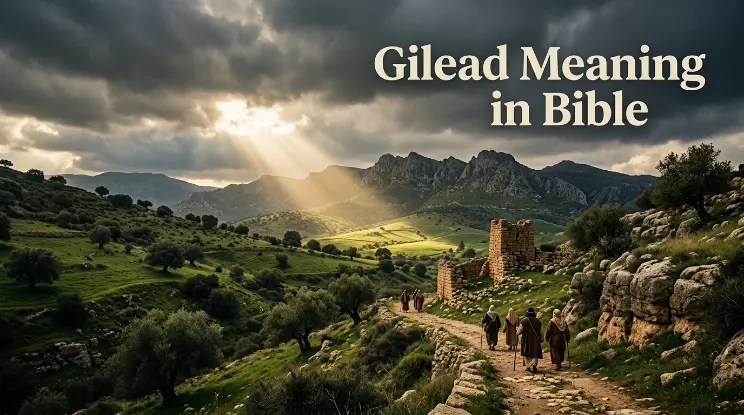
At its core, the Gilead meaning in Bible usage refers to a rugged, hilly region located east of the Jordan River, roughly in what is modern-day Jordan today. The name “Gilead” comes from the Hebrew word Gil’ad (גִּלְעָד), which most scholars translate as “hill of testimony,” “rocky region,” or “heap of witness.”
That last translation “heap of witness” actually comes directly from a specific event in Genesis. The name wasn’t randomly assigned; it was born out of a real moment of reconciliation between two feuding family members. We’ll dig into that story in a moment because it’s genuinely one of the more human, relatable stories in the Old Testament.
Geographically, Gilead sat between the Sea of Galilee to the north and the Dead Sea to the south, on the eastern side of the Jordan Valley. It was known for:
- Lush, fertile highlands
- Dense forests and pastureland
- Natural springs and streams
- Aromatic trees and resin-producing plants
This last point matters a lot, because it’s the reason Gilead became associated with healing and medicinal balm something we’ll explore in detail later.
Quick Snapshot: Gilead at a Glance
| Feature | Description |
| Hebrew Meaning | “Hill of testimony” or “heap of witness” |
| Location | East of the Jordan River (modern Jordan) |
| Terrain | Mountainous, forested, fertile highlands |
| Famous For | Balm, spices, livestock, prophets |
| Team Associated | Half-team of Manasseh, Gad, Reuben |
| Notable People | Jacob, Laban, Jephthah, Elijah |
The Origin Story: How Gilead Got Its Name
To really understand the Gilead meaning in Bible narrative, you have to go back to Genesis 31. This chapter tells the story of Jacob, who had spent twenty years working for his uncle Laban in Paddan Aram. Their relationship was complicated, to say the least full of trickery, broken promises, and mounting tension.
Eventually, Jacob decided he’d had enough. He packed up his wives, children, servants, and flocks and fled without telling Laban. When Laban found out, he chased after Jacob for seven days and finally caught up with him in the hill country.
What happened next is surprisingly tender for a story that started with betrayal and pursuit. Instead of a violent confrontation, God intervened in a dream, warning Laban not to harm Jacob. So when the two men finally met face to face, they talked things through, aired their grievances, and ultimately made a covenant of peace.
To mark this agreement, they gathered stones and built a heap a physical pile of rocks meant to serve as a witness to their pact. Laban called it Jegar Sahadutha (Aramaic for “witness heap”), while Jacob called it Galeed (Hebrew for the same thing). Over time, this location and the surrounding hill country came to be known as Gilead.
This origin story gives the region a built-in theme: reconciliation and witness. Gilead literally means a place where two people who had every reason to remain enemies chose peace instead and made a physical monument to remember it.
Why This Backstory Matters
Understanding this origin changes how you read every later mention of Gilead. It’s not just a random geographic label it carries an embedded idea of testimony, agreement, and boundary-marking. In a sense, Gilead was the ancient world’s version of a signed treaty, except instead of paper, they used stacked stones that could be seen for generations.
Gilead’s Role Throughout the Bible
Once you understand the name’s origin, it’s worth tracing how Gilead shows up across different books of Scripture. It’s mentioned dozens of times, and each appearance adds another layer to its meaning.
1. Gilead as Tribal Territory
After the Israelites left Egypt and conquered land east of the Jordan, Gilead became home to the team of Gad, the team of Reuben, and half of the team of Manasseh (Numbers 32). These team specifically requested this land because it was excellent for raising livestock the pastures were rich and the terrain was well-suited for grazing sheep and cattle.
Moses granted their request on one condition: the men had to help their fellow Israelites conquer the land west of the Jordan before settling permanently in Gilead. This shows an early biblical example of communal responsibility you don’t get to claim your inheritance and walk away from your obligations to the larger group.
2. Gilead in the Book of Judges
Gilead plays a major role in the story of Jephthah, one of the judges of Israel. Jephthah was actually born in Gilead but was driven out by his half-brothers because his mother was a different woman than his father’s wife. Despite this rejection, when the Ammonites threatened Israel, the elders of Gilead came begging Jephthah to lead them into battle.
Jephthah agreed, defeated the Ammonites, but then made a rash vow that led to tragic consequences involving his own daughter (Judges 11). This story shows Gilead not just as a geographic backdrop but as a place tied to themes of family conflict, redemption, and the weight of our words.
There’s also a chilling episode in Judges 12 where the word “Shibboleth” a Gileadite pronunciation test was used to identify and eliminate fleeing Ephraimites at the fords of the Jordan. This is actually where the modern English word “shibboleth,” meaning a distinguishing custom or password, originates.
3. Gilead and the Prophet Elijah
One of the most famous residents connected to this region is the prophet Elijah, described in 1 Kings 17:1 as “Elijah the Tishbite, of the inhabitants of Gilead.” Elijah was a fiery, uncompromising prophet who confronted King Ahab and Queen Jezebel, called down fire from heaven on Mount Carmel, and was eventually taken up to heaven in a whirlwind.
There’s something fitting about Elijah coming from Gilead’s rugged wilderness a landscape that seemed to produce tough, resilient, no-nonsense figures who weren’t afraid to speak hard truths.
4. Gilead in the Story of David
When David fled from his son Absalom’s rebellion, he took refuge in Gilead, specifically in the city of Mahanaim (2 Samuel 17). The people of Gilead showed David remarkable hospitality, bringing him food, bedding, and supplies during a desperate time. Once again, Gilead is associated with refuge and support in moments of crisis.
The Famous “Balm in Gilead” What Does It Really Mean?
If you’ve ever heard the phrase “balm in Gilead,” you’ve likely heard it in a hymn, a poem, or maybe even in casual conversation as a metaphor for healing. But where does this phrase actually come from, and what’s the real Gilead meaning in Bible connection here?
The phrase originates primarily from the Book of Jeremiah. In Jeremiah 8:22, the prophet laments:
“Is there no balm in Gilead; is there no physician there? Why then is not the health of the daughter of my people recovered?”
Jeremiah is speaking metaphorically here, mourning the spiritual and moral sickness of Judah. Gilead was famous throughout the ancient Near East for producing a valuable, aromatic resin used for medicinal purposes and wound care this resin was often called “balm” or “balsam.” Merchants and physicians sought it out because of its healing properties, and it was even a valuable trade commodity, as referenced back in Genesis 37:25, when Ishmaelite traders carrying Gilead’s balm and spices were the ones who purchased Joseph from his brothers.
So when Jeremiah asks “Is there no balm in Gilead?” he’s essentially saying: “Gilead is known for having a cure for physical wounds so why can’t anyone heal this deeper, spiritual wound in our nation?” It’s a rhetorical question dripping with sorrow, pointing out that even though physical remedies existed, there seemed to be no remedy for the people’s unfaithfulness and moral decay.
Why This Phrase Became So Iconic
This verse inspired the well-known African American spiritual “There Is a Balm in Gilead,” which flips Jeremiah’s despairing question into a declaration of hope and faith. The song essentially answers Jeremiah’s rhetorical question with a resounding “yes” there IS a balm, found in Jesus, that heals the sin-sick soul.
This is a beautiful example of how biblical imagery gets reinterpreted and repurposed across centuries, cultures, and forms of art. The literal balm of Gilead a real, tangible medicinal resin from an actual place became a lasting metaphor for spiritual healing and restoration.
Symbolic and Spiritual Meaning of Gilead
Beyond the historical and geographic facts, Gilead carries symbolic weight that Bible scholars and pastors often draw on. Here are some of the key spiritual themes associated with this region:
- Witness and Covenant Rooted in its origin story, Gilead represents agreements made and honored, even between former enemies.
- Healing and Restoration Thanks to its famous balm, Gilead symbolizes the availability of a cure, both physically and spiritually.
- Refuge in Crisis As seen with David’s flight from Absalom, Gilead represents a place of safety during turmoil.
- Resilience and Strength The rugged terrain produced strong, determined figures like Elijah and Jephthah.
- Testing and Identity The Shibboleth incident shows Gilead as a place where identity and belonging were literally tested.
These layered meanings are part of why “Gilead” continues to resonate as a name and symbol far beyond its ancient geographic borders. It’s even been used as a title or setting in modern literature and film most notably in Margaret Atwood’s “The Handmaid’s Tale,” which repurposes the name for a fictional dystopian society, drawing (somewhat ironically) on the biblical association with covenant and witness.
Gilead’s Geography and Why It Mattered
It helps to understand why Gilead’s specific location made it so significant in biblical times. Positioned east of the Jordan River, it served as a natural buffer zone and trade corridor between Israel and neighboring regions like Ammon and Moab.
Key geographic features included:
- The Jabbok River, which flowed through Gilead and was the site of Jacob’s famous wrestling match with the angel (Genesis 32)
- Mount Gilead, a general term for the elevated hill country
- Ramoth Gilead, an important fortified city and one of the designated cities of refuge
- Jabesh Gilead, a city with strong ties to King Saul, whose body was rescued and honored by its residents after his death (1 Samuel 31)
This geographic richness meant Gilead wasn’t just a backdrop it was a functioning, strategic, and economically valuable region that shows up repeatedly in major biblical narratives.
Lessons We Can Draw From Gilead’s Story
Even if you’re not approaching this from a strictly religious lens, there’s real wisdom embedded in Gilead’s biblical story:
- Reconciliation is possible even after betrayal. Jacob and Laban’s story shows that conflict doesn’t have to end in violence sometimes a conversation and a boundary can restore peace.
- Healing often requires seeking it out. Jeremiah’s lament reminds us that having access to a remedy isn’t the same as choosing to use it.
- Where you come from doesn’t define your future. Jephthah was rejected by his family yet became a leader for the very people who cast him out.
- Small differences can reveal big divides. The Shibboleth story is a sobering reminder of how quickly identity markers can become tools of exclusion.
- Support during crisis matters deeply. The hospitality shown to David by the people of Gilead is a model of practical compassion.
Frequently Asked Questions About Gilead
1. What does the name Gilead mean in the Bible?
The name Gilead means “hill of testimony” or “heap of witness,” derived from the Hebrew word Gil’ad. It originates from Genesis 31, where Jacob and Laban built a stone heap as a witness to their peace covenant.
2. Where was Gilead located geographically?
Gilead was located east of the Jordan River, in the mountainous region that is now part of modern-day Jordan. It stretched roughly between the Sea of Galilee and the Dead Sea.
3. What is the “balm in Gilead” referring to?
The “balm in Gilead” refers to a medicinal resin that was produced in the Gilead region and used for healing wounds. Jeremiah 8:22 uses this balm as a metaphor, asking why there’s no spiritual cure for Judah’s moral sickness despite the region’s reputation for physical healing.
4. Which biblical figures are associated with Gilead?
Several key figures are tied to Gilead, including Jacob and Laban (its naming), Jephthah (a judge born and raised there), the prophet Elijah (called “Elijah the Tishbite of Gilead”), and King David, who took refuge there during Absalom’s rebellion.
5. What team of Israel settled in Gilead?
The team of Gad, the team of Reuben, and half of the team of Manasseh settled in Gilead because of its excellent grazing land for their livestock, as recorded in Numbers 32.
6. Why is the word “Shibboleth” connected to Gilead?
During a conflict recorded in Judges 12, the Gileadites used the word “shibboleth” as a pronunciation test to identify fleeing Ephraimites, who couldn’t say the “sh” sound correctly. This event is the origin of the modern English word “shibboleth,” meaning a distinguishing custom or test of belonging.
7. Is Gilead mentioned in the New Testament?
Gilead is not prominently featured in the New Testament, as it’s primarily an Old Testament location. However, its symbolic legacy particularly the “balm in Gilead” imagery continues to influence Christian hymnody, theology, and metaphorical language about spiritual healing found throughout Christian teaching.
Final Thoughts: Why Gilead Still Matters Today
So, what’s the real takeaway when it comes to the Gilead meaning in Bible context? Gilead is far more than a dot on an ancient map. It’s a place woven into some of the Bible’s most emotionally rich stories a reconciliation between family members, a prophet’s cry for healing, a leader’s rise from rejection, and a refuge for a king in exile.
Its name itself, “heap of witness,” reminds us that some places carry meaning simply because of what happened there the promises made, the healing sought, the identities tested, and the shelter offered. Whether you encounter the word “Gilead” in a hymn, a sermon, a classic novel, or your own personal Bible study, you now have the fuller picture: a rugged, fertile land east of the Jordan that became a lasting symbol of witness, healing, and restoration.

Hi, I’m Daniel Foster, a writer at GrasePath.com. I enjoy exploring the deeper meanings of biblical words, names, symbols, and verses to help readers better understand Scripture. My goal is to present accurate, easy-to-read, and well-researched content that makes the Bible more accessible for everyone. Through every article, I strive to provide clear explanations, meaningful insights, and trustworthy information to support your faith and Bible study journey.