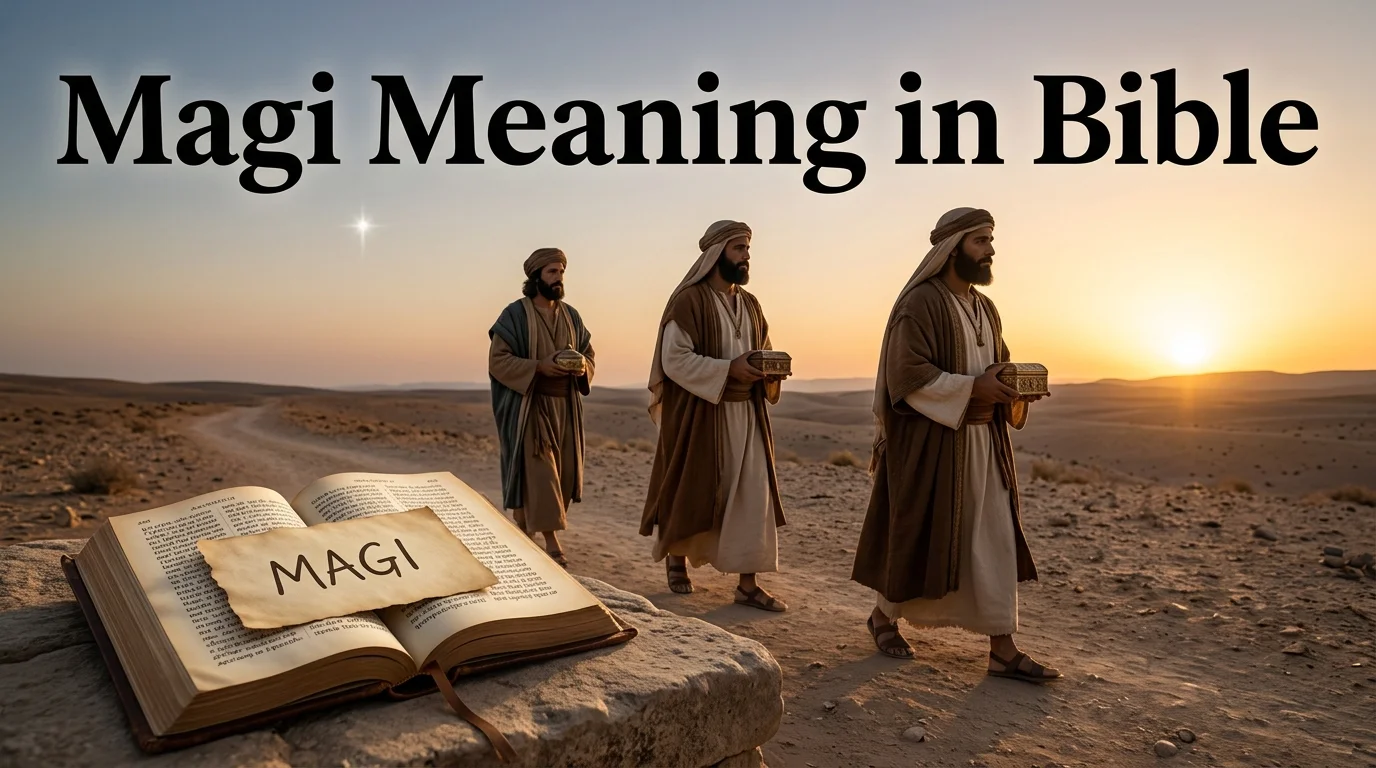
Every December, nativity scenes around the world feature three robed figures kneeling beside a manger, gifts in hand.
But have you ever stopped to wonder who these mysterious visitors actually were? The magi meaning in Bible texts goes far deeper than the simplified “three wise men” story most of us grew up with. In fact, the real biblical account of the magi is stranger, richer, and more historically fascinating than almost any Christmas card could capture.
If you’ve ever asked yourself what the word “magi” actually means, where these men came from, why they followed a star, or whether there were really only three of them, you’re in the right place.
What Does “Magi” Actually Mean?
The word “magi” (singular: magus) comes from the ancient Greek word magoi, which itself was borrowed from Old Persian. It originally referred to a specific class of priests in ancient Persia, particularly among the Zoroastrian religious tradition. These men weren’t kings, and they weren’t just casual travelers they were highly trained scholars.
In the ancient world, magi were known for their expertise in:
- Astrology and astronomy reading the movement of stars and planets
- Interpreting dreams a skill highly valued in royal courts
- Religious rituals serving as priests within Zoroastrianism
- Philosophy and science by ancient standards, they were considered among the most educated people alive
Interestingly, our modern English words “magic” and “magician” actually descend from this same root word. That connection reveals a lot about how the ancient world viewed the magi not as sorcerers in the fantasy sense, but as respected intellectuals who studied the heavens and were believed to possess unique spiritual insight.
So when we talk about the magi meaning in Bible terms, we’re really talking about foreign scholar-priests, not the crowned kings so often depicted in artwork.
Where Does the Bible Actually Mention the Magi?
Here’s something that surprises a lot of people: the magi appear in exactly one book of the entire Bible the Gospel of Matthew. They are completely absent from Mark, Luke, and John.
The account is found in Matthew 2:1-12, and it’s surprisingly brief compared to the elaborate nativity traditions built around it. Matthew introduces them simply as “magi from the east” who arrive in Jerusalem asking, “Where is the one who has been born king of the Jews? We saw his star when it rose and have come to worship him.”
That’s it. No names. No specific number. Mention of camels. No description of their homeland beyond “the east.” Everything else the names Melchior, Caspar, and Balthasar, the idea that they were kings, the assumption that there were exactly three comes from later church tradition, not from the biblical text itself.
Why Only Matthew Includes the Magi
Matthew’s Gospel was written primarily for a Jewish-Christian audience, and one of its central themes is proving that Jesus was the promised Messiah not just for the Jewish people, but for the entire world. The arrival of foreign, non-Jewish scholars traveling great distances to worship a Jewish infant king fits perfectly into that theme. It signals from the very beginning of the Gospel that Jesus’s significance extends beyond Israel to all nations.
This detail matters a lot when considering the full magi meaning in Bible theology their presence isn’t just a cute detail, it’s a deliberate theological statement.
Where Did the Magi Come From?
Matthew simply says they came “from the east,” which has fueled centuries of speculation. Based on historical and cultural context, most biblical scholars believe the magi likely originated from one of these regions:
- Persia (modern-day Iran) the historical homeland of the Zoroastrian magi priesthood
- Babylon (modern-day Iraq) a major center of astrology and astronomical study in the ancient world
- Arabia supported by the type of gifts they brought, which were common trade goods from that region
Babylon is often considered the strongest candidate. This region had a well-established Jewish community dating back to the Babylonian exile centuries earlier, meaning the magi could plausibly have had access to Jewish scriptures, including prophetic texts about a coming king which may explain how they knew to look for a star signaling his birth in the first place.
How Many Magi Were There? (It’s Probably Not Three)
This is one of the biggest misconceptions tied to the magi meaning in Bible tradition. Nowhere does the biblical text state that there were three magi.
The number three became popular for a simple reason: Matthew mentions three gifts gold, frankincense, and myrrh. Over time, people assumed three gifts must mean three gift-givers. But in the ancient world, a delegation of scholars traveling such a long distance would likely have included a larger group advisors, guards, servants, and translators possibly numbering in the dozens.
Some early Christian traditions in the Eastern church actually describe as many as twelve magi. The number three simply stuck in Western tradition because it made for a tidier story and because it eventually got attached to individual names during the medieval period.
The Star of Bethlehem: Fact, Miracle, or Astronomical Event?
No discussion of the magi would be complete without addressing the star that guided them. This has become one of the most debated details in biblical history, and it plays a central role in understanding the magi meaning in Bible narrative.
Matthew describes the star as rising in the east and eventually stopping directly over the place where Jesus was. Scholars have proposed several theories over the years:
- A supernatural sign many theologians interpret it as a miraculous, non-natural phenomenon created specifically for this event
- A planetary conjunction astronomers have pointed to rare alignments of Jupiter and Saturn around 6-7 BC that would have appeared as an unusually bright object
- A comet Chinese astronomical records document a comet sighting around 5 BC
- A nova or supernova a sudden burst of stellar brightness that would have faded after several months
Whatever the star actually was, its significance to the magi is the real point of the story. As trained astrologers, they would have been uniquely equipped to notice and interpret an unusual celestial event as a sign of major political or spiritual importance which is exactly what led them on their journey in the first place.
The Gifts of the Magi and What They Symbolize
The three gifts presented to Jesus weren’t randomly chosen. Each carried deep symbolic weight, and together they form one of the richest parts of the magi meaning in Bible story.
Gold
Gold was, and still is, a universal symbol of wealth, royalty, and kingship. Presenting gold to the infant Jesus symbolically acknowledged him as a king.
Frankincense
This fragrant resin was burned as incense in religious worship and temple rituals throughout the ancient Near East. Giving frankincense pointed to Jesus’s identity as divine worthy of worship, not just political respect.
Myrrh
Myrrh is a resin most commonly associated with embalming and burial practices in the ancient world. Its inclusion is often seen as a subtle, almost prophetic nod to Jesus’s eventual suffering and death.
Taken together, the three gifts tell a compact theological story: king, God, and sacrifice all wrapped into a single visit from foreign travelers to a humble home.
Why Did the Magi Visit Jesus?
At its heart, the magi’s journey was an act of worship. Matthew records that upon finally locating Jesus, “they bowed down and worshiped him.” For ancient scholars from a completely different culture and religious background to travel such a long distance and offer worship to a Jewish child carries enormous symbolic weight.
This detail reinforces a theme that runs throughout Matthew’s Gospel: Jesus came not just for one nation, but for the entire world. The magi, as outsiders, become the first Gentiles in the New Testament to recognize and honor Jesus’s significance long before most of his own people did.
King Herod’s Role in the Story
The magi’s visit also sets off one of the darker chapters of the nativity narrative. When they arrived in Jerusalem asking about a newborn “king of the Jews,” it deeply troubled King Herod, who saw any rival claim to the throne as a serious threat.
Herod summoned the magi secretly and asked them to report back once they found the child, claiming he also wished to worship him. In reality, historical accounts of Herod’s brutal and unreasonable rule strongly suggest his true intention was to eliminate a potential threat to his throne.
Warned in a dream not to return to Herod, the magi departed for their homeland by a different route. Herod’s fury over being outwitted led to the horrifying event known as the Massacre of the Innocents, where he ordered the execution of male children in Bethlehem under the age of two a tragic and often overlooked piece of the full magi meaning in Bible account.
Common Misconceptions About the Magi
Given how much popular culture and holiday tradition have reshaped this story, it’s worth clearing up a few widespread myths:
- Myth: They were kings. The Bible never calls them kings that idea likely developed from Old Testament prophecies (like Psalm 72 and Isaiah 60) that mention kings bringing gifts, which later got merged with the magi story.
- Myth: There were exactly three of them. As covered earlier, this comes from the number of gifts, not an actual headcount.
- Myth: They visited Jesus in the manger on the night he was born. Matthew’s account suggests they arrived at a “house,” not a stable, and likely visited weeks or even up to two years after Jesus’s birth which is why Herod’s murderous order targeted children up to age two.
- Myth: We know their names. Melchior, Caspar, and Balthasar are traditional names that emerged centuries later, not names found anywhere in scripture.
The Legacy of the Magi in Christian Tradition
Even though their biblical appearance is brief, the magi have had an outsized influence on Christian art, theology, and holiday tradition. The Christian holiday of Epiphany, celebrated on January 6th, specifically commemorates the visit of the magi and the revelation of Jesus to the Gentile world.
Their story has inspired countless works of art, from Renaissance paintings to modern nativity displays, and their symbolic gifts continue to shape how Christians understand the identity of Jesus as king, God, and sacrificial savior.
Why the Magi Meaning in Bible Still Matters Today
Understanding the true magi meaning in Bible scripture does more than correct a few Christmas trivia facts. It reveals something profound about the nature of the Christmas story itself: from the very beginning, Jesus’s arrival was framed as something meant for the entire world not just one nation, culture, or religious background.
The magi remind us that spiritual truth can be recognized by unexpected people, from unexpected places, through unexpected means even the careful study of stars in the night sky. Their journey, driven by genuine curiosity and reverence, continues to resonate with readers of all backgrounds looking for meaning in an ancient and enduring story.
Frequently Asked Questions About the Magi Meaning in Bible
1. What is the magi meaning in Bible terms exactly?
In biblical terms, the magi were foreign scholar-priests, likely from Persia or Babylon, who studied astrology and were known for interpreting celestial signs. They traveled to worship the newborn Jesus after seeing a star they believed signaled the birth of a significant king.
2. Were the magi actually kings?
No. The Bible never describes them as kings. This idea developed later, largely influenced by Old Testament prophecies about kings bringing gifts, which became associated with the magi story over time.
3. How many magi visited Jesus? The Bible doesn’t specify a number. The tradition of “three” comes from the three gifts mentioned gold, frankincense, and myrrh not from an actual count of visitors.
4. Did the magi visit Jesus on the night he was born?
Most scholars believe they arrived later, possibly weeks or up to two years after Jesus’s birth, since Matthew describes them visiting a “house” rather than a stable, and Herod’s order targeted children up to age two.
5. What does the word “magi” actually mean?
“Magi” comes from the Greek word magoi, referring to a class of Persian priests known for astrology, dream interpretation, and religious scholarship. It’s also the root of the modern words “magic” and “magician.”
6. What is the significance of the three gifts the magi brought?
Gold symbolized kingship, frankincense represented divinity and worship, and myrrh foreshadowed suffering and burial together painting a symbolic picture of who Jesus was believed to be.
7. Where in the Bible can I read about the magi?
The story of the magi is found exclusively in the Gospel of Matthew, chapter 2, verses 1 through 12. No other Gospel mentions their visit.
Final Thoughts
The real magi meaning in Bible scripture is far richer than the simplified version most of us grew up celebrating each December. These weren’t three kings in fine robes casually strolling up to a manger they were dedicated scholars from a distant land, driven by genuine intellectual and spiritual curiosity, who undertook a long and risky journey guided by a star they believed carried profound significance.
Their story, brief as it is in scripture, carries enormous symbolic weight: it’s a story about recognition, reverence, and the idea that truth can be found and honored by people from any background willing to seek it. The next time you see a nativity scene this holiday season, you’ll know the real story behind those mysterious travelers from the east and just how much depth lies behind the simple phrase “magi meaning in Bible.”

James Parker is a Bible writer at GrasePath.com who loves exploring the deeper meaning of Scripture. He shares clear, trustworthy insights about biblical names, symbols, dreams, and spiritual teachings in simple language. His mission is to help readers strengthen their faith and better understand God’s Word every day.