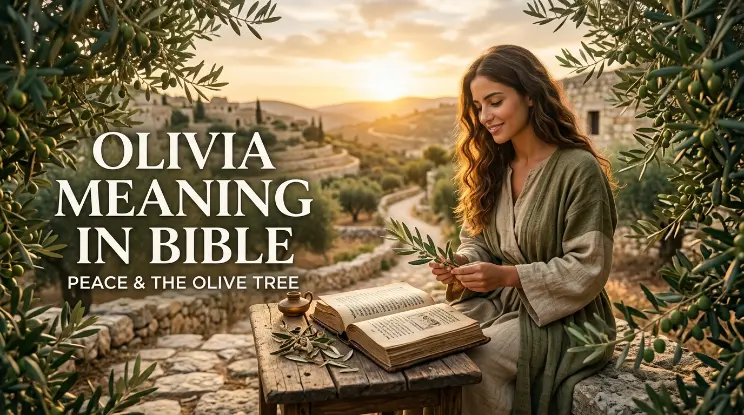
If you’re expecting a baby girl, searching for a meaningful name, or simply curious about your own name’s roots, you’ve probably typed “Olivia meaning in Bible” into a search bar at some point. It’s one of the most popular names in the world right now, and there’s something about it that feels timeless, graceful, and quietly sacred.
Here’s the thing, though and I want to be upfront about it from the start: Olivia does not appear as a character or word in the original biblical texts. You won’t find an “Olivia” walking through the pages of Genesis or standing beside Mary in the Gospels.
But that doesn’t mean the name lacks biblical depth. Quite the opposite. Olivia is deeply connected to one of the most powerful and recurring symbols in Scripture the olive tree and the olive branch.
Quick Answer: What Does Olivia Mean in the Bible?
Let’s answer the core question right away before we go deeper.
Olivia is not a name found directly in the Bible. It’s a name derived from the Latin word oliva, meaning “olive” or “olive tree.” While the name itself is a later literary and linguistic creation, the olive tree holds enormous symbolic and spiritual meaning throughout the Bible representing peace, prosperity, healing, divine blessing, and the Holy Spirit.
So when people ask about the Olivia meaning in Bible context, what they’re really connecting to is the deep well of olive symbolism found in Scripture, from the Book of Genesis all the way through the New Testament.
Let’s unpack that fully.
Where Does the Name Olivia Actually Come From?
To understand the biblical connection, it helps to first understand the linguistic origin of the name.
The Latin Roots
Olivia comes from the Latin word oliva, which simply means “olive.” This word traveled through Old French as olive before becoming a distinct name in English. The olive tree has been cultivated across the Mediterranean region for thousands of years, and it became deeply woven into ancient culture, religion, and daily life including within the Hebrew and early Christian world that produced the Bible.
Shakespeare’s Influence
Many name historians credit William Shakespeare with popularizing Olivia as a given name. In his 1602 play Twelfth Night, Olivia is a noble, intelligent countess strong-willed, graceful, and admired by everyone around her. This literary appearance helped push “Olivia” from a botanical word into a beloved feminine name across Europe.
Not a Hebrew or Greek Biblical Name
Unlike names such as Sarah, Hannah, Mary, or Elizabeth all of which appear directly in Scripture Olivia has no direct Hebrew or Greek biblical origin. It didn’t exist as a personal name in the ancient world of the Old or New Testament. This is an important distinction for anyone doing serious name research, because plenty of websites incorrectly claim Olivia is a “biblical name” without clarifying this nuance.
That said, the root meaning olive carries some of the richest symbolism in the entire Bible. This is where the real spiritual depth of the name comes from.
The Olive Tree in the Bible: Where the Real Meaning Lives
If Olivia’s name means “olive,” then to understand its spiritual significance, we need to look at what the olive tree represented to the people who wrote and lived the biblical story.
1. A Symbol of Peace
The most famous olive reference in the Bible comes from the story of Noah’s Ark in Genesis 8:11:
After the great flood, Noah sent out a dove to find dry land, and it returned carrying a fresh olive leaf in its beak.
This single image became one of the most enduring symbols in human history the olive branch as a sign of peace, hope, and reconciliation between God and humanity. Even today, thousands of years later, we still use the phrase “extending an olive branch” to describe making peace with someone.
For anyone named Olivia, this connection alone gives the name a beautiful undertone: peace, renewal, and hope after hardship.
2. A Symbol of Divine Blessing and Prosperity
Throughout the Old Testament, the olive tree represented abundance and God’s favor. The land of Israel is repeatedly described as a place flowing with “oil and honey,” referring to olive oil as a sign of prosperity.
- Deuteronomy 8:8 lists the olive tree among the blessings of the Promised Land.
- Psalm 128:3 compares children to “olive shoots around your table” a picture of a flourishing, blessed family.
- Jeremiah 11:16 refers to Israel itself as “a green olive tree, fair, and of goodly fruit.”
This connects the name Olivia to themes of family blessing, fruitfulness, and a flourishing life qualities many parents hope to instill in a daughter.
3. A Symbol of Healing and Anointing
Olive oil wasn’t just food in the ancient world it was medicine, fuel for lamps, and most importantly, a sacred substance used in religious ceremonies.
- Priests, prophets, and kings were anointed with olive oil as a sign of being set apart for God’s purpose (1 Samuel 16:13).
- Olive oil was used to soothe wounds, as seen in the Parable of the Good Samaritan (Luke 10:34), where oil was poured on the injured man to help heal him.
- James 5:14 instructs believers to anoint the sick with oil while praying for healing.
This gives the name Olivia a quiet association with healing, compassion, and being chosen or set apart a meaningful layer for anyone drawn to the name for spiritual reasons.
4. A Symbol of the Holy Spirit
In both Old and New Testament theology, olive oil is often used as a symbol of the Holy Spirit God’s presence, guidance, and empowerment poured out on His people. The lampstand in the Tabernacle, described in Exodus 27:20, burned continuously using pure olive oil, representing God’s unending presence with His people.
5. The Mount of Olives
One of the most sacred locations in the New Testament is the Mount of Olives, a hillside covered in olive groves just outside Jerusalem. This is where:
- Jesus often prayed and taught His disciples
- He wept over Jerusalem (Luke 19:41)
- He prayed in deep anguish the night before His crucifixion, in the Garden of Gethsemane a name that literally means “oil press”
- He ascended into heaven after His resurrection (Acts 1:9-12)
The olive tree, quite literally, stood at the center of some of the most emotionally profound moments in the entire New Testament story.
So What Does “Olivia” Symbolically Mean in a Biblical Sense?
Bringing all of this together, here’s a clear summary of the spiritual meanings connected to the name Olivia through its root word, “olive”:
- Peace from the dove and olive branch after the flood
- Hope and renewal a fresh start after hardship
- Prosperity and blessing fruitfulness and abundance
- Healing oil used to soothe and restore
- Being set apart anointing of priests, prophets, and kings
- The Holy Spirit’s presence oil as a symbol of divine guidance
- Sacred devotion the Mount of Olives and Gethsemane
While Olivia isn’t a name spoken by any biblical figure, few names carry a symbol as richly layered and spiritually significant as the olive.
Olivia vs. Other Names With Biblical Ties
It helps to compare Olivia with names that do have direct biblical origins, so you can see exactly where it fits in.
| Name | Biblical Origin? | Root Meaning |
| Sarah | Yes, Old Testament | “Princess” |
| Hannah | Yes, Old Testament | “Grace” or “Favor” |
| Mary (Miriam) | Yes, New Testament | “Bitter” or “Beloved” |
| Elizabeth | Yes, New Testament | “God is my oath” |
| Olivia | No symbolic connection only | “Olive” |
| Deborah | Yes, Old Testament | “Bee” |
This table makes it clear: Olivia belongs to a category of names that are symbolically biblical rather than literally biblical much like names such as Ivy, Grace (when used generically), or Faith, which draw meaning from concepts rather than direct scriptural characters.
Why Parents Choose Olivia for Spiritual or Christian Reasons
Even though Olivia isn’t found in Scripture, it remains an extremely popular name among Christian families, and for good reason. Here’s why:
1. It Carries a Peaceful, Gentle Meaning
Parents often want a name that reflects the character they hope their child will grow into. “Olive,” with its associations of peace and gentleness, fits that desire beautifully.
2. It Connects to Powerful Biblical Imagery
Even without being a “Bible name” in the technical sense, Olivia allows parents to lean into rich biblical symbolism the dove, the olive branch, healing oil, and the Mount of Olives during naming ceremonies, baptisms, or dedications.
3. It’s Elegant and Timeless
Beyond spiritual meaning, Olivia has topped baby name charts in the United States, United Kingdom, Canada, and Australia for years. It manages to feel both classic and fresh a rare balance in the world of baby names.
4. It Pairs Beautifully With Middle Names That Have Direct Biblical Roots
Many Christian parents choose Olivia as a first name and pair it with a strong, directly biblical middle name, such as:
- Olivia Grace
- Olivia Faith
- Olivia Hope
- Olivia Ruth
- Olivia Esther
- Olivia Joy
This combination lets parents enjoy Olivia’s elegant sound while still anchoring the full name in explicit scriptural meaning.
Real-Life Reflection: The Olive Tree’s Lesson for an Olivia
There’s something worth sitting with here. Olive trees are famous for their resilience. They can survive drought, rocky soil, and centuries of harsh weather some living olive trees in the Middle East are believed to be over 2,000 years old, meaning they may have existed during the time of Jesus.
An olive tree doesn’t produce its fruit quickly, either. It often takes years, sometimes decades, before a young tree bears a full harvest. But once it does, it can keep producing fruit for generations.
For a girl named Olivia, that’s not a bad metaphor to grow into: patience, deep roots, quiet strength, and a life that produces good fruit over time themes that echo throughout biblical teaching, including Jesus’s own words in John 15 about abiding and bearing fruit.
Common Misconceptions About Olivia’s Biblical Meaning
Because so many parenting blogs and name-meaning sites repeat information without fact-checking, a few myths have spread widely. Let’s clear them up:
- Myth: “Olivia is directly mentioned in the Bible.” Truth: No verse or genealogy contains the name Olivia. It’s a Latin-derived name that came centuries after the Bible was written.
- Myth: “Olivia means ‘peace’ in Hebrew.” Truth: Olivia isn’t a Hebrew word at all it’s Latin. The association with peace comes from the olive branch symbolism in Genesis, not from a Hebrew definition of the name itself.
- Myth: “Olivia is a saint’s name from early Christianity.” Truth: While there have been Christian women named Olivia throughout history (including Saint Olivia of Palermo, associated with olive groves in Sicilian tradition), the name’s biblical connection is symbolic, not scriptural.
Being accurate about this matters especially if you’re choosing the name for a christening, baptism, or a personal spiritual reason.
Tips for Parents Considering Olivia as a Christian Baby Name
If you’re drawn to Olivia for spiritual reasons, here are a few thoughtful ways to make the biblical connection more intentional:
- Choose a biblical middle name to strengthen the scriptural tie (Olivia Faith, Olivia Grace, Olivia Ruth).
- Read Genesis 8 together as a family during a baptism or naming ceremony to highlight the dove and olive branch story.
- Reference Psalm 128 in a baby dedication card or nursery decor the verse about children being like olive shoots is especially touching for a daughter.
- Consider a verse-based nursery theme built around olive branches, doves, or the Mount of Olives for a subtle but meaningful nod to Scripture.
- Explain the meaning honestly as she grows that her name reflects the beautiful symbolism of peace and blessing found throughout the Bible, even though “Olivia” itself isn’t a name spoken by a biblical figure.
Frequently Asked Questions About Olivia Meaning in Bible
1. Is Olivia a name mentioned in the Bible?
No. Olivia does not appear anywhere in the Old or New Testament. It’s a Latin-derived name meaning “olive,” which became popular through literature most notably Shakespeare’s Twelfth Night long after the Bible was written.
2. What does the name Olivia symbolically mean in a biblical sense?
Olivia is symbolically tied to the olive tree and olive branch, which represent peace, hope, healing, prosperity, and God’s blessing throughout Scripture, most famously in the story of Noah’s dove in Genesis 8.
3. Does Olivia mean “peace” in the Bible?
Not directly by definition, but by association. The olive branch became a universal symbol of peace after Noah’s flood story, so Olivia carries that peaceful symbolism even though the word “peace” isn’t its literal translation.
4. Is Olivia a good Christian name for a baby girl?
Yes. While it isn’t a direct biblical name, Olivia is widely embraced by Christian families for its gentle sound and its meaningful connection to olive symbolism found throughout Scripture, especially peace, healing, and blessing.
5. What is the Hebrew equivalent of Olivia?
There isn’t a true Hebrew equivalent, since Olivia is Latin in origin. However, some parents look to the Hebrew name “Zeitan” or consider names like “Tamar” or “Deborah” if they specifically want a Hebrew biblical name with nature-based meaning.
6. What does the olive branch represent in the Bible?
The olive branch represents peace, hope, and reconciliation. It first appears in Genesis 8:11, when a dove returns to Noah’s Ark carrying an olive leaf, signaling that the floodwaters were receding and life on earth could begin again.
7. What middle names pair well with Olivia for a biblical meaning?
Popular choices include Olivia Grace, Olivia Faith, Olivia Hope, Olivia Ruth, and Olivia Joy. These middle names carry direct biblical meaning and beautifully complement Olivia’s symbolic connection to peace and blessing.
Final Thoughts: The Real Beauty Behind Olivia’s Meaning
So, what’s the honest answer to “Olivia meaning in Bible”? It’s this: Olivia isn’t a name plucked from the pages of Scripture, but it carries the spirit of one of the Bible’s most treasured symbols the olive tree. From Noah’s dove to the anointing oil of kings and prophets, from the fruitful groves of the Promised Land to the sacred slopes of the Mount of Olives, the olive has always represented peace, healing, blessing, and the quiet presence of God among His people.
For any parent, or anyone simply curious about their own name, that’s a meaning worth holding onto.

James Parker is a Bible writer at GrasePath.com who loves exploring the deeper meaning of Scripture. He shares clear, trustworthy insights about biblical names, symbols, dreams, and spiritual teachings in simple language. His mission is to help readers strengthen their faith and better understand God’s Word every day.










