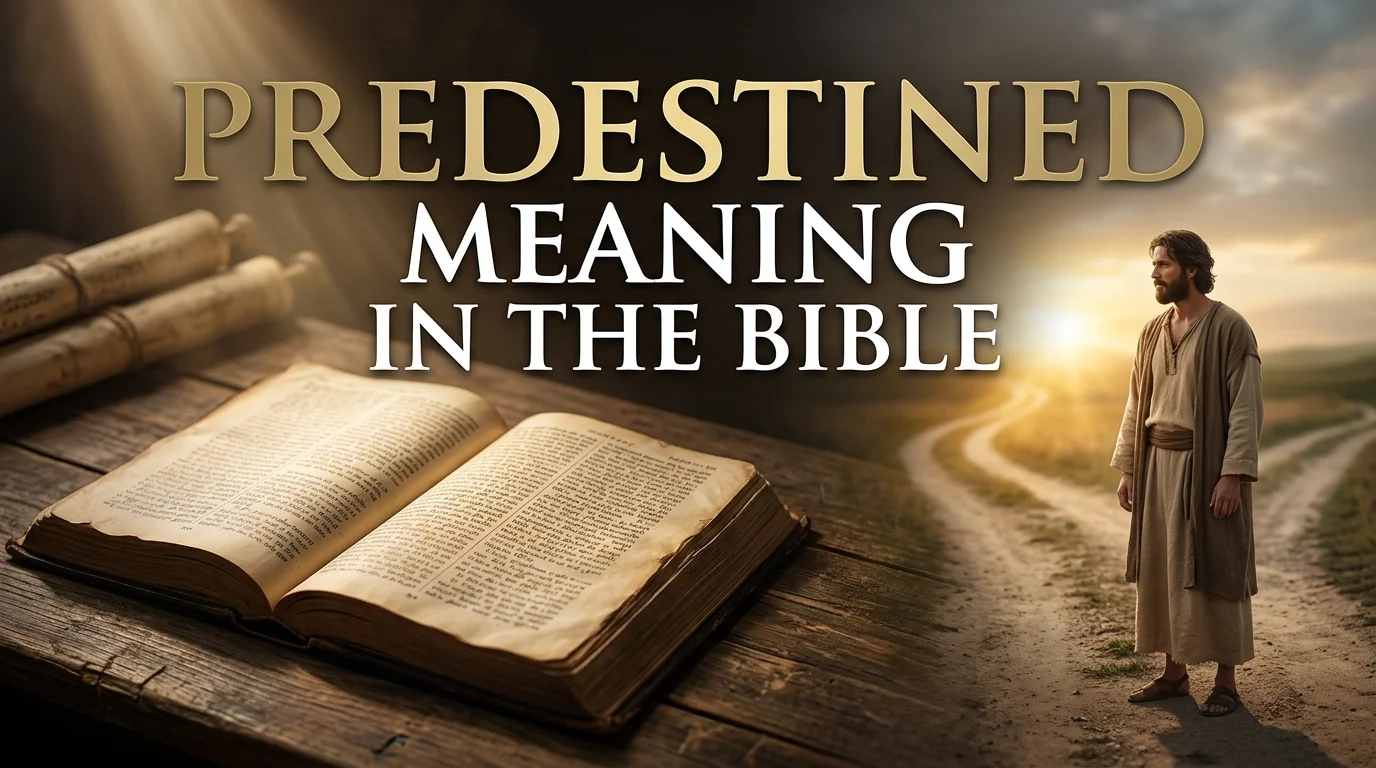
Have you ever stumbled across a verse like Ephesians 1:5, read the word “predestined,” and immediately felt a wave of questions rush in? Does this mean God already decided your entire life before you were born? Do you even have free will? Or is this one of those theological words that sounds scarier than it actually is?
If you’ve been chasing the predestined meaning in the Bible, you’re not alone. It’s one of the most debated, misunderstood, and honestly fascinating topics in all of Christian theology. Pastors have preached entire sermon series on it. Scholars have written thick books arguing over it. And everyday believers, like you, just want a straight answer: what does the Bible actually say?
This guide breaks it down in plain language. No confusing seminary jargon, no picking a side and pretending it’s the only “correct” view. Just a clear, honest look at what the word means, where it appears in Scripture, how different Christian traditions interpret it, and why it matters for how you live your everyday life.
What Does “Predestined” Actually Mean?
At its core, the word “predestined” comes from the Greek word proorizo (προορίζω), which literally means “to determine beforehand” or “to decide ahead of time.” When you break down the word itself, “pre” means before, and “destine” relates to a fixed purpose or direction. So predestination, in the simplest terms, refers to God deciding something in advance before it ever happens in time.
In a biblical context, predestination usually refers to God’s plan for believers, especially concerning salvation, adoption into His family, and being conformed to the image of Christ. It’s not really about God micromanaging every tiny decision you make daily (what you eat for lunch, which route you drive to work). Instead, the biblical usage of the word centers on God’s overarching purpose for humanity and for those who trust in Him.
Here’s the tricky part: the term shows up in the New Testament only a handful of times, yet it has sparked centuries of theological debate. Understanding the predestined meaning in the Bible requires looking closely at the actual verses, the original language, and the broader context in which Paul (who wrote most of these passages) was writing.
A Quick Word Study
The Greek term proorizo appears six times in the New Testament:
- Acts 4:28
- Romans 8:29-30 (twice)
- 1 Corinthians 2:7
- Ephesians 1:5
- Ephesians 1:11
Each of these passages uses the word slightly differently, but they all share the same root idea: something determined by God ahead of time. Understanding each occurrence individually helps paint a fuller picture of what biblical predestination really involves.
Key Bible Verses About Predestination
Let’s walk through the major passages so you can see the concept in its original context rather than relying on secondhand explanations.
Romans 8:29-30
This is probably the most quoted predestination passage in the entire Bible. Paul writes that those God foreknew, He also predestined to be conformed to the image of His Son. He then connects predestination to calling, justification, and glorification forming what theologians often call the “golden chain of salvation.”
The key idea here isn’t random selection out of nowhere. It’s tied directly to being shaped into Christ’s likeness. In other words, predestination in this passage is about the goal believers becoming like Jesus as much as it is about the process leading there.
Ephesians 1:4-5
Paul tells the Ephesian believers that God chose them before the foundation of the world and predestined them for adoption as sons through Jesus Christ. This passage emphasizes a few important things:
- The choice happened before creation itself
- It’s connected to adoption into God’s family
- It happens specifically “through Jesus Christ,” not apart from Him
- The motivation is described as God’s love and the purpose of His will
Ephesians 1:11
Here Paul broadens the scope, saying believers “have obtained an inheritance, having been predestined according to the purpose of him who works all things according to the counsel of his will.” This verse ties predestination to God’s sovereign control over all things, not just salvation in isolation.
Acts 4:28
Interestingly, this verse uses the same Greek word but in reference to the crucifixion of Jesus. The early church prayed, acknowledging that Herod, Pontius Pilate, the Gentiles, and the people of Israel did “whatever your hand and your plan had predestined to take place.” This shows that predestination in Scripture isn’t limited to individual salvation it also relates to God’s sovereign orchestration of major redemptive events in history.
1 Corinthians 2:7
Paul mentions “God’s wisdom, secret and hidden, which God decreed before the ages for our glory.” While the English translations vary slightly, this passage ties predestination to God’s eternal wisdom and glory rather than an arbitrary decision.
Different Christian Views on Predestination
Here’s where things get genuinely interesting and where a lot of the confusion around this topic comes from. Christians across history have not agreed on exactly how predestination works, even though they’re reading the same verses. Understanding these different frameworks can help you see why this topic generates so much discussion.
1. The Calvinist / Reformed View
Rooted in the teaching of theologians like John Calvin and later systematized by the Synod of Dort, this view holds that God has sovereignly and unconditionally chosen certain individuals for salvation before the foundation of the world, based solely on His will rather than anything foreseen in the individual (like faith or good works). This is often summarized in the acronym TULIP, with the “U” standing for Unconditional Election.
In this framework:
- God’s choice precedes and causes a person’s faith
- Salvation is entirely a gift, with no human contribution
- The emphasis lands heavily on God’s sovereignty and grace
2. The Arminian View
Named after theologian Jacobus Arminius, this perspective teaches that predestination is based on God’s foreknowledge meaning God, existing outside of time, sees in advance who will freely choose to trust in Christ, and predestines them based on that foreseen faith.
In this framework:
- Human free will plays a genuine role in accepting or rejecting salvation
- God’s predestination is a response to foreknown faith, not an arbitrary decree
- The emphasis lands more on human responsibility working alongside grace
3. The Catholic and Orthodox Perspective
Catholic and Eastern Orthodox theology generally holds a view that blends divine sovereignty with human cooperation (often called synergism). Predestination is affirmed as a genuine biblical teaching, but it’s held together with the belief that humans must freely cooperate with grace throughout their lives. Mystery plays a big role here many Catholic and Orthodox theologians are comfortable holding both truths in tension without fully resolving the philosophical puzzle.
4. The Corporate Election View
A newer, but increasingly discussed, interpretation suggests that predestination in passages like Ephesians 1 refers less to individuals and more to the corporate body of believers “in Christ” as a group. In this view, God predestined that everyone who is “in Christ” would receive adoption, redemption, and glory, rather than predestining specific individuals by name before they existed.
Each of these views has thoughtful, Bible-believing theologians defending it, and each wrestles honestly with passages that seem to emphasize both God’s sovereignty and human responsibility. It’s worth studying multiple perspectives rather than assuming there’s only one “obvious” reading.
Predestination vs. Free Will: Can Both Be True?
This is the question that keeps small group Bible studies going for hours. If God predestined certain outcomes, does that mean humans don’t really have free will?
Scripture actually holds both truths side by side without fully explaining how they fit together mechanically:
- Passages emphasizing God’s sovereignty: Romans 9, Ephesians 1, Isaiah 46:9-10
- Passages emphasizing human choice and responsibility: Joshua 24:15 (“choose this day whom you will serve”), John 3:16 (“whoever believes”), 2 Peter 3:9 (God “not wishing that any should perish, but that all should reach repentance”)
Many theologians describe this as a divine mystery not a contradiction, but a truth too big to fully fit inside human logic. Think of it like looking at two sides of the same mountain from different valleys. Both views are real; they just come from different vantage points, and the full picture only becomes clear from a height we don’t have access to yet.
A helpful way some pastors explain it: from God’s perspective (outside of time, all-knowing, sovereign), everything is planned and certain. From your perspective (inside time, making real choices), your decisions are genuinely yours and genuinely matter. The Bible speaks to both realities because both are true within their own frame.
Why Predestination Matters in Everyday Faith
It’s easy to treat predestination like an abstract puzzle for theologians in ivory towers, but this doctrine actually has real, practical weight for everyday believers.
It Offers Comfort and Security
Knowing that your salvation isn’t hanging by a thread dependent entirely on your ability to hold on tight enough can be deeply reassuring. If God set His love on you before the world began, that’s a foundation that doesn’t shake when life gets hard.
It Encourages Humility
If salvation ultimately traces back to God’s initiative and grace rather than your own effort or merit, there’s little room left for spiritual pride. This doctrine tends to humble believers rather than puff them up.
It Fuels Worship, Not Passivity
Some worry that predestination leads to a “why bother” attitude toward evangelism or personal growth. But historically, some of the most passionate missionaries and evangelists (like William Carey and George Whitefield) held strong views on God’s sovereign election while also working tirelessly to share the gospel. Belief in God’s plan and active human effort have coexisted throughout church history.
It Shapes How We See Suffering and Purpose
Romans 8:28-29 ties predestination directly to “all things working together for good” for those who love God. That connection means predestination isn’t just a cold theological fact it’s meant to give believers hope that their lives have purpose and direction, even during painful seasons.
Common Misunderstandings About Predestination
Before wrapping up, let’s clear away a few misconceptions that tend to cause unnecessary confusion or anxiety.
- Misunderstanding #1: Predestination means God forces people against their will. Most theological traditions, even Reformed ones, teach that God works through a person’s will, not against it meaning people still choose according to their nature and desires.
- Misunderstanding #2: Predestination means your daily choices don’t matter. Scripture consistently calls believers to make real decisions, pursue obedience, and grow in faith none of that language makes sense if choices were meaningless.
- Misunderstanding #3: It’s only about who “makes it to heaven.” As shown in Acts 4:28 and 1 Corinthians 2:7, predestination in Scripture covers much more than final salvation it touches God’s overarching plan across history.
- Misunderstanding #4: All Christians agree on exactly how it works. As we’ve seen, faithful, Bible-believing Christians land in different places on the mechanics of predestination, even while agreeing the concept is biblical.
How to Study This Topic for Yourself
If this article has sparked your curiosity (or maybe just more questions), here are some practical next steps:
- Read the key passages in context don’t just isolate single verses. Read all of Romans 8-9 and Ephesians 1 in one sitting.
- Compare translations sometimes seeing how the ESV, NIV, NASB, and KJV render the same verse illuminates nuances in the Greek.
- Read authors from different perspectives pick up a short book from a Reformed author and an Arminian author to see how each handles the same texts.
- Talk to your pastor or a trusted Bible teacher theology is meant to be studied in community, not just alone with a search engine.
- Hold your conclusions with humility this is a topic where godly, sincere believers disagree, so grace matters as much as certainty.
Frequently Asked Questions About Predestination in the Bible
1. What is the simplest definition of predestination in the Bible?
Predestination refers to God determining something especially His plan of salvation and purpose for believers before it happens in time, as described in passages like Ephesians 1:5 and Romans 8:29-30.
2. Is predestination the same as fate?
Not exactly. Fate typically implies an impersonal, blind force controlling events, while biblical predestination is rooted in the personal, purposeful will of a loving God who acts with intention and relationship in mind.
3. Does predestination mean I don’t have free will?
Christians disagree on the precise mechanics, but most traditions affirm that people still make genuine choices, even while holding that God’s plan encompasses those choices in ways we don’t fully understand.
4. Where in the Bible is predestination mentioned?
The main passages include Acts 4:28, Romans 8:29-30, 1 Corinthians 2:7, and Ephesians 1:5 and 1:11, all using the Greek word proorizo.
5. What’s the difference between predestination and election?
The terms are closely related and often used together. “Election” typically refers to God’s choosing, while “predestination” emphasizes the advance timing and purpose of that choice together they describe overlapping aspects of God’s plan.
6. Do Catholics believe in predestination?
Yes, Catholic theology affirms predestination as a biblical teaching, though it’s typically framed alongside human cooperation with grace, rather than the more deterministic framework found in some Reformed traditions.
7. How should predestination affect the way I live?
Rather than causing anxiety or passivity, understanding predestination is meant to bring comfort, humility, and motivation. Reminding believers that their life has purpose within a larger, loving plan.
Final Thoughts
At the end of the day, wrestling with the predestined meaning in the Bible isn’t about winning a theological debate it’s about growing closer to understanding the character and heart of God. Scripture presents predestination as a truth meant to bring comfort, not confusion; humility, not fear; and purpose, not passivity.
Whether you lean toward a Reformed understanding, an Arminian perspective, or something in between. The heart of the doctrine remains the same: God has a plan, that plan is rooted in love, and it’s bigger than anything we could have orchestrated ourselves. Instead of letting this topic become a source of anxiety, let it become an invitation to trust more deeply in a God who was thinking of you before the world even began.

Hi, I’m Daniel Foster, a writer at GrasePath.com. I enjoy exploring the deeper meanings of biblical words, names, symbols, and verses to help readers better understand Scripture. My goal is to present accurate, easy-to-read, and well-researched content that makes the Bible more accessible for everyone. Through every article, I strive to provide clear explanations, meaningful insights, and trustworthy information to support your faith and Bible study journey.