If you’ve ever been reading the King James Version and stumbled across the word “subtil” in Genesis, you’ve probably paused and wondered what it actually means. It looks like a typo for “subtle,” but it isn’t. Understanding the subtil meaning in the Bible opens up a fascinating window into ancient Hebrew thought, old English translation choices, and one of the most important verses in all of Scripture the introduction of the serpent in the Garden of Eden.
This word carries far more weight than most readers realize. It’s not just an old spelling quirk; it’s a translator’s careful attempt to capture a Hebrew concept that doesn’t have a single perfect English equivalent. In this article, we’ll dig deep into where the word comes from, what it meant to the original biblical audience, how it’s used throughout Scripture, and why it still matters for how we understand temptation, wisdom, and deception today.
By the end, you’ll not only know the dictionary definition you’ll understand the theology, history, and spiritual lessons packed into this single, curious word.
Understanding the Subtil Meaning in the Bible
Let’s start with the basics. The word “subtil” appears in the King James Version (KJV) and other older English Bible translations as an archaic spelling of “subtle.” It shows up most famously in Genesis 3:1:
“Now the serpent was more subtil than any beast of the field which the LORD God had made.”
In modern English, we’d simply write “subtle.” But in 1611, when the King James translators were working, “subtil” was the standard spelling. Over the centuries, English spelling evolved and settled on “subtle,” but many older Bible translations kept the original spelling intact, which is why it still appears today in reprints of the KJV.
So at a surface level, the subtil meaning in the Bible is straightforward: it means crafty, cunning, clever, or shrewd. But that’s only the beginning of the story. The Hebrew word behind this English translation carries a double meaning that’s absolutely essential to understanding the passage correctly.
The Hebrew Word Behind “Subtil”
The original Hebrew word translated as “subtil” in Genesis 3:1 is arum (עָרוּם). This is where things get interesting, because this exact same Hebrew root appears just one verse earlier in Genesis 2:25 where Adam and Eve are described as “naked” (arummim) and unashamed.
The Hebrew author is making a deliberate wordplay here. The people were “arum” (naked, innocent, exposed) and the serpent was “arum” (crafty, cunning, shrewd). This isn’t a coincidence it’s a literary technique used throughout Hebrew Scripture to draw a sharp contrast between innocence and cunning in the very same breath.
This wordplay is largely lost in English translation, which is part of why understanding the subtil meaning in the Bible requires looking beyond just the English word and into the original language.
Key facts about the Hebrew word arum:
- It can mean “crafty,” “shrewd,” “cunning,” “prudent,” or “sensible” depending on context
- It is a neutral word in Hebrew it isn’t automatically negative
- In Proverbs, the same root is often translated as “prudent” and is praised as a virtue
- In Genesis 3, the context (a serpent scheming to deceive) gives it a negative, cunning connotation
This is a crucial point many readers miss. The word itself isn’t inherently evil. It’s the context a creature using its cleverness to manipulate and deceive that gives the word its negative shade in the Genesis narrative.
Subtil vs. Subtle: What’s the Difference?
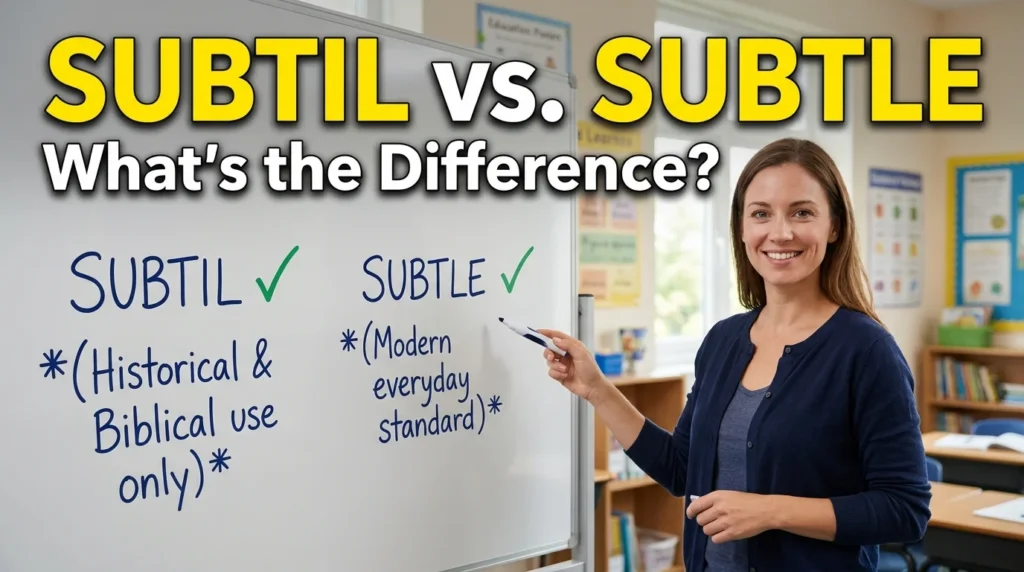
A common question people ask is whether “subtil” and “subtle” mean different things. The honest answer is no they’re the same word, just spelled differently across different periods of English history.
- Subtil the older, archaic spelling used in 17th-century English and preserved in the King James Version
- Subtle the modern spelling used in virtually every contemporary Bible translation (NIV, ESV, NLT, NASB, etc.)
If you compare Genesis 3:1 across translations, you’ll see the shift clearly:
- KJV: “Now the serpent was more subtil than any beast of the field.”
- NIV: “Now the serpent was more crafty than any of the wild animals.”
- ESV: “Now the serpent was more crafty than any other beast of the field.”
- NASB: “Now the serpent was more crafty than any beast of the field.”
Notice something interesting? Most modern translations don’t even use “subtle” anymore they use “crafty.” This is because many modern scholars feel “crafty” captures the deceptive, scheming nature of the serpent more accurately than “subtle,” which in modern English can sound almost like a compliment (as in “a subtle sense of humor” or “subtle flavors”).
This shift in translation reflects an important truth: the subtil meaning in the Bible isn’t really about being quiet or understated. It’s about being cunning and calculated, often with a hidden agenda.
Where Else Does “Subtil” Appear in the Bible?
While Genesis 3:1 is by far the most famous use of the word, “subtil” and its related forms show up in several other places throughout the King James Version. Looking at these additional examples helps paint a fuller picture of how the word functions across Scripture.
2 Samuel 13:3
In this passage, Jonadab is described as “a very subtil man.” Here, the word describes a person who is calculating and manipulative Jonadab goes on to help orchestrate a deceptive and troubling scheme involving Amnon and Tamar. Once again, the word carries a negative, scheming connotation tied to manipulation.
Proverbs and the Idea of Prudence
Interestingly, the same Hebrew root (arum) appears throughout the book of Proverbs, but it’s usually translated as “prudent” rather than “subtil” or “crafty.” For example:
- “A prudent man foreseeth the evil, and hideth himself” (Proverbs 22:3, KJV)
- “The prudent are crowned with knowledge” (Proverbs 14:18, KJV)
This is where the dual nature of the Hebrew word becomes really clear. Being “arum” can be a virtue (wise, discerning, careful) or a vice (deceptive, manipulative, self-serving) depending entirely on how that cleverness is used. The Bible seems to be teaching that shrewdness itself is morally neutral it’s the intent behind it that determines whether it’s wisdom or wickedness.
Job and the Wisdom Literature
Similar language appears in Job, where cunning and cleverness are sometimes praised as forms of practical wisdom, and other times condemned when used to deceive or manipulate others. This reinforces the idea that Scripture treats shrewdness as a tool one that can build up or tear down depending on the heart of the person using it.
The Theological Significance of the Serpent Being “Subtil”
Now let’s get to the heart of why this word matters so much theologically. The description of the serpent as “subtil” in Genesis 3:1 isn’t just a throwaway adjective it sets the tone for the entire temptation narrative.
Here’s why this detail is so important:
1. It establishes the nature of the threat immediately. Before the serpent even speaks, the text warns the reader: this creature is cunning. The audience is meant to approach the coming dialogue with caution, understanding that what follows is a calculated manipulation, not an innocent conversation.
2. It contrasts sharply with human innocence. As mentioned earlier, the wordplay between “naked” (Adam and Eve) and “subtil” (the serpent) in back-to-back verses highlights a stark contrast. The humans are exposed and vulnerable; the serpent is calculating and strategic. This sets up an unequal contest from the very beginning.
3. It reveals the nature of temptation itself. The serpent doesn’t lie outright at first it asks a subtle, twisted question: “Yea, hath God said, Ye shall not eat of every tree of the garden?” This is the essence of cunning deception: not a direct falsehood, but a distortion, a half-truth designed to create doubt. Understanding the subtil meaning in the Bible helps us see that temptation rarely announces itself. It creeps in through clever questions, reasonable-sounding doubts, and subtle twists of truth.
4. It teaches discernment as a spiritual skill. If the serpent’s power was its subtlety, then the appropriate human response is discernment the ability to recognize when something sounds reasonable on the surface but is actually leading us away from truth.
Real-Life Applications: What This Word Teaches Us Today
You might be thinking, “This is interesting history, but how does it apply to my life?” Actually, quite a lot. The concept behind the subtil meaning in the Bible is remarkably relevant to modern life, even outside of a religious context.
Here are a few practical takeaways:
- Not all deception is obvious. Just like the serpent didn’t tell an outright lie at first, manipulation in daily life in relationships, marketing, politics, or online misinformation often works through subtle framing rather than blatant falsehoods.
- Cleverness isn’t automatically good or bad. The same trait that makes someone “crafty” in a harmful sense can make someone “prudent” in a helpful sense. It depends on how that intelligence is applied.
- Questions can be more dangerous than statements. The serpent’s approach was to ask a distorted question rather than make a direct claim. This is a pattern worth watching for subtle reframing that plants doubt without ever stating an outright lie.
- Innocence needs discernment, not naivety. The Genesis narrative doesn’t suggest Adam and Eve should have been suspicious of everything. Instead, it highlights the value of testing ideas against what we already know to be true, rather than accepting persuasive-sounding logic at face value.
How Bible Translators Have Handled This Word Over Time
It’s worth taking a moment to appreciate just how much translation choices shape our understanding of Scripture. The King James translators in 1611 chose “subtil” because, at the time, it was the best available word to capture the layered meaning of “arum” clever, calculating, and quietly dangerous.
As the English language evolved, later translators recognized that “subtle” had softened in meaning. In everyday modern usage, “subtle” often implies something delicate or understated a subtle joke, a subtle color palette, a subtle hint. That’s very different from the sense of deliberate, scheming cunning found in the Hebrew text.
This is why most modern translations (NIV, ESV, NASB, CSB) now render the word as “crafty” instead. It’s a more accurate reflection of the negative, manipulative sense intended in Genesis 3:1, while “subtil” remains a fascinating linguistic fossil preserved in the KJV.
A quick comparison table of translations:
| Translation | Word Used in Genesis 3:1 |
| King James Version (KJV) | Subtil |
| New International Version (NIV) | Crafty |
| English Standard Version (ESV) | Crafty |
| New American Standard Bible (NASB) | Crafty |
| New Living Translation (NLT) | Shrewd |
| Christian Standard Bible (CSB) | Cunning |
Common Misunderstandings About the Word “Subtil”
Because the word looks so similar to “subtle,” many readers assume it means something quiet, gentle, or barely noticeable like a soft-spoken personality trait. But that misses the point entirely.
Here are a few misconceptions worth clearing up:
- Misconception 1: “Subtil” means the serpent was quiet or shy. In reality, it means the serpent was intelligent, calculating, and strategic not timid at all.
- Misconception 2: The word implies the serpent was evil by nature. As we’ve seen, the same Hebrew root is used positively elsewhere in Scripture to describe prudence and wisdom. The negative meaning comes from context, not the word itself.
- Misconception 3: It’s simply a spelling error. It’s not a mistake it’s a legitimate historical spelling that was standard English at the time the KJV was translated.
- Misconception 4: Modern translations “fixed” a translation error. It’s more accurate to say modern translations updated the word choice to better match how English usage has shifted over the last 400 years, not that the original translation was wrong.
Why This Word Still Matters for Bible Study Today
Studying a single word like this might seem like a small detail, but it’s exactly this kind of close reading that deepens biblical literacy. When you understand the subtil meaning in the Bible, you gain insight into:
- How Hebrew wordplay works and why it’s often invisible in English translations
- How English itself has changed since the 1600s
- Why comparing multiple Bible translations can reveal nuances you’d otherwise miss
- How a single character trait (craftiness) sets the stage for one of the most consequential narratives in the entire Bible
This is a great reminder that careful word study isn’t just an academic exercise it can genuinely deepen your understanding of the text’s meaning and message.
Frequently Asked Questions (FAQs)
What does “subtil” mean in the Bible?
“Subtil” is an archaic English spelling of “subtle,” used in the King James Version to describe someone or something as crafty, cunning, or shrewd. It most famously describes the serpent in Genesis 3:1.
Is “subtil” a typo for “subtle” in the King James Version?
No, it’s not a typo. “Subtil” was the standard English spelling in 1611 when the King James Version was translated. English spelling later evolved, and “subtle” became the modern standard form.
What Hebrew word is translated as “subtil” in Genesis 3:1?
The Hebrew word is “arum” (עָרוּם), which can mean crafty, cunning, shrewd, or prudent depending on the context in which it’s used.
Why do modern Bible translations use “crafty” instead of “subtil”?
Modern translations like the NIV and ESV use “crafty” because it more clearly conveys the negative, manipulative sense of the original Hebrew word, whereas “subtle” in modern English can sound like a positive or neutral trait.
Does “subtil” always have a negative meaning in the Bible?
Not always. The same Hebrew root used for “subtil” in Genesis 3 is translated as “prudent” elsewhere, such as in Proverbs, where it describes a positive trait of wisdom and foresight.
What does the serpent being “subtil” teach us about temptation?
It teaches that temptation often works through clever, indirect questions and half-truths rather than obvious lies, which is why discernment is such an important spiritual skill.
Where else does the word “subtil” appear in the Bible?
Besides Genesis 3:1, it appears in passages like 2 Samuel 13:3, describing Jonadab as “a very subtil man” who helps orchestrate a deceptive scheme.
Final Thoughts
At first glance, “subtil” might look like nothing more than an old-fashioned spelling of “subtle.” But as we’ve seen, the subtil meaning in the Bible runs much deeper than spelling alone. Rooted in the Hebrew word “arum,” it captures a rich, double-edged concept cleverness that can be either wise and prudent or deceptive and dangerous, depending entirely on how it’s used.
In Genesis 3:1, this word sets the stage for one of the most pivotal moments in Scripture, warning readers from the very first sentence that the serpent’s approach would be calculated rather than obvious. It reminds us that deception rarely announces itself loudly it often slips in through clever questions and subtle reframing.

James Parker is a Bible writer at GrasePath.com who loves exploring the deeper meaning of Scripture. He shares clear, trustworthy insights about biblical names, symbols, dreams, and spiritual teachings in simple language. His mission is to help readers strengthen their faith and better understand God’s Word every day.