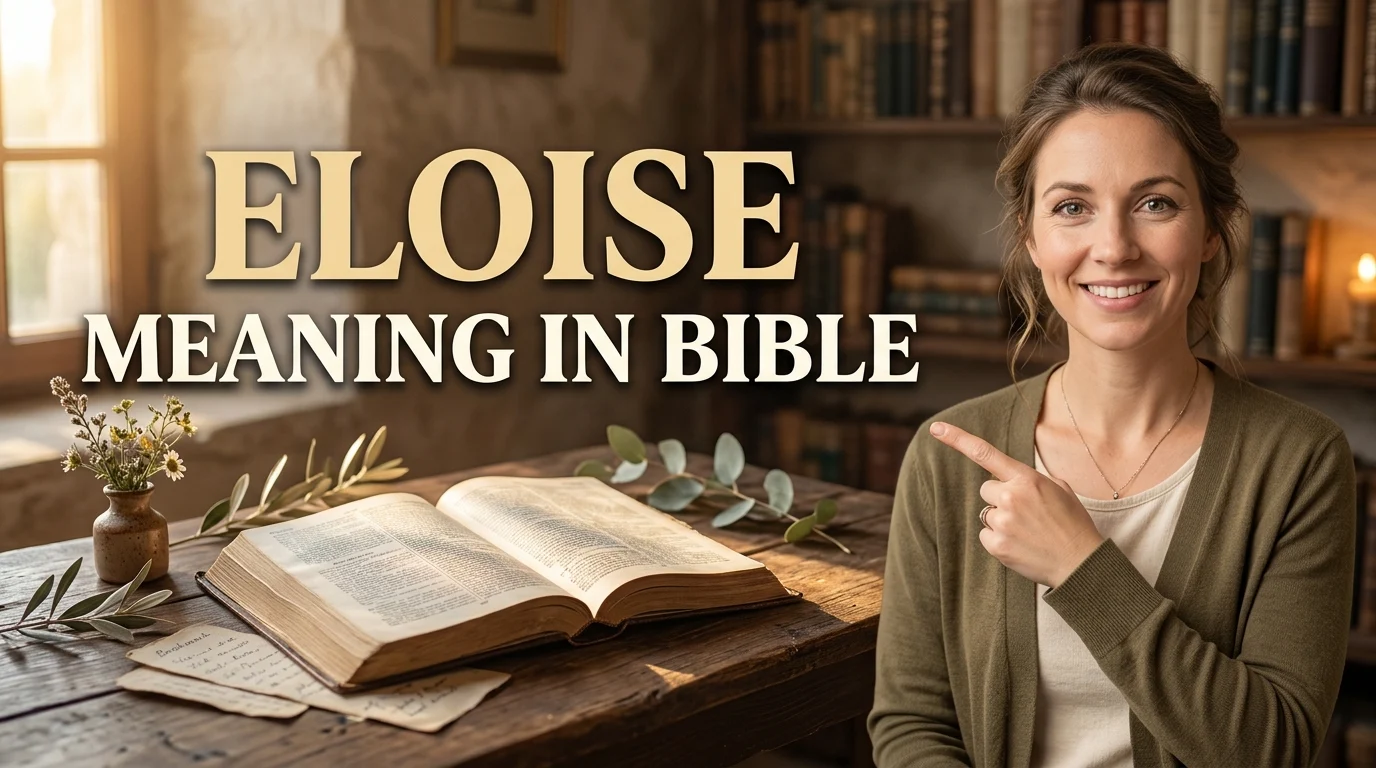
Choosing a meaningful name is a special decision, especially when you want one with a connection to biblical values and Christian faith. Eloise is a beautiful name with an elegant sound and a long history, but its direct biblical connection is not established. The name is generally considered a French form of the Old German name Helewidis, often interpreted as “healthy” or “whole” and sometimes associated with the idea of being wide or extensive.
Although Eloise does not appear as a personal name in the Bible, its traditional meanings can inspire positive reflections on strength, well-being, and a complete life. For Christian families, these ideas may connect with biblical themes of spiritual growth, God’s care, and inner strength.
Scripture frequently encourages believers to seek wisdom, live with faith, and develop a strong relationship with God. Verses such as Proverbs 31:25 describe a woman clothed with strength and dignity, while 3 John 1:2 expresses a wish for well-being and good health. These passages do not define the name Eloise, but they offer meaningful themes that parents may associate with it.
The True Origin and Etymology of the Name Eloise
Before we connect Eloise to biblical ideas, it helps to start with solid linguistic ground. Eloise is the English form of the French name Héloïse (or Éloïse). That French form itself grew out of an older Germanic name, Helewidis or Heilwidis.
Break the Germanic pieces apart and the picture becomes clear:
- “Heil” or “hail” means healthy, whole, or hale.
- “Wid” or “wit” means wide or broad.
Put together, the name essentially means “healthy and wide” or “whole and expansive.” Some older sources occasionally link it to ideas of robust strength or even a healthy forest, but the core sense remains soundness and breadth.
You may see popular baby-name sites claim that Eloise means “famous warrior.” That interpretation usually comes from a later confusion with the name Louise (which does carry warrior associations through the Germanic “hlud” and “wig”). Reliable etymological references, however, keep the focus on health and width.
A secondary folk association sometimes appears with the Greek word “helios,” meaning sun. While the sound is similar, there is no proven historical connection. The name’s real journey runs from early medieval Germanic lands through Old French and into modern English, where it was revived in the nineteenth century after centuries of quieter use.
The most famous historical bearer remains Héloïse d’Argenteuil, the brilliant twelfth-century scholar and abbess whose correspondence with the philosopher Peter Abelard still moves readers today. Her life of intellect, devotion, and eventual monastic leadership has given the name a quiet air of learning and resilience that many parents still find attractive.
Is Eloise Found Anywhere in the Bible?
A careful search of both the Hebrew Bible and the New Testament turns up no person, place, or term spelled Eloise, Eloisa, or Héloïse. The name simply post-dates the biblical period by many centuries. It belongs to the medieval European naming tradition rather than the ancient Near Eastern one.
That fact does not close the conversation. Scripture frequently celebrates the very qualities embedded in the name’s meaning. Health of body and soul, completeness, and an expansive life under God’s care appear as recurring gifts and goals throughout the biblical story. Understanding the eloise meaning in bible therefore becomes an exercise in thematic resonance rather than direct citation.
How the Core Meaning of Eloise Aligns with Biblical Themes
Wholeness and Shalom
The Germanic root “heil” points to being healthy and complete. In Hebrew thought the closest parallel is the rich word “shalom.” Shalom is more than the absence of conflict; it describes a state of total well-beingphysical, relational, spiritual, and communal.
Numbers 6:24-26 records the classic priestly blessing:
“The Lord bless you and keep you; the Lord make his face shine on you and be gracious to you; the Lord turn his face toward you and give you peace.”
That final word “peace” is shalom. When parents choose Eloise with its sense of health and width, they are often reaching for a similar hope: that their child will live under the covering of God’s complete well-being.
Physical and Spiritual Health
The New Testament continues the theme. The apostle John writes to his friend Gaius:
“Dear friend, I pray that you may enjoy good health and that all may go well with you, even as your soul is getting along well” (3 John 1:2).
Here physical health and soul prosperity travel together. The eloise meaning in bible conversations often highlight this pairing. A name that literally speaks of being healthy can serve as a quiet prayer for both body and spirit.
Jeremiah 30:17 offers another strong echo: “But I will restore you to health and heal your wounds, declares the Lord.” Restoration language appears again and again. Eloise, with its emphasis on wholeness, naturally invites reflection on God’s healing work.
Breadth and Abundance
The second element, “wide,” suggests expansion and openness. Scripture frequently uses spatial imagery for the life God desires for His people. In Psalm 18:19 David celebrates, “He brought me out into a spacious place; he rescued me because he delighted in me.” Isaiah 54:2 urges, “Enlarge the place of your tent\ldots lengthen your cords, strengthen your stakes.” An expansive, un-cramped life is part of the biblical vision of blessing.
Parents who sense that their daughter will need room to growintellectually, emotionally, and spirituallysometimes find the width aspect of Eloise especially meaningful.
Connections to Biblical Names That Share the “El” Sound
Although Eloise itself is not Hebrew, many modern Christian parents notice the opening syllable “El.” In Hebrew “El” is one of the oldest and most common words for God. It appears in hundreds of biblical names:
- Elijah – “My God is Yahweh”
- Elisha – “God is salvation”
- Elizabeth – “God is my oath”
- Eli – “My God”
- Elohim – the plural form used for God in Genesis 1
Because Eloise begins with the same sound, some families enjoy a poetic link. They may interpret the name devotionally as “God is near” or “belonging to God,” even while acknowledging that this is a secondary, faith-based association rather than a strict linguistic one.
Elizabeth offers a particularly close parallel. Her name means “God is my oath” or “pledged to God.” The story of Elizabeth and Zechariah in Luke 1 shows a couple who waited long years for a child and then received John the Baptist. Themes of faithfulness, promise, and unexpected joy surround her. Parents who love both the sound of Eloise and the biblical story of Elizabeth sometimes feel the two names complement each other.
Elisha, the prophet who received a double portion of Elijah’s spirit, brings another layer. His life was marked by miracles of healing, provision, and restorationagain resonating with the health and wholeness ideas already present in Eloise.
Spiritual Symbolism Parents Often Attach to Eloise
When Christian families discuss the spiritual side of Eloise, several motifs surface repeatedly:
- A reminder of God’s desire for our complete well-being
- An invitation to live with an open, expansive heart
- A quiet call to pursue wisdom and learning (inspired by the historical Héloïse)
- A symbol of resilience after hardship, drawn from the abbess’s own story
- A gentle pointer toward the light of Christ, sometimes via the folk link to “helios”
None of these associations are forced onto the text of Scripture. They grow naturally from the name’s meaning and from the lives of those who have carried it. In that sense the eloise meaning in bible is less about finding a verse that contains the name and more about letting the name’s inherent qualities dialogue with biblical truth.
Historical and Cultural Journey of the Name
After the medieval peak associated with Héloïse of Argenteuil, the name faded in English-speaking countries. It experienced a modest revival in the 1800s and then another surge in the late twentieth and early twenty-first centuries. In recent years Eloise has ranked among the more popular girls’ names in the United States, the United Kingdom, Australia, and parts of Europe.
Variants appear across languages:
- Éloïse or Héloïse (French)
- Eloisa (Italian)
- Eloísa or Heloísa (Spanish and Portuguese)
- Elouise (occasional English spelling)
The Portuguese form Heloísa remains especially common in Brazil. Each version carries the same core sense of health and breadth while adapting to local pronunciation.
Literary and popular culture have also kept the name visible. Kay Thompson’s classic children’s books about the mischievous hotel resident Eloise introduced the name to a new generation of young readers. Television characters and public figures have continued the trend. Yet for many faith-oriented parents the deeper draw remains the combination of elegant sound and positive meaning.
Practical Reflections for Choosing Eloise Today
If you are considering Eloise for a daughter, here are a few thoughtful angles to explore:
- Pray the meaning. Ask God to make the child’s life marked by genuine healthbody, mind, and spiritand by a spacious, unhurried walk with Him.
- Pair it intentionally. Middle names such as Grace, Faith, Joy, or even Elizabeth can reinforce the spiritual themes you value.
- Share the story. As your child grows, tell her both the Germanic origin and the biblical ideas of shalom and restoration. Names become more meaningful when children understand the hopes attached to them.
- Watch for character formation. Encourage the breadth aspect by exposing her to books, nature, service, and thoughtful conversation. The historical Héloïse was known for her sharp mind and deep faith; those qualities remain worth cultivating.
- Hold the name loosely. No name guarantees a particular future. Eloise simply offers a beautiful reminder of qualities Scripture already celebrates.
Related Biblical Concepts Worth Meditating On
Several passages repay slow reading when you are reflecting on the eloise meaning in bible:
- Psalm 147:3 – “He heals the brokenhearted and binds up their wounds.”
- Colossians 2:10 – “In Christ you have been brought to fullness.”
- Philippians 4:7 – “And the peace of God, which transcends all understanding, will guard your hearts and your minds in Christ Jesus.”
- Isaiah 30:21 – “Whether you turn to the right or to the left, your ears will hear a voice behind you, saying, ‘This is the way; walk in it.’”
- Proverbs 4:7 – “The beginning of wisdom is this: Get wisdom. Though it cost all you have, get understanding.”
These verses do not mention Eloise, yet they illuminate the same territory of healing, completeness, guidance, and wise living that the name evokes.
Why the Name Continues to Resonate with Faith Communities
In an age of rapid change and constant noise, many parents long for names that feel both classic and hopeful. Eloise satisfies that longing. It sounds refined without being stiff. It carries centuries of history without feeling outdated. Most importantly for Christian families, its inherent meaning of health and expansiveness lines up gracefully with the abundant life Jesus promised (John 10:10).
The absence of a direct biblical character named Eloise actually frees the name in a helpful way. Instead of being locked to one historical figure’s story, it can serve as an open invitation to the broader biblical vision of flourishing under God’s care.
Common Misconceptions About Eloise and the Bible
A quick internet search will turn up articles that claim Eloise is Hebrew for “God is my oath” or that it appears in ancient manuscripts. Those claims do not hold up under careful study. The name is Germanic and French in origin. Any “El” connection is phonetic and devotional rather than etymological.
Honest research honors both the linguistic facts and the spiritual longings of parents. You can love the name for its real meaning and still attach faith-filled hopes to it without rewriting history.
Living Out the Meaning of Eloise
Whether you already carry the name, are choosing it for a child, or simply enjoy exploring name meanings, the invitation remains the same: pursue the kind of whole, spacious life that Scripture describes. Cultivate physical health as a form of stewardship. Seek emotional and relational health through forgiveness and community. Pursue spiritual health through prayer, Scripture, and obedience. And ask God to enlarge your capacity for love, service, and joy.
In that sense every believerregardless of the name on the birth certificatecan embody the best of what Eloise represents.
Frequently Asked Questions
What is the exact Eloise meaning in Bible terms?
Eloise does not appear in the Bible, so there is no exact scriptural definition. Its Germanic meaning of “healthy and wide” resonates strongly with biblical themes of shalom, restoration, and abundant life.
Is Eloise a biblical name?
No. The name entered European usage in the medieval period, long after the biblical texts were written. It is not found in Hebrew, Greek, or Aramaic Scripture.
Does Eloise have any Hebrew roots?
Strictly speaking, no. The name is of Germanic origin via Old French. Some people enjoy a secondary association with the Hebrew “El” (God) because of the similar sound, but this is not the linguistic root.
What spiritual meaning do Christians often give to Eloise?
Many Christians highlight ideas of divine nearness, complete well-being, healing, and an expansive life under God’s care. These meanings grow from the name’s core sense of health and breadth rather than from a direct biblical citation.
Are there any Bible characters similar to Eloise?
Elizabeth (“God is my oath”) and Elisha (“God is salvation”) share the opening “El” sound and carry themes of faithfulness and divine help. Their stories offer rich material for reflection alongside the name Eloise.
Why do some sites claim Eloise means “God is my salvation”?
Those claims usually rest on the phonetic similarity to names like Elisha or on creative combinations of Hebrew words. They are popular interpretations rather than established etymology.
Is it appropriate for Christian parents to choose the name Eloise?
Yes. Countless Christian families select names that are not found in Scripture yet still carry positive, faith-compatible meanings. Eloise fits comfortably in that category when chosen with thoughtful intention.
Conclusion:
The search for the eloise meaning in bible ultimately leads us beyond a simple dictionary entry. While the name itself never appears in the sacred text, its celebration of health, completeness, and spacious living finds deep harmony with the heart of Scripture. From the priestly blessing of shalom to the New Testament prayer for body and soul prosperity, the Bible consistently points toward the kind of flourishing life that Eloise quietly evokes.
Choosing or carrying this name can become a gentle, daily reminder of God’s desire for our wholeness. It invites us to live with open hands and expanded hearts, trusting the One who heals, restores, and leads us into broad places. In a world that often feels fragmented and narrow, that message remains both timely and profoundly biblical.

James Parker is a Bible writer at GrasePath.com who loves exploring the deeper meaning of Scripture. He shares clear, trustworthy insights about biblical names, symbols, dreams, and spiritual teachings in simple language. His mission is to help readers strengthen their faith and better understand God’s Word every day.