The word “eunuch” appears in several important passages of the Bible, carrying historical, cultural, and spiritual significance. In biblical times, a eunuch generally referred to a man who had been castrated, often serving in royal households, guarding important officials, or managing responsibilities within a king’s court.
However, the meaning of the term can be broader in certain biblical contexts, sometimes referring to people who were unable to marry or have children. One of the most meaningful references appears in Matthew 19:12, where Jesus discusses different kinds of eunuchs and teaches about those who choose to live unmarried lives for the sake of God’s kingdom.
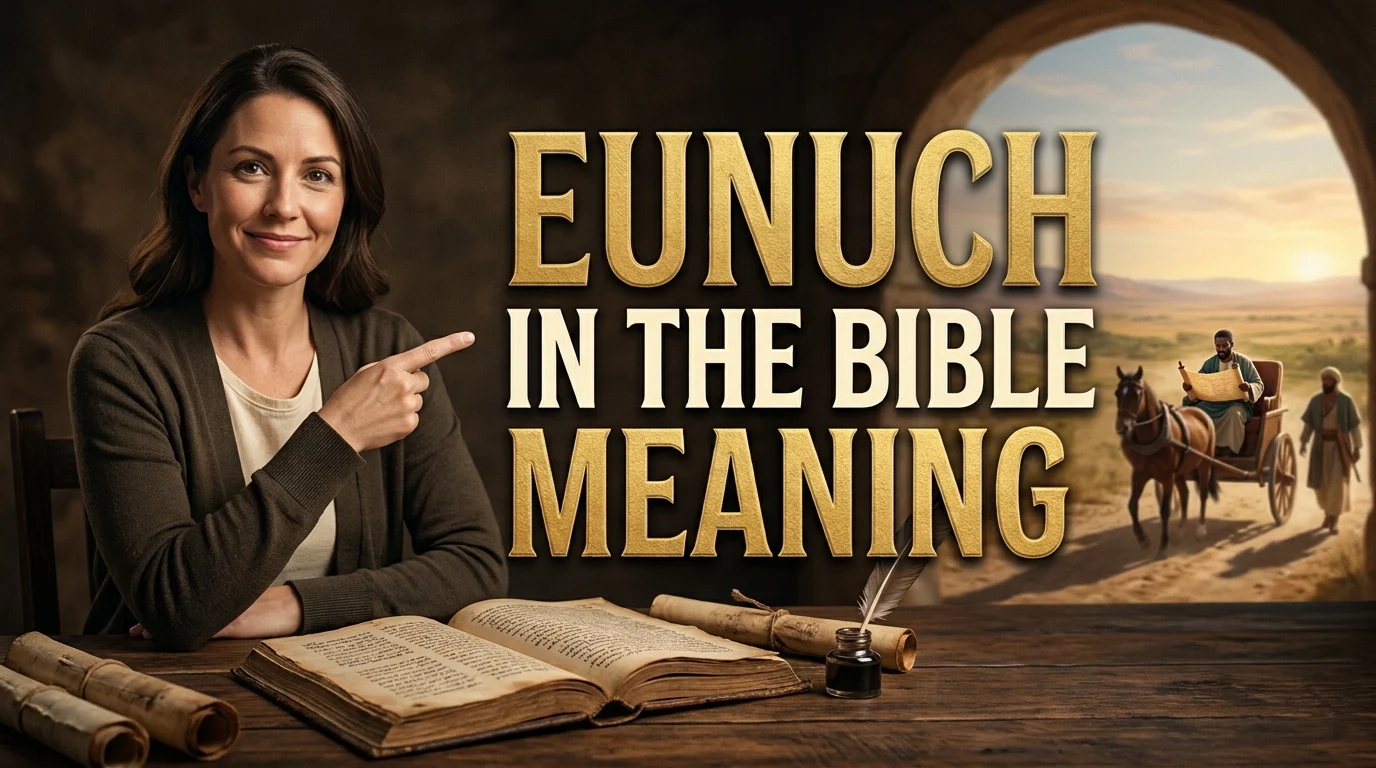
Another important example is the Ethiopian eunuch in Acts 8:26–39, an influential official who encounters Philip, hears the message about Jesus, and receives baptism. His story highlights the importance of faith and shows how the good news of Christ reaches people from different backgrounds.
What Does Eunuch in the Bible Meaning Really Point To?
When people search for the eunuch in the Bible meaning, they usually want a straightforward answer. In simple terms, a eunuch was often a man who had been castrated. This made him unable to father children. In the ancient Near East, rulers commonly used such men as trusted servants, especially around the royal household and the women’s quarters. Because a eunuch could not start his own dynasty, kings believed he would stay loyal and less likely to plot against the throne.
But the eunuch in the Bible meaning is broader than just physical castration. The Hebrew word saris (sometimes written cariyc) appears dozens of times in the Old Testament. It can mean a castrated man, yet it also functions as a title for a high court official or chamberlain. Not every saris was necessarily emasculated. Context decides the sense.
In the New Testament, the Greek word eunouchos carries similar flexibility. It literally suggests “bed-keeper” or “guardian of the bedchamber.” Over time it came to describe castrated men, men born unable to reproduce, or those who chose a celibate life for spiritual reasons.
So the eunuch in the Bible meaning can include:
- Men physically castrated by force or custom
- Men born with conditions that prevented fatherhood
- Court officials who held positions often filled by eunuchs
- People who voluntarily lived without marriage for the sake of God’s kingdom
This range matters. It keeps us from forcing one narrow definition onto every passage.
The Hebrew and Greek Words Behind Eunuch in the Bible Meaning
Looking at the original languages sharpens our grasp of the eunuch in the Bible meaning.
In Hebrew, saris likely came from an Akkadian term meaning something like “he who is at the head” or a trusted courtier. By the time of the biblical writers, it often pointed to someone who served closely in the palace. Sometimes the physical condition of castration is clear from the setting; other times the word simply marks an official of rank.
The Greek eunouchos appears in the Septuagint (the Greek translation of the Hebrew Scriptures) and in the New Testament. Jesus uses it in Matthew 19, and Luke records it in Acts 8 for the Ethiopian official. The word could describe:
- A man made sterile by surgery or injury
- A man born without the ability to father children
- A man who chose not to marry in order to focus fully on spiritual service
These distinctions help explain why some Bible translations render saris as “officer,” “chamberlain,” or “eunuch” depending on the verse. Potiphar in Genesis is called a saris of Pharaoh, yet he had a wife. That detail suggests the title could apply to a non-castrated official. In other places, such as the court of Esther or the prophecy about Babylon, the physical meaning fits better.
Understanding these word choices keeps the eunuch in the Bible meaning from becoming rigid or one-dimensional.
Why Did Ancient Cultures Rely on Eunuchs?
To appreciate the eunuch in the Bible meaning, it helps to know the cultural backdrop. In Egypt, Assyria, Babylon, Persia, and later in other empires, eunuchs filled important roles. Kings placed them in charge of harems because they posed no sexual threat to the royal women. They also served as messengers, treasurers, military officers, and personal attendants.
Their lack of family ties was seen as an advantage. Without sons to promote, a eunuch’s loyalty supposedly stayed with the king. History shows this was not always true some eunuchs gained enormous power and influence but the practice continued for centuries.
In Israel and Judah the picture is more mixed. The Law of Moses took a firm stance. Deuteronomy 23:1 states that no one emasculated by crushing or cutting could enter the assembly of the Lord. Leviticus also restricted men with certain physical defects from priestly service. These rules reflected the high value placed on bodily wholeness and the rejection of practices common in surrounding pagan religions, where self-mutilation sometimes honored false gods.
Yet even under the Law, eunuchs appear in the courts of Israelite and Judean kings. They are mentioned as attendants, officials, and sometimes as people of real influence. The tension between legal restriction and practical reality sets the stage for later prophetic hope.
Old Testament Passages That Shape Eunuch in the Bible Meaning
Several key texts give the eunuch in the Bible meaning its depth.
The Exclusion in Deuteronomy
Deuteronomy 23:1 is blunt. A man who had been made a eunuch could not join the full worshiping community of Israel. This exclusion carried social and religious weight. A eunuch might serve in the palace, but he stood outside the covenant assembly in a formal sense. The rule protected the community’s sense of purity and completeness, yet it left some men feeling permanently cut off.
The Promise in Isaiah
Isaiah 56 flips the script in a beautiful way. The prophet speaks to foreigners and eunuchs who feel excluded. He says, in essence, “Do not let the eunuch say, ‘I am a dry tree.’” God promises those who keep His Sabbaths, choose what pleases Him, and hold fast to His covenant something better than sons and daughters. He will give them a monument and an everlasting name inside His house a name that will never be cut off.
This passage is one of the most important for understanding the eunuch in the Bible meaning. It shows God’s heart moving beyond physical condition. Faithfulness and covenant loyalty matter more than the ability to produce biological heirs. The “dry tree” becomes fruitful in a spiritual sense. Many later readers, including the Ethiopian eunuch in Acts, would have known this promise.
Prophecies of Exile
Isaiah 39:7 and 2 Kings 20:18 contain a sobering word to King Hezekiah. Some of his descendants would be taken to Babylon and become eunuchs in the palace of the king there. The prediction came true during the Babylonian exile. Young men from the royal line and nobility were carried away and placed under the care of the chief of the eunuchs (see Daniel 1). Whether Daniel and his friends themselves were castrated is debated Scripture never states it outright—but the cultural practice makes it a real possibility. Their story still demonstrates that God can use people in foreign courts for His purposes, even under hard circumstances.
Eunuchs in the Royal Courts
Throughout the historical books we meet eunuchs as part of palace life. They appear in the courts of Ahab, Jehoram, and later Judean kings. In the book of Esther, eunuchs manage the harem and serve as trusted messengers. Hegai, Hathach, and others play quiet but important roles in the story of God’s deliverance of His people. These accounts show that the eunuch in the Bible meaning includes men who held real responsibility and sometimes acted with courage and integrity.
Jesus’ Teaching on Eunuchs and Its Impact
One of the most famous references comes from Jesus Himself. In Matthew 19 the disciples react strongly to Jesus’ teaching on marriage and divorce. They suggest that if the standard is so high, maybe it is better not to marry at all. Jesus replies with a statement that expands the eunuch in the Bible meaning in a profound way:
“For there are eunuchs who were born that way, and there are eunuchs who have been made eunuchs by others and there are those who choose to live like eunuchs for the sake of the kingdom of heaven. The one who can accept this should accept it.”
Jesus lists three categories:
- Those born as eunuchs men with congenital conditions that prevent normal sexual function or desire for marriage.
- Those made eunuchs by others men castrated by force, custom, or the actions of other people.
- Those who choose to live like eunuchs for the kingdom of heaven people who voluntarily remain single and celibate so they can devote themselves more fully to God’s work.
The third category is especially striking. Jesus treats voluntary celibacy as a legitimate and honorable calling when it is embraced for the sake of the kingdom. This does not elevate singleness above marriage; rather, it recognizes that some people receive a gift that frees them for undivided service. The apostle Paul later echoes a similar idea in 1 Corinthians 7 when he speaks of the advantages of remaining unmarried in certain situations.
Jesus’ words remove shame from the first two groups and give dignity to the third. The eunuch in the Bible meaning now includes people who, by birth, by force, or by free choice, live outside the usual pattern of marriage and family and who can still belong fully to the kingdom.
The Ethiopian Eunuch: A Living Example of Inclusion
No discussion of the eunuch in the Bible meaning is complete without the story in Acts 8. An angel directs Philip the evangelist to a desert road. There he meets an Ethiopian official—a eunuch of great authority under Candace, queen of the Ethiopians. This man had charge of the entire treasury. He had traveled to Jerusalem to worship and was now heading home, reading the prophet Isaiah in his chariot.
Philip hears him reading Isaiah 53, the passage about the suffering servant. The eunuch admits he does not understand. Philip joins him, explains that the text points to Jesus, and shares the good news. When they come to water, the eunuch asks what prevents him from being baptized. Nothing does. Both go down into the water, Philip baptizes him, and the Spirit takes Philip away. The eunuch continues on his way rejoicing.
This account is rich with meaning. The man was a Gentile, a high official, and a eunuch. Under the old covenant he would have faced barriers to full participation. Yet the gospel welcomes him without hesitation. His baptism becomes an early sign that the good news is for every nation and every kind of person. Tradition holds that he carried the Christian faith back to Ethiopia, helping plant the church in Africa.
The story also connects beautifully with Isaiah 56. The eunuch who once might have felt like a dry tree receives a place and a name in God’s family that can never be taken away. The eunuch in the Bible meaning here becomes a picture of radical grace and inclusion.
Spiritual Lessons from the Eunuch in the Bible Meaning
What can modern readers take away from all this?
First, physical condition or social status does not determine a person’s value before God. The Law once excluded eunuchs from the assembly, but the prophets and the New Testament open the door wide. Faithfulness and trust in God matter more than outward completeness.
Second, God often works through people who seem limited by the world’s standards. Daniel and his friends, whether or not they were physically eunuchs, served with excellence in a pagan court. The Ethiopian eunuch became a bridge for the gospel. Court officials who happened to be eunuchs sometimes showed remarkable courage, as when Ebed-Melech rescued Jeremiah from a cistern.
Third, Jesus legitimizes a life of singleness devoted to the kingdom. Not everyone is called to marriage. Those who remain single for the sake of undivided service to God follow a path Jesus Himself affirmed. This does not mean forced isolation or rejection of relationships; it means freedom to focus energy, time, and love in particular ways.
Fourth, the promise of an everlasting name still stands. In a culture that often measures success by descendants or legacy, Isaiah’s words remind us that God can give a lasting memorial that is better than sons and daughters. Spiritual fruit and faithfulness outlast biological lines.
Finally, the eunuch in the Bible meaning challenges any form of exclusion based on physical difference. The early church’s readiness to baptize the Ethiopian official sets a pattern of welcome that the church is still called to live out.
Common Questions About Court Officials and Celibacy
Many readers notice that some men called eunuchs in Scripture clearly married or held positions that did not require castration. This is where the flexible use of the term helps. The title could travel with the job even when the physical condition did not. In other cases the physical meaning is primary. Careful reading of context prevents confusion.
Others wonder whether Jesus was endorsing self-castration. The history of the church shows that a few individuals took His words too literally, but the mainstream understanding has always treated the third category as metaphorical—choosing celibacy rather than literal surgery. Jesus’ teaching upholds the goodness of the body and of marriage while allowing space for those called to a different path.
Practical Insights for Today
If you are single by choice, by circumstance, or by calling, the biblical discussion of eunuchs offers encouragement. Your life is not incomplete in God’s eyes. You can bear lasting fruit. You can receive a name and a place that endures.
If you have felt excluded because of physical difference, chronic illness, or any condition that sets you apart, Isaiah 56 and Acts 8 speak directly to you. God sees, welcomes, and values you.
If you serve in positions of trust and responsibility, the stories of court eunuchs remind us that integrity and loyalty still matter. God can use quiet faithfulness in high places.
And if you simply want to understand Scripture better, grasping the eunuch in the Bible meaning opens up richer reading of Genesis, the historical books, Isaiah, Daniel, Matthew, and Acts.
FAQ Section
What is the basic eunuch in the Bible meaning?
The basic meaning refers to a man who was castrated or otherwise unable to father children, often employed as a trusted court official. The term can also describe high-ranking officers who were not necessarily castrated, and in Jesus’ teaching it includes those who choose celibacy for the kingdom of heaven.
Does every mention of a eunuch mean the person was castrated?
No. The Hebrew word saris and the Greek eunouchos can function as titles for court officials. Context determines whether the physical condition is in view. Potiphar is one clear example where castration is unlikely.
Why does Deuteronomy exclude eunuchs from the assembly?
The Law required physical wholeness for full participation in the covenant community. The restriction also distanced Israel from pagan practices that sometimes involved self-mutilation. Later Scripture shows God expanding the welcome.
What does Isaiah 56 promise to eunuchs?
God promises faithful eunuchs a monument and an everlasting name within His house something better than sons and daughters. Their name will never be cut off. This is a powerful word of inclusion and hope.
How did Jesus expand the idea of eunuchs?
In Matthew 19:12 Jesus describes three kinds: those born that way, those made that way by others, and those who choose to live like eunuchs for the sake of the kingdom of heaven. He affirms voluntary celibacy as a valid calling for some.
Who was the Ethiopian eunuch and why is his story important?
He was a high treasury official serving the queen of Ethiopia. After hearing Philip explain Isaiah 53, he believed and was baptized. His story shows the gospel crossing ethnic, social, and physical barriers and becoming one of the earliest examples of Gentile inclusion.
Was the prophet Daniel a eunuch?
Scripture never states this explicitly. Daniel and his friends were placed under the chief of the eunuchs, and Isaiah had prophesied that some of Hezekiah’s line would become eunuchs in Babylon. Many later Jewish and Christian writers believed they were, but the Bible itself leaves the question open.
Conclusion:
The eunuch in the Bible meaning reaches far beyond a historical job description. It touches themes of exclusion and welcome, physical limitation and spiritual fruitfulness, forced circumstances and free choice, and the surprising ways God builds His kingdom. From the restrictions of Deuteronomy to the open door of Isaiah, from the courts of ancient kings to the desert road where Philip met an Ethiopian official, Scripture consistently points to a God who values faithfulness over outward completeness.
Jesus’ words in Matthew 19 give dignity to those born different, those harmed by others, and those who voluntarily set aside marriage for the sake of the kingdom. The baptism of the Ethiopian eunuch demonstrates that nothing neither nationality, social rank, nor physical condition can keep a seeking heart from the water of baptism and the joy of belonging.

James Parker is a Bible writer at GrasePath.com who loves exploring the deeper meaning of Scripture. He shares clear, trustworthy insights about biblical names, symbols, dreams, and spiritual teachings in simple language. His mission is to help readers strengthen their faith and better understand God’s Word every day.