Have you ever wondered why so many churches celebrate a special day fifty days after Easter? That day is Pentecost, and understanding the pentecost meaning in the bible opens a window into one of the most powerful moments in Christian history. It is far more than a calendar date. It marks the moment when the Holy Spirit came upon the early followers of Jesus, transforming a small group of believers into a bold, Spirit-filled community that would change the world.
In this in-depth exploration, we will unpack the biblical roots of Pentecost, its connection to the Jewish festival of Shavuot, the dramatic events of Acts chapter 2, and the lasting spiritual meaning it carries for believers today.
You are new to the faith or have attended church for years, discovering the true pentecost meaning in the bible can deepen your appreciation for the work of the Holy Spirit and the birth of the Church.
What Does Pentecost Mean in the Bible?
The word “Pentecost” comes from the Greek term pentēkostē, which simply means “fiftieth.” In the New Testament, it refers to the day that falls fifty days after the Passover Sabbath, or more precisely, fifty days after the resurrection of Jesus. The pentecost meaning in the bible is therefore tied both to a specific timing and to a profound spiritual event.
In the Old Testament, this same period was already set apart as a harvest festival. The Jewish people called it the Feast of Weeks, or Shavuot. Farmers brought the firstfruits of their wheat harvest to the temple as an offering of thanksgiving. Over time, Jewish tradition also linked Shavuot with the giving of the Law at Mount Sinai. So when the Holy Spirit arrived on the day of Pentecost in the book of Acts, the timing was rich with meaning. God was giving a new kind of “firstfruits” the Spirit Himself and establishing a new covenant written not on stone tablets but on human hearts.
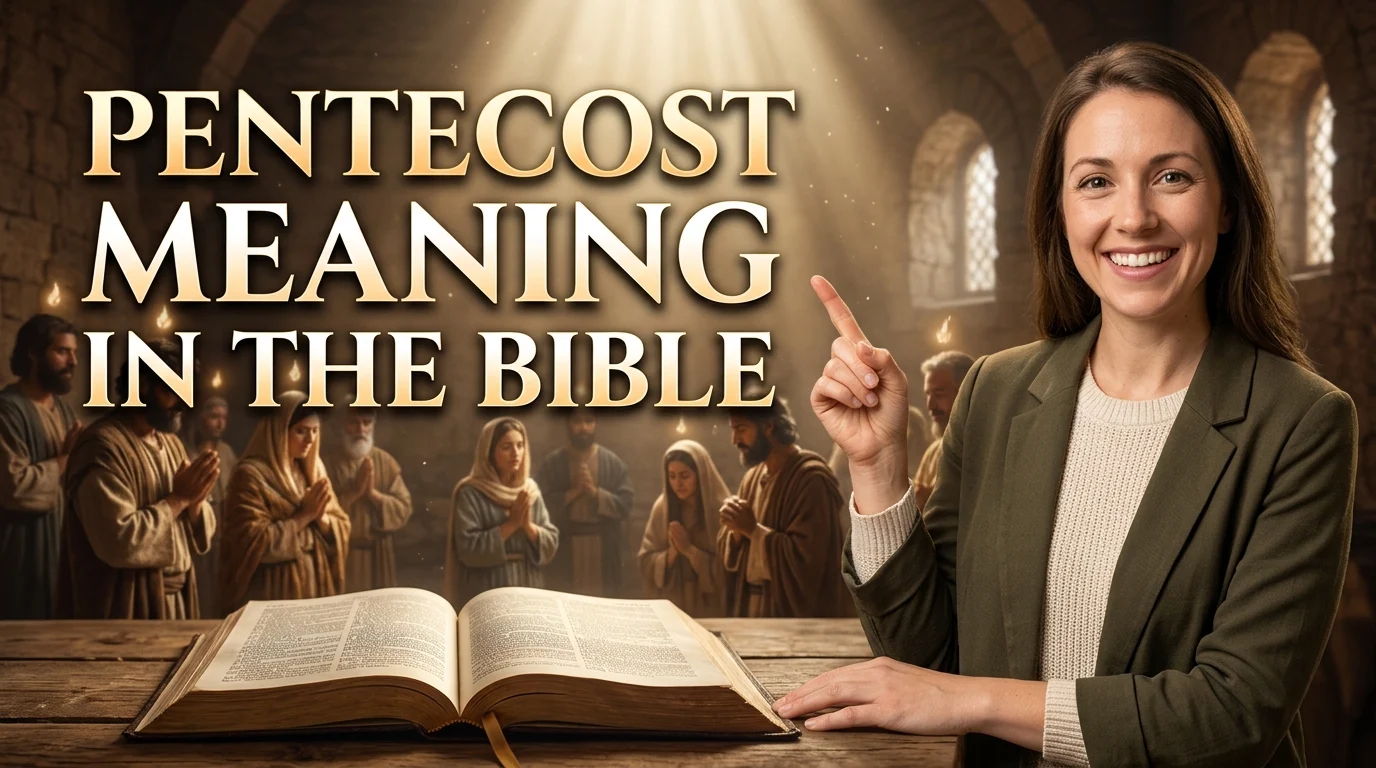
The New Testament account appears in Acts 2. Jesus had told His disciples to wait in Jerusalem for the promise of the Father. They obeyed. On the morning of Pentecost, while they were gathered in one place, a sound like a rushing wind filled the house. Tongues of fire rested on each of them, and they began to speak in other languages as the Spirit enabled them. A crowd of devout Jews from every nation under heaven heard the disciples declaring the wonders of God in their own native tongues. Peter stood up and preached the first Christian sermon, explaining that what they were seeing was the fulfillment of Joel’s prophecy: God was pouring out His Spirit on all people.
That single day marks the public birth of the Church. Three thousand people were baptized and added to the community of believers. The pentecost meaning in the bible is therefore inseparable from the outpouring of the Holy Spirit, the empowerment of ordinary individuals, and the beginning of the Church’s mission to the ends of the earth.
The Old Testament Roots of Pentecost
To grasp the full pentecost meaning in the bible, we must first look backward. The Feast of Weeks is described in several places in the Torah. Leviticus 23:15-21 instructs the Israelites to count seven full weeks from the day after the Sabbath of Passover, then present a new grain offering. Deuteronomy 16:9-12 adds that they were to rejoice before the Lord with their families, servants, and the foreigners living among them. The festival was both agricultural and spiritual—a time to thank God for the harvest and to remember His faithfulness.
By the time of Jesus, Jewish teachers had also connected Shavuot with the giving of the Torah at Sinai. According to tradition, the Law was given on the fiftieth day after the Exodus. The parallel is striking. At Sinai, God spoke amid fire, wind, and thunder, and the people received the written word. In Jerusalem on the day of Pentecost, God again spoke amid wind and fire, but this time the word was written on the hearts of believers through the indwelling Spirit.
This continuity helps us see that Pentecost is not a sudden invention of the early Church. It is the fulfillment of something God had been preparing for centuries. The harvest festival becomes a spiritual harvest. The giving of the Law becomes the giving of the Spirit who enables people to keep the deeper intent of the Law love for God and neighbor.
The Dramatic Events of Acts 2
The account in Acts 2 is one of the most vivid narratives in the New Testament. Luke, the author, carefully sets the scene. The disciples were all together in one place. Suddenly a sound came from heaven like a violent wind. Tongues as of fire appeared and rested on each of them. They were filled with the Holy Spirit and began to speak in other tongues.
The noise attracted a large crowd. Jerusalem was packed with pilgrims who had come for the feast. Luke lists the regions represented: Parthians, Medes, Elamites, residents of Mesopotamia, Judea, Cappadocia, Pontus, Asia, Phrygia, Pamphylia, Egypt, parts of Libya, visitors from Rome, Cretans, and Arabs. Each person heard the disciples speaking in his or her own language. The reaction was mixed—some were amazed, others accused the disciples of being drunk.
Peter’s response is masterful. He first dismisses the charge of drunkenness by noting the early hour. Then he quotes the prophet Joel at length, showing that the outpouring of the Spirit was the promised sign of the last days. He moves quickly to the life, death, and resurrection of Jesus of Nazareth. He declares that God has made this Jesus both Lord and Messiah. When the people are cut to the heart and ask what they should do, Peter answers with the classic invitation: “Repent and be baptized, every one of you, in the name of Jesus Christ for the forgiveness of your sins. And you will receive the gift of the Holy Spirit.”
Three thousand responded that day. The new community devoted itself to the apostles’ teaching, fellowship, the breaking of bread, and prayer. Signs and wonders followed. Believers shared their possessions. The Lord added to their number daily those who were being saved.
This sequence—waiting, receiving the Spirit, bold proclamation, repentance, baptism, and community life—forms the pattern that the Church has returned to again and again throughout history. Understanding this pattern is central to the pentecost meaning in the bible.
Key Themes in the Pentecost Meaning in the Bible
Several major themes emerge when we study Pentecost carefully.
First is the universal scope of the gospel. The list of nations in Acts 2 is deliberate. The Spirit’s gift of languages reverses the confusion of Babel. Where human pride once scattered the nations, the Spirit now gathers them to hear the same good news. Pentecost announces that the message of Jesus is for every people group.
Second is the empowerment of ordinary people. The disciples were not professional orators or trained theologians. They were fishermen, tax collectors, and ordinary individuals. Yet the Spirit enabled them to speak with clarity and power. The same Spirit continues to equip believers today for witness and service.
Third is the fulfillment of prophecy. Peter’s sermon rests heavily on Joel 2 and on the Psalms that speak of the Messiah. Pentecost is presented as the beginning of the “last days,” the era in which God pours out His Spirit on all flesh sons and daughters, young and old, servants and free.
Fourth is the birth of a new community. The early Church was marked by radical generosity, shared meals, continuous prayer, and mutual care. Pentecost is not only about individual experience; it is about the formation of a people who live differently because the Spirit lives in them.
Fifth is the ongoing presence of the Spirit. The gift given on that first Pentecost is not a one-time historical event locked in the past. The same Spirit continues to fill, guide, convict, comfort, and empower every generation of believers.
How Pentecost Connects to the Life of Jesus
Jesus Himself prepared the way for Pentecost. In John 14–16 He promised that the Father would send another Helper, the Spirit of truth. He told the disciples it was better for them that He go away, because only then would the Spirit come. After the resurrection He breathed on them and said, “Receive the Holy Spirit.” Yet the full public outpouring waited until the day of Pentecost.
The timing is significant. Jesus’ death and resurrection occurred during Passover. His ascension took place forty days later. Pentecost followed ten days after that. The fifty-day period links the sacrifice of the true Passover Lamb with the giving of the Spirit who applies the benefits of that sacrifice to every believer.
In a real sense, Pentecost is the completion of the work Jesus began. He finished the work of redemption on the cross and in the empty tomb. The Spirit now applies that finished work, regenerating hearts, sealing believers, and empowering them for mission.
Spiritual Significance for Believers Today
What does the pentecost meaning in the bible mean for ordinary Christians living in the twenty-first century? Several practical implications stand out.
It reminds us that Christianity is a Spirit-empowered faith. We are not left to follow Jesus in our own strength. The same Spirit who filled the upper room is available to every believer who asks. Prayer for a fresh filling of the Spirit remains a vital practice.
It calls us to bold witness. The disciples who once hid behind locked doors became fearless preachers. Pentecost challenges us to move from private faith to public testimony, trusting that the Spirit will give us the words and the courage we need.
It invites us into genuine community. The early Church’s shared life was not an optional extra; it was the natural fruit of the Spirit’s presence. In a culture marked by isolation, Pentecost points us toward intentional fellowship, mutual care, and radical generosity.
It keeps us expectant. The Spirit still speaks, still convicts, still heals, still guides. While we do not demand dramatic manifestations, we remain open to the Spirit’s surprising work in our gatherings and in our daily lives.
It roots us in the larger story of God’s redemptive plan. From Sinai to Jerusalem to our own local congregations, God is forming a people for Himself. Pentecost places us inside that ongoing story.
Common Misunderstandings About Pentecost
Over the centuries, certain misunderstandings have clouded the pentecost meaning in the bible. One is the idea that the gift of tongues is the only or the necessary evidence of the Spirit’s filling. Acts shows a variety of evidences bold preaching, generosity, unity, miracles, and yes, languages. The Spirit distributes gifts as He wills.
Another misunderstanding is that Pentecost was only for the apostolic age. The promise Peter quoted from Joel is for “all who are far off,” including future generations. The Spirit continues to be given to all who repent and believe.
A third error is treating Pentecost as merely a historical marker with little relevance for daily discipleship. In reality, the Spirit who came that day is the same Spirit who produces the fruit of love, joy, peace, patience, kindness, goodness, faithfulness, gentleness, and self-control in believers today.
Living Out the Pentecost Meaning in Daily Life
How can we practically respond to the pentecost meaning in the bible?
Begin each day by inviting the Holy Spirit to fill you afresh. Simple prayers such as “Come, Holy Spirit” or “Fill me again today” keep us dependent rather than self-reliant.
Stay rooted in Scripture. The Spirit speaks primarily through the written word He inspired. Regular reading and meditation keep us aligned with His voice.
Pursue genuine Christian community. Join a small group, serve alongside other believers, practice hospitality, and share both joys and struggles. The Spirit loves to work in the context of committed relationships.
Be ready to speak about Jesus when opportunities arise. You do not need a polished presentation. Simply share what God has done in your life and trust the Spirit to use your ordinary words.
Cultivate the fruit of the Spirit. Ask God to grow love, joy, peace, and the other virtues in you. Character transformation is one of the clearest signs of the Spirit’s ongoing work.
Remain open to the Spirit’s leading in unexpected ways. Sometimes He prompts us to pray for a stranger, give generously, or take a step of faith that feels risky. Learning to recognize and obey those promptings is part of walking in the Spirit.
Historical Celebrations of Pentecost Through the Centuries
The early Church quickly began to celebrate Pentecost as an annual feast. By the second century it was already a recognized day of rejoicing. In the Eastern Orthodox tradition, Pentecost is one of the twelve great feasts and is sometimes called the Feast of the Holy Trinity because the full revelation of Father, Son, and Spirit is celebrated.
In Western Christianity the day became associated with the color red, symbolizing the fire of the Spirit, and with special hymns and readings focused on the Acts 2 narrative. Many churches still hold special services, baptisms, and confirmations on or near Pentecost Sunday.
Throughout history, periods of spiritual renewal have often been linked with a fresh emphasis on the Holy Spirit. The Methodist revival under John Wesley, the various Pentecostal and charismatic movements of the twentieth century, and countless local awakenings have all drawn strength from the biblical account of Pentecost. Each generation rediscovers that the same Spirit who came then is still at work now.
The Broader Biblical Story of the Holy Spirit
Pentecost does not stand alone. The Spirit is present from the opening pages of Scripture. In Genesis 1 the Spirit of God hovers over the waters. In the lives of the judges, the Spirit comes upon individuals for specific tasks. The prophets speak of a coming day when the Spirit will be poured out on all flesh. Jesus is conceived by the Spirit, anointed by the Spirit at His baptism, and led by the Spirit throughout His ministry.
Pentecost is therefore the climactic moment when the Spirit who had been active in limited and temporary ways is now given permanently and universally to all who belong to Christ. The Church becomes the new temple in which the Spirit dwells. Individual believers become living stones in that temple.
This larger story protects us from isolating Pentecost as a strange or isolated event. It is the natural outworking of God’s long plan to dwell with His people.
Practical Ways Churches Can Honor the Meaning of Pentecost
Local congregations can keep the pentecost meaning in the bible alive in several simple ways.
Teach regularly on the person and work of the Holy Spirit so that believers grow in understanding and expectancy.
Create space in worship services for prayer, waiting, and openness to the Spirit’s leading rather than rushing through a tightly controlled program.
Celebrate the diversity of gifts within the body. Encourage every member to discover and use the gifts the Spirit has given.
Practice intentional hospitality that reflects the early Church’s radical welcome of people from every background.
Hold special services or teaching series around the season of Pentecost that focus on mission, empowerment, and the birth of the Church.
Encourage personal stories of how the Spirit has worked in people’s lives. Testimony builds faith and reminds the community that God is still active.
Conclusion:
The pentecost meaning in the bible is rich, multi-layered, and deeply practical. It is the story of God keeping His promise, pouring out His Spirit, empowering ordinary people, and launching a global movement that continues to this day. From the ancient harvest festival of Shavuot to the wind and fire of Acts 2, from the first Christian sermon to the ongoing life of the Church, Pentecost stands as a pivotal moment in redemptive history.
When we grasp that meaning, we are invited to live differently. We wait on the Spirit rather than relying solely on our own strength. Speak boldly about Jesus. We form communities marked by generosity and love. Remain open to the surprising work of God in our generation.
Frequently Asked Questions About Pentecost Meaning in the Bible
What is the simple definition of Pentecost in the Bible?
Pentecost is the day, fifty days after Jesus’ resurrection, when the Holy Spirit was poured out on the disciples in Jerusalem, empowering them to preach the gospel and marking the public beginning of the Church.
Is Pentecost the same as the Jewish feast of Shavuot?
Yes. Pentecost is the Greek name for the Jewish Feast of Weeks, or Shavuot. The early Christians experienced the outpouring of the Spirit on the very day the Jewish people were celebrating that feast.
Why did the Holy Spirit come as wind and fire?
Wind and fire were familiar biblical symbols of God’s powerful presence. At Sinai, God appeared in fire and storm. On Pentecost, the same God manifested His presence in ways the disciples and the watching crowd would recognize as divine.
Did everyone who received the Spirit speak in tongues?
On that first day many did, as a sign that the gospel was for every language group. Later accounts in Acts show other evidences of the Spirit’s filling, such as boldness, prophecy, and changed lives. The Spirit distributes gifts as He chooses.
How is Pentecost connected to Jesus’ promise of the Helper?
In John 14–16 Jesus promised that the Father would send the Spirit of truth after He returned to heaven. Pentecost is the fulfillment of that specific promise.
Should Christians still celebrate Pentecost today?
Many churches do, using the day to focus on the Holy Spirit, the birth of the Church, and the ongoing call to mission. Whether or not a formal celebration is held, the truths of Pentecost remain central to Christian life.
What is the main takeaway from the Pentecost story for modern believers?
The main takeaway is that the same Holy Spirit who empowered the first disciples is available to every believer today. We are called to wait on Him, receive His filling, and step out in faith to share the good news of Jesus with the world.

Hi, I’m Daniel Foster, a writer at GrasePath.com. I enjoy exploring the deeper meanings of biblical words, names, symbols, and verses to help readers better understand Scripture. My goal is to present accurate, easy-to-read, and well-researched content that makes the Bible more accessible for everyone. Through every article, I strive to provide clear explanations, meaningful insights, and trustworthy information to support your faith and Bible study journey.