The Bible is filled with powerful themes that reveal God’s love, mercy, and desire to restore people to a right relationship with Him. One of the most important of these themes is redemption, which means being rescued, delivered, or set free from something that holds a person captive. The redemption meaning in the Bible is especially connected to God’s plan to save humanity from sin and bring people back into a relationship with Him.
In the Old Testament, redemption often involved freeing someone from slavery, rescuing people from danger, or paying a price to release someone from an obligation. These examples help explain the deeper spiritual meaning of redemption in the New Testament.
Christians believe that Jesus Christ made redemption possible through His death and resurrection, offering forgiveness and freedom from the power of sin. Ephesians 1:7 teaches that believers have redemption through Christ’s blood and the forgiveness of sins according to God’s grace.
What Is the Redemption Meaning in the Bible?
At its core, the redemption meaning in the Bible refers to being bought back, rescued, or set free from bondage, sin, or captivity usually through the payment of a price. Think of it like a ransom. In the ancient world, if someone was a slave or a prisoner of war, they could be “redeemed” if someone paid the price to buy their freedom.
The Bible takes that everyday concept and turns it into something eternal. Instead of paying money to free a slave, God pays the ultimate price through Jesus Christ to free humanity from the slavery of sin and death.
Here’s a simple way to think about it:
- Redemption = being bought back from a bad situation
- The price = something valuable given in exchange for freedom
- The result = freedom, restoration, and a new relationship with God
So when Christians talk about redemption, they’re not just talking about forgiveness. They’re talking about a full rescue mission one that changes your identity, your future, and your relationship with your Creator.
The Original Hebrew and Greek Words Behind Redemption
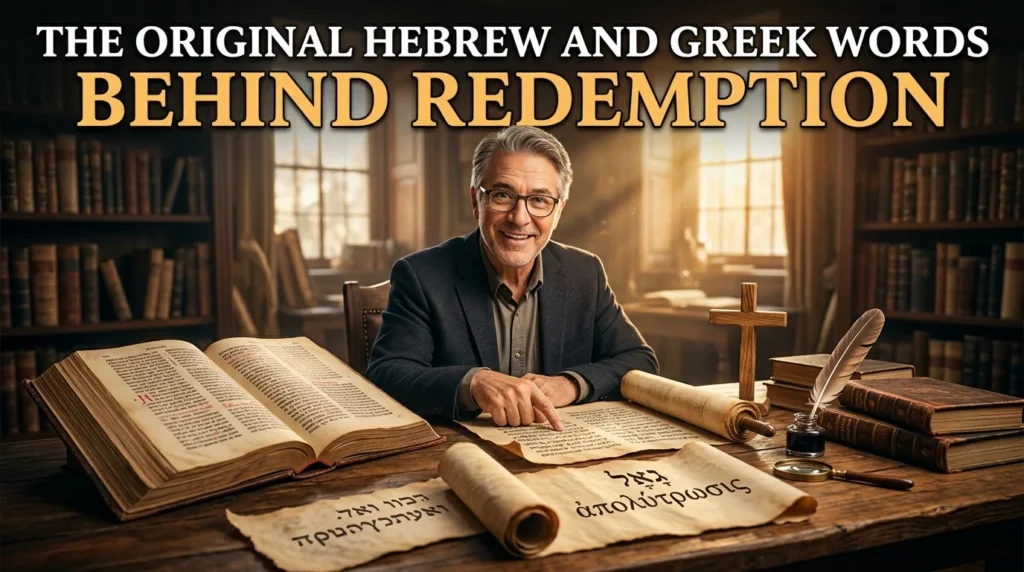
To really grasp the depth of this concept, it helps to look at the original languages the Bible was written in.
Hebrew Words for Redemption
In the Old Testament, two main Hebrew words are translated as “redeem” or “redemption”:
- Ga’al (גָּאַל) This word describes a “kinsman-redeemer,” a close relative who had the legal right and responsibility to rescue a family member from slavery, poverty, or a lost inheritance. You see this beautifully illustrated in the Book of Ruth, where Boaz acts as a kinsman-redeemer for Ruth and Naomi.
- Padah (פָּדָה) This word carries the idea of paying a ransom price to release someone from bondage or danger. It’s often used to describe God rescuing Israel from slavery in Egypt.
Greek Words for Redemption
In the New Testament, the Greek language adds even more depth:
- Agorazo (ἀγοράζω) Meaning “to buy in the marketplace,” this word was used for purchasing a slave and setting them free.
- Exagorazo (ἐξαγοράζω) This intensifies the idea, meaning to “buy out” or “buy back completely,” removing someone entirely from the marketplace of slavery.
- Lytroo (λυτρόω) This word means to release someone by paying a ransom, and it’s directly connected to the price Jesus paid on the cross.
Understanding these original words shows us that redemption isn’t a vague, feel-good idea. It’s a concrete, costly act of rescue.
Redemption in the Old Testament: The Foundation of the Story
Long before Jesus arrived on the scene, the Old Testament was already laying the groundwork for what redemption would ultimately mean.
The Exodus: Israel’s Redemption from Slavery
One of the clearest pictures of redemption in the Old Testament is the Exodus story. The Israelites were enslaved in Egypt for over 400 years. God heard their cries, sent Moses, and delivered them through the Red Sea a dramatic, unforgettable act of rescue.
This event became the defining image of redemption for the entire nation of Israel. Every year at Passover, Jewish families would retell this story to remind themselves that they were once slaves, but God redeemed them with “a mighty hand and an outstretched arm.”
The Kinsman-Redeemer System
In ancient Israelite culture, if a person fell into debt, lost their land, or became enslaved, a close relative (a “kinsman-redeemer”) had the responsibility to step in and buy back what was lost. This wasn’t optional charity it was a covenant obligation woven into the fabric of Israelite law.
The Book of Ruth gives us a touching real-life example. After Naomi and Ruth lose everything, Boaz a relative of Naomi’s late husband steps in to redeem their land and marry Ruth, restoring their family’s future. This story isn’t just a sweet romance; it’s a foreshadowing of a much bigger redemption story to come.
Redemption in the Sacrificial System
The Old Testament sacrificial system also pointed toward redemption. Animal sacrifices were offered to atone for sin, symbolically transferring guilt and paying a price for wrongdoing. These sacrifices couldn’t permanently remove sin, but they pointed forward to a final, perfect sacrifice that would.
Redemption in the New Testament: Jesus as the Ultimate Redeemer
If the Old Testament plants the seeds of redemption, the New Testament shows the full harvest. Everything points to one central truth: Jesus Christ is humanity’s ultimate Redeemer.
The Price of Redemption
According to the New Testament, humanity is enslaved not by Egypt or Babylon, but by sin and death. Every person is born into this spiritual bondage, unable to free themselves no matter how hard they try.
The price to break this bondage wasn’t silver or gold. It was the life of Jesus Christ, given willingly on the cross. First Peter makes this explicit, describing believers as ransomed not with perishable things like silver or gold but with the precious life of Christ, offered like a spotless sacrificial lamb.
This is the heartbeat of the gospel: Jesus paid a debt He didn’t owe because we owed a debt we couldn’t pay.
Redemption Through the Cross
The cross is where redemption becomes personal. Jesus didn’t just teach about freedom He purchased it with His own life. Paul’s letter to the Ephesians captures this directly, describing how believers have redemption through Christ’s blood, resulting in the forgiveness of sins according to the richness of God’s grace.
Notice the connection here: redemption and forgiveness go hand in hand. When you’re redeemed, your sins aren’t just overlooked they’re paid for and removed.
Redemption and Adoption
One of the most beautiful aspects of New Testament redemption is that it doesn’t stop at rescue. It leads to adoption. Once you’re redeemed, you’re not just freed from slavery you’re welcomed into God’s family as a son or daughter. Paul explains this in Galatians, describing how God sent His Son to redeem those under the law so that believers could receive full adoption as His children.
This means redemption isn’t just about escaping something bad. It’s about being welcomed into something incredible a permanent place in God’s family.
Key Aspects of Biblical Redemption
Let’s break down the major components that make up the full picture of redemption in Scripture.
1. Redemption Requires a Price
Nothing about redemption is cheap or automatic. In every biblical example, something valuable is exchanged:
- Israel’s redemption from Egypt came through God’s mighty power and the blood of the Passover lamb
- Ruth and Naomi’s redemption came through Boaz’s willingness to take on their debt and responsibility
- Humanity’s redemption came through the death of Jesus Christ
2. Redemption Involves a Redeemer
Someone has to step in and act. You can’t redeem yourself. In the Old Testament, it was often a close relative. In the New Testament, it’s Jesus fully God and fully human who qualifies as the perfect Redeemer because He shares in our humanity while remaining sinless.
3. Redemption Results in Freedom
The whole point of redemption is release. Freedom from slavery. From sin’s power. Freedom from guilt and shame. Freedom from the fear of death.
4. Redemption Leads to a New Identity
Once redeemed, your identity changes. You’re no longer defined by your past mistakes, your failures, or your former way of life. You become a new creation, part of God’s family, with a fresh purpose and calling.
5. Redemption Is Both Personal and Cosmic
Biblical redemption isn’t only about individual souls being saved it’s part of a much bigger story. Romans describes creation itself groaning, waiting for the day it will be liberated from decay and brought into the freedom that belongs to God’s children. In other words, redemption is God’s plan to eventually restore all of creation, not just human hearts.
Real-Life Examples and Applications of Redemption
Understanding redemption theologically is important, but let’s bring it down to earth. What does this actually look like in real life?
Example 1: The Prodigal Son
Jesus’ parable of the prodigal son is a redemption story in miniature. A son takes his inheritance, wastes it on reckless living, and ends up broke and desperate. When he finally returns home, expecting rejection, his father runs to meet him, embraces him, and throws a celebration. This story captures redemption’s heart: no matter how far you’ve wandered, restoration is possible.
Example 2: The Woman at the Well
In John’s Gospel, Jesus meets a Samaritan woman with a complicated past five failed marriages and a current relationship outside of marriage. Instead of condemning her, Jesus offers her “living water,” a symbol of the spiritual freedom and new life He offers. She leaves that encounter transformed, running to tell her whole town about Him.
Example 3: The Apostle Paul
Before his conversion, Paul (then called Saul) persecuted Christians, even approving of their executions. Yet after encountering Jesus on the road to Damascus, he became one of the greatest missionaries in history. His story shows that redemption isn’t limited by how “far gone” someone seems to be.
Applying Redemption to Everyday Life
You don’t need a dramatic backstory to experience redemption. Here are practical ways this truth applies today:
- When you feel shame over past mistakes redemption reminds you that your identity isn’t defined by your worst moments.
- When you feel stuck in unhealthy patterns redemption offers the power to break free, not through willpower alone, but through a relationship with God.
- When you feel unworthy of love redemption shows that you were valuable enough for Jesus to pay the ultimate price for you.
- When you’re helping someone else who feels hopeless sharing the message of redemption can offer them genuine hope.
Why the Redemption Meaning in the Bible Still Matters Today
It’s easy to think of redemption as an ancient, abstract theological concept. But its relevance hasn’t faded one bit.
We live in a culture obsessed with self-improvement, second chances, and “glow-up” stories. Yet so many people still feel trapped by addiction, broken relationships, financial stress, anxiety, or regret. The biblical concept of redemption speaks directly into that exhaustion. It says: you don’t have to fix yourself before you’re loved. You don’t have to earn your way back. Someone has already paid the price to bring you home.
This is what separates biblical redemption from every self-help philosophy out there. It’s not about trying harder. It’s about receiving a gift that’s already been purchased on your behalf.
Common Symbols and Themes Connected to Redemption
To deepen your understanding, here are a few symbols and themes the Bible uses alongside redemption:
- The Passover Lamb a symbol of substitutionary sacrifice, later fulfilled by Jesus as “the Lamb of God”
- The Red Sea Crossing a picture of moving from slavery into freedom
- The Kinsman-Redeemer a legal and familial role showing redemption as an act of covenant love
- The Cross the ultimate symbol of the price paid for humanity’s redemption
- The Empty Tomb proof that redemption leads not just to forgiveness, but to new life
Frequently Asked Questions About Redemption in the Bible
1. What does redemption mean in the Bible in simple terms?
Redemption in the Bible means being bought back or rescued from slavery, sin, or captivity through a price paid on your behalf. In Christian theology, this price was paid by Jesus through His death on the cross.
2. What is the difference between redemption and salvation?
Salvation is the broader term for being rescued from sin and its consequences, while redemption specifically emphasizes the price paid to secure that rescue. Think of salvation as the overall rescue and redemption as the “how” behind it.
3. Who is the redeemer in the Bible?
In the Old Testament, redeemers were often close relatives who rescued family members from debt or slavery, like Boaz in the Book of Ruth. In the New Testament, Jesus Christ is presented as the ultimate Redeemer of humanity.
4. What is a kinsman-redeemer in the Bible?
A kinsman-redeemer was a close male relative in ancient Israel who had the legal responsibility to rescue a family member from poverty, slavery, or a lost inheritance. This role foreshadows Jesus’ role as humanity’s Redeemer.
5. What Bible verse best explains redemption?
Ephesians 1:7 is one of the clearest verses, explaining that believers have redemption through Christ’s blood, resulting in the forgiveness of sins according to God’s abundant grace.
6. Can anyone be redeemed, no matter what they’ve done?
Yes. Biblical stories like the prodigal son and the Apostle Paul show that redemption is available to anyone, regardless of their past. The invitation to be redeemed isn’t based on how good someone has been, but on God’s grace and willingness to offer it.
7. How is redemption connected to forgiveness of sins?
Redemption and forgiveness are closely linked but not identical. Redemption is the act of being bought back through a price paid, while forgiveness is the result the wiping away of guilt and sin that redemption makes possible.
Final Thoughts:
At the end of the day, the redemption meaning in the Bible isn’t just an interesting theological topic to study it’s an invitation. It’s the story of a God who saw humanity trapped in slavery to sin, refused to leave us there, and paid an unimaginable price to bring us home.
From the Exodus out of Egypt to the empty tomb on Easter morning, the entire Bible tells one continuous story: God rescues, restores, and redeems. Whether you’re wrestling with guilt, feeling distant from God, or simply curious about what Christianity teaches, understanding redemption offers something rare in this world real hope, freely given, and fully paid for.

Hi, I’m Daniel Foster, a writer at GrasePath.com. I enjoy exploring the deeper meanings of biblical words, names, symbols, and verses to help readers better understand Scripture. My goal is to present accurate, easy-to-read, and well-researched content that makes the Bible more accessible for everyone. Through every article, I strive to provide clear explanations, meaningful insights, and trustworthy information to support your faith and Bible study journey.