Some biblical words carry powerful meanings that can be difficult to understand without exploring their spiritual context. “Reprobates” is one such word, appearing in discussions about sin, conscience, judgment, and a person’s relationship with God. If you have encountered this term while reading Scripture, understanding its meaning can help you better grasp the seriousness of the Bible’s warnings and its call to live according to God’s truth.
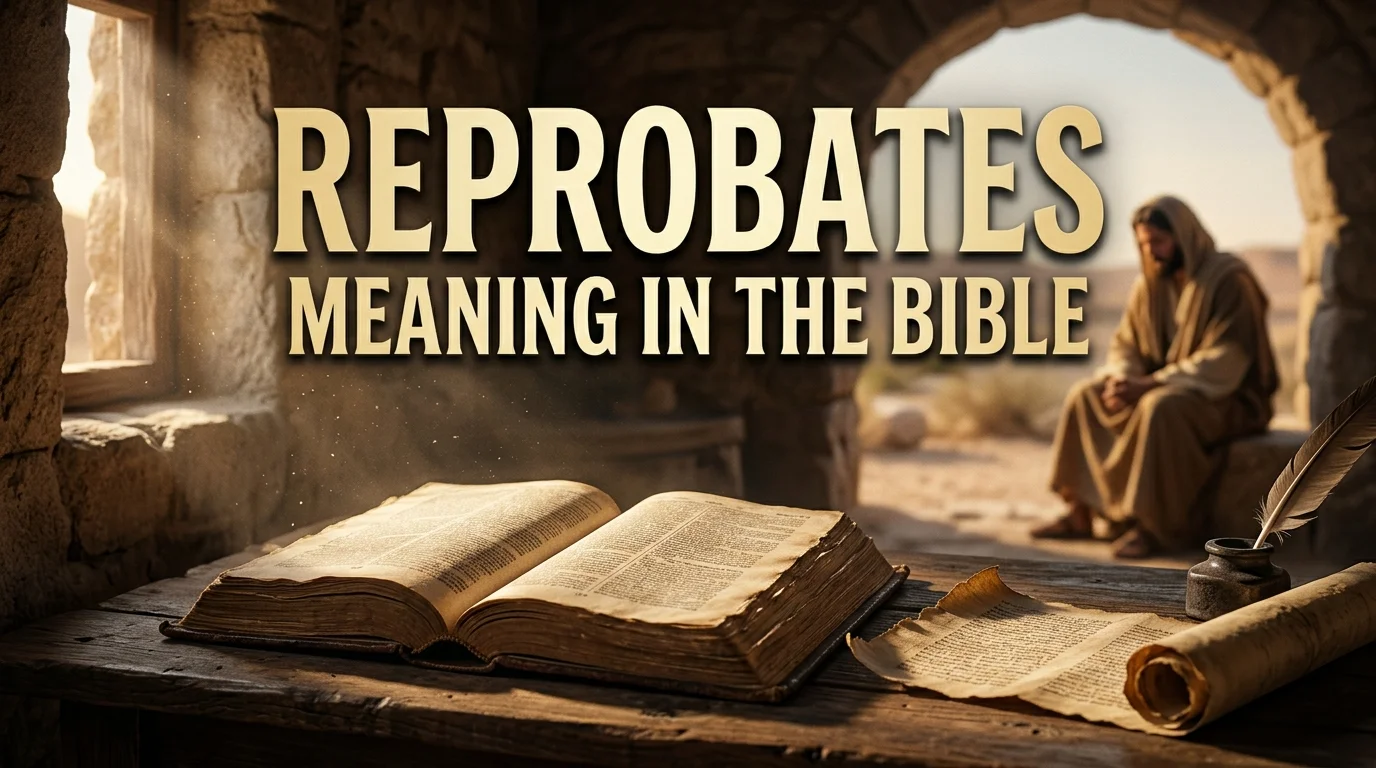
In the Bible, reprobates generally refers to people who have been rejected or found unworthy after being tested, particularly in a spiritual or moral sense. The exact meaning depends on the passage and Bible translation. In Romans 1:28, the King James Version describes people who did not retain God in their knowledge as having a “reprobate mind.” This phrase refers to a corrupted or disapproved way of thinking associated with rejecting God’s truth and choosing unrighteous behavior. It is not simply a label for someone who makes an ordinary mistake or struggles with temptation.
The word also appears in 2 Corinthians 13:5, where Paul encourages readers to examine themselves to see whether they are in the faith. This context highlights the importance of honest self-examination and spiritual responsibility.
What Does the Word Reprobate Actually Mean?
In everyday English, “reprobate” often describes someone who is thoroughly immoral or beyond reform. In the Bible the word carries a more precise sense rooted in testing and rejection.
The Greek term behind most New Testament uses is adokimos. It is the negative form of dokimos, which means “approved after testing” or “genuine.” So adokimos means “not standing the test,” “unapproved,” “rejected,” or “worthless after examination.” Think of a metal that fails the refiners’ fire or a coin that turns out counterfeit. Once tested and found lacking, it is set aside.
In the Old Testament the concept appears in Jeremiah 6:30. The prophet describes the people of Judah as “reprobate silver” because the Lord has rejected them. The refining process has taken place, yet what remains is dross rather than pure metal. The image is vivid: repeated opportunities for purification have been given, but the material refuses to yield genuine silver.
This testing-and-rejection idea travels into the New Testament. When Scripture speaks of a reprobate mind or reprobates, it is describing people or states of mind that have been examined by God’s standard and found wanting. The failure is not random; it follows a pattern of refusing to acknowledge God and His truth.
Reprobates Meaning in the Bible Through Key Passages
Several passages use the word or the underlying Greek term. Looking at them in context keeps us from twisting the meaning.
Romans 1 and the Reprobate Mind
Romans 1:28 is the most well-known reference. Paul writes that because people did not think it worthwhile to retain the knowledge of God, “God gave them over to a reprobate mind, to do those things which are not convenient.”
Notice the sequence. First comes the human choice: they suppress the truth they already know. Creation itself displays God’s power and divine nature, leaving them without excuse. Instead of honoring Him or giving thanks, they exchange His glory for images and His truth for a lie. As a result, God hands them over. The “reprobate mind” is both a judgment and a consequence. It is a mind that no longer functions according to moral reality. What should be obvious becomes twisted. Actions that are unnatural and destructive begin to seem normal or even celebrated.
The surrounding verses list the downward spiral—impurity, dishonorable passions, and a long catalog of further sins. The reprobate mind does not invent new sins so much as it loses the capacity to call them wrong. Conscience grows dull. Approval of evil becomes common.
Testing Ourselves in 2 Corinthians 13
In 2 Corinthians 13:5–7 Paul turns the same word toward the church itself: “Examine yourselves, whether ye be in the faith; prove your own selves. Know ye not your own selves, how that Jesus Christ is in you, except ye be reprobates?”
Here the term is almost a challenge. Paul urges believers to test their own profession. The presence of Christ is the decisive proof. If Christ is not in them, they are reprobates—unapproved, failing the test of genuine faith. Paul quickly adds that he hopes the Corinthians will realize he and his companions are not reprobates. The word therefore can apply both to those outside the faith and as a sober warning inside the community.
False Teachers and Moral Failure
2 Timothy 3:8 compares certain men to Jannes and Jambres, the magicians who opposed Moses. These men “resist the truth: men of corrupt minds, reprobate concerning the faith.” Titus 1:16 adds another layer: people who claim to know God yet deny Him by their works are “unto every good work reprobate.” Profession without corresponding life reveals the failure. When tested against the standard of truth and good works, they do not pass.
The Athletic Image and the Land That Fails
In 1 Corinthians 9:27 Paul uses a related sense when he disciplines his body so that after preaching to others he himself will not be a “castaway” (the same Greek word). The picture is of an athlete disqualified for failing to meet the rules of the contest. Hebrews 6:8 applies the term to land that receives rain yet produces only thorns and thistles. Such ground is “rejected” and near to being cursed. The warning is serious: continued unfruitfulness after receiving God’s kindness places a person or community in dangerous territory.
How Reprobation Relates to God’s Sovereignty and Human Responsibility
The biblical language of reprobates does not require us to settle every debate about election and free will before we can understand the texts. Still, the doctrine of reprobation in systematic theology grows out of these passages and related ones.
Some traditions emphasize that God actively elects some to salvation and, in the same eternal plan, passes over others, leaving them in their sin. Others stress that reprobation is primarily the just response to persistent unbelief. In either case the biblical picture is consistent on two points. First, God is never the author of sin. People are held responsible for suppressing truth they already possess. Second, the hardening described is real. When God “gives them over,” He is not forcing evil desires that were absent; He is removing restraints and allowing the chosen path to reach its natural end.
The practical result is the same: a mind and life that fail the test of God’s approval. The warning is not meant to produce despair for those who still hear and respond, but to awaken urgency. Soft hearts can become hard. Repeated rejection of light can leave a person walking in deeper darkness.
Characteristics of a Reprobate Condition
Scripture paints a recognizable picture without giving us a checklist for declaring any living person beyond hope. Common marks include:
- Persistent refusal to acknowledge God or retain His truth in knowledge.
- Exchange of the truth of God for lies, whether philosophical, religious, or moral.
- A darkened understanding that confuses good and evil.
- Approval of practices Scripture calls sinful, not merely personal struggle but public celebration.
- Profession of faith that is contradicted by lifestyle and works.
- Resistance to correction and truth, often accompanied by hostility toward those who hold it.
These traits appear in varying degrees. The full “reprobate mind” of Romans 1 is an advanced stage. Earlier stages still allow room for repentance. The existence of warning passages themselves shows that God continues to call people back.
Why the Concept Matters for Everyday Faith
Understanding reprobates meaning in the bible guards us against two opposite errors. One is casual assumption that everyone who claims Christian identity is automatically approved. Paul told the Corinthians to examine themselves. Self-deception is possible. The other error is despair or harsh judgment of others. Only God sees the heart fully. Our role is to hold out the gospel, live consistently, and leave final judgment to Him.
The theme also highlights the kindness of God. He does not immediately abandon those who reject Him. Romans 1 shows a process—three “God gave them over” statements that escalate. Patience precedes the fuller giving over. That patience is still operating in the world today. Every opportunity to hear the gospel, every conviction of conscience, every moment of moral clarity is evidence of residual mercy.
For those who sense their own hearts growing cold, the remedy is not self-effort alone but returning to the One who alone can renew the mind. Romans 12:2 speaks of transformation by the renewing of the mind. The opposite of a reprobate mind is a mind being conformed to Christ.
Practical Ways to Guard Against a Hardened Heart
Awareness of the danger can produce healthy vigilance. Consider these practices drawn from the wider teaching of Scripture:
- Stay close to the Word. Regular exposure to truth keeps the conscience sharp.
- Practice honest self-examination without descending into morbid introspection. Ask whether Christ is truly present and whether fruit consistent with repentance is growing.
- Cultivate thankfulness. Romans 1 lists failure to give thanks as an early step toward darkness.
- Seek community that speaks truth in love. Isolation makes hardening easier.
- Respond quickly to conviction. Delayed obedience often becomes disobedience.
- Pray for a soft heart. David’s prayer in Psalm 51 remains a model for anyone who fears drifting.
These are not techniques to earn approval. They are means of grace that keep us in the path of life.
Reprobates Meaning in the Bible Across Different Translations
Modern translations often choose different English words because “reprobate” has become less common and can sound archaic. The NIV frequently uses “depraved mind.” The ESV prefers “debased mind.” The NASB may say “depraved” or “rejected.” The underlying Greek remains adokimos. Comparing versions helps readers see the range of meaning—moral corruption, failure under testing, and divine rejection—without losing the force of the original idea.
In the Old Testament the parallel image of refuse silver or dross appears in several places. The consistent theme is that God tests, and what fails the test is set aside.
Hope Beyond the Warning
The existence of reprobation language does not cancel the free offer of the gospel. Jesus still invites the weary and heavy-laden. The same apostle who wrote about the reprobate mind also wrote that “whosoever shall call upon the name of the Lord shall be saved.” The warnings function as guardrails, not as closed doors for those who still respond.
Even the severe language of Hebrews 6 is followed by pastoral encouragement. The writer is “persuaded better things” of his readers. The purpose is to move people toward maturity and fruitfulness, not to produce hopelessness.
For anyone troubled by these passages, the simplest and most biblical response is to turn to Christ. Faith in Him is the opposite of failing the test. His righteousness covers those who trust Him. His Spirit renews the mind. Presence is the proof that a person is not reprobate.
Historical and Theological Reflections
Throughout church history teachers have wrestled with how to hold together God’s sovereignty, human responsibility, and the real possibility of hardening. Augustine, the Reformers, and later writers all engaged the texts. Some systems make reprobation an active decree parallel to election. Others treat it as passive permission. The biblical writers themselves spend less time on the metaphysics and more time on the moral reality and the call to respond.
What remains constant is the seriousness of rejecting light. Light received and refused does not leave a person in the same condition. The conscience can be seared. Understanding can be darkened. Desire can become disordered. These are real spiritual dangers, and Scripture refuses to soft-pedal them.
At the same time, the overall message of the Bible is one of redemption. God is patient, not wanting any to perish. The cross stands as the ultimate demonstration that God takes sin seriously and still provides a way of escape.
Living in Light of This Truth
Knowing reprobates meaning in the bible should produce humility rather than superiority. None of us stand approved by our own performance. Approval comes only through union with Christ. That knowledge frees us from both self-righteousness and despair. It also fuels compassion. People walking in darkness need the light of the gospel, not merely condemnation.
It encourages careful living. Small compromises, repeated neglect of Scripture, and gradual acceptance of cultural lies can move a heart in the wrong direction. The path of the reprobate mind begins with seemingly small refusals to honor God as God.
Finally, it fuels worship. The fact that any of us have soft hearts, responsive consciences, and a desire for truth is evidence of grace. Left to ourselves, the trajectory of Romans 1 is the natural course. That God interrupts that course for many is pure mercy.
Frequently Asked Questions About Reprobates Meaning in the Bible
What is the simplest definition of reprobate in the Bible?
A reprobate is someone or something that has been tested by God’s standard and found unapproved or rejected. The Greek word points to failure under examination, like metal that proves worthless in the fire.
Does having a reprobate mind mean a person can never be saved?
Scripture presents the reprobate mind as a severe stage of hardening that follows persistent rejection of truth. While the condition is dangerous and can become fixed, the Bible never tells us to declare any living person beyond the reach of God’s mercy. The ongoing offer of the gospel assumes that repentance remains possible until the final judgment.
Is “reprobate” the same as the unforgivable sin?
They are related but not identical. The unforgivable sin involves blasphemy against the Holy Spirit and a settled rejection of His testimony about Christ. A reprobate mind is the broader moral and intellectual state that can result from prolonged resistance to God. Both describe serious spiritual danger.
Can a true Christian become reprobate?
Genuine believers are kept by the power of God. Passages that use the word in connection with professing believers function as warnings to examine whether faith is real. They do not teach that a person truly united to Christ can later be rejected. The warnings drive people to Christ rather than away from assurance.
Why does the King James Version use the word more often than modern translations?
Language changes. “Reprobate” was a more ordinary word in the early seventeenth century for something rejected after testing. Modern translators often choose “depraved,” “debased,” “rejected,” or “unfit” to communicate the same Greek idea more clearly to contemporary readers.
How should churches respond to the teaching about reprobates?
With both seriousness and hope. Preach the warnings without softening them. Hold out the free invitation of the gospel. Encourage self-examination rooted in the finished work of Christ rather than morbid introspection. Guard doctrine and practice so that profession and life remain consistent.
What is the opposite of a reprobate mind?
A renewed mind that is being transformed by the Spirit and the Word. It is a mind that honors God, gives thanks, loves truth, and grows in discernment. Romans 12:2 and Philippians 4:8 describe the positive counterpart.
Conclusion
The study of reprobates meaning in the bible confronts us with the gravity of rejecting God’s truth and the reality that hearts can harden past the point of easy return. Yet the same Scriptures that warn also shine with the light of redemption. God tests, but He also saves. He gives people over, yet He still calls. The reprobate condition is a sobering possibility, not the final word for anyone who turns to Christ in faith.
Let the warnings produce healthy fear of drifting and deeper gratitude for grace. Examine yourself not to manufacture doubt but to confirm that Jesus Christ is in you. Live in the light while the light remains. The One who searches hearts is also the One who renews them. That is the hope that stands over every serious discussion of reprobation.

James Parker is a Bible writer at GrasePath.com who loves exploring the deeper meaning of Scripture. He shares clear, trustworthy insights about biblical names, symbols, dreams, and spiritual teachings in simple language. His mission is to help readers strengthen their faith and better understand God’s Word every day.