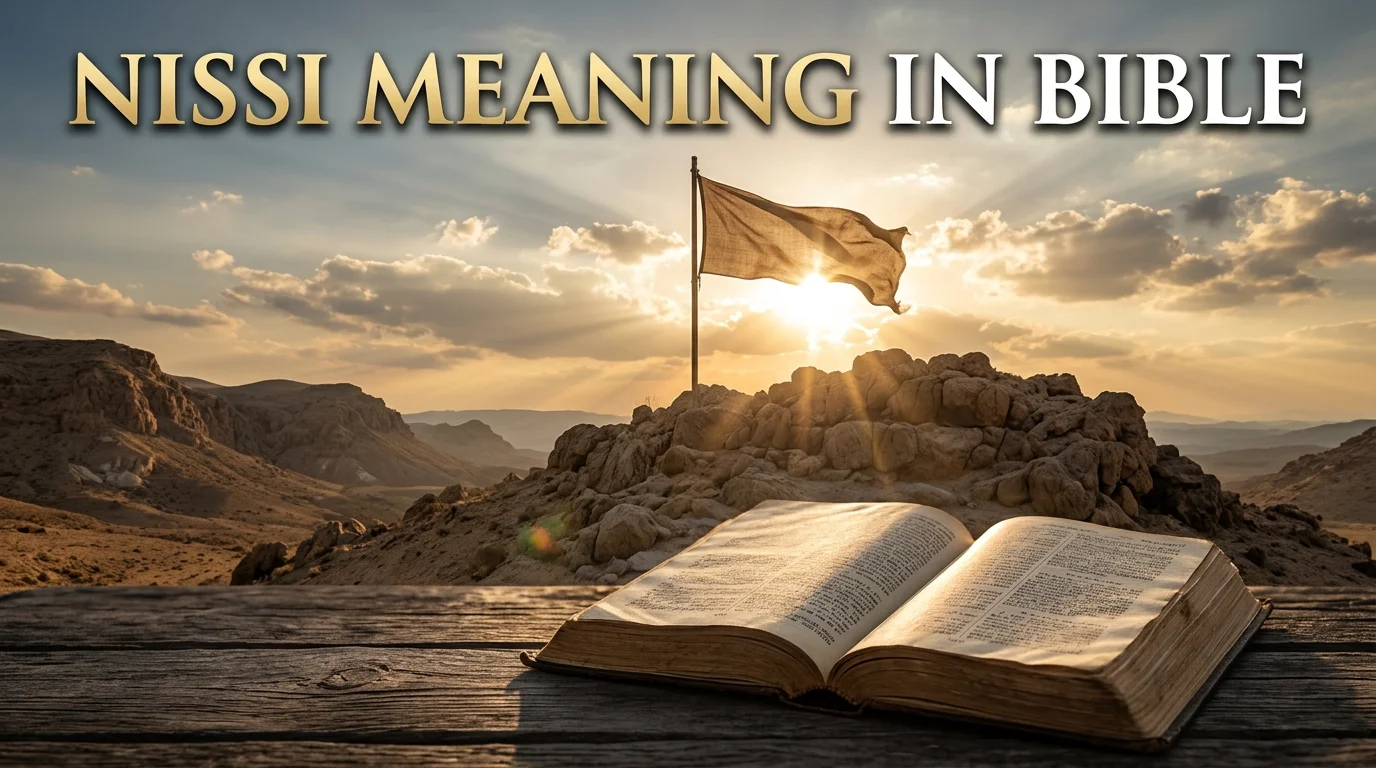
Names in the Bible often reveal powerful truths about God’s character, protection, and faithfulness, and Nissi meaning in the Bible is a beautiful example of this spiritual significance. The word “Nissi” is commonly understood through the biblical name Jehovah Nissi, meaning “The Lord Is My Banner.” This name appears in Exodus 17:15, where Moses builds an altar after the Israelites defeat the Amalekites and calls it Jehovah Nissi.
In this story, the Israelites face a difficult battle, and Moses’ raised hands become associated with their victory as Joshua leads the army. Afterward, Moses honors God by giving the altar this meaningful name. In biblical times, a banner served as a sign of identity, unity, leadership, and a rallying point for people during battle.
Calling the Lord “my banner” therefore expresses trust in God as the source of strength, guidance, and victory. For Christians, Jehovah Nissi can serve as a reminder that success and protection are not simply matters of human ability but also opportunities to recognize God’s faithfulness. You are studying biblical names, searching for spiritual encouragement, or exploring the meaning of Jehovah Nissi for personal reflection, understanding its original context can deepen your appreciation of this powerful expression.
What Does Nissi Mean in the Bible?
At its simplest, the nissi meaning in bible is “my banner” or “my standard.” When joined with the sacred name of God, it becomes Jehovah-Nissi or Yahweh-Nissi, meaning “The Lord is my Banner.”
In ancient times a banner was not a decorative flag. It was a raised signal pole, often with an ensign, that soldiers looked for in the chaos of battle. The banner marked identity, direction, and the place to regroup. Whoever controlled the banner controlled the morale of the army. Moses took that military image and placed it squarely on God. He was saying, “The Lord Himself is the standard we fight under. Is the one we look to. He is the reason we prevail.”
The name appears in Exodus 17:15. After a hard-fought victory, Moses built an altar and called it Jehovah-Nissi. That single act turned a battlefield into a place of worship and remembrance.
The Hebrew Roots of Nissi
To grasp the nissi meaning in bible more fully, we need to look at the original language. The word comes from the Hebrew root nes (נֵס). This root carries the idea of something lifted up, displayed, or raised high so it can be seen from a distance. It can mean:
- A military standard or signal pole
- A rallying point
- A sign or miracle that points beyond itself
In modern Hebrew the same root is still used for “miracle.” That double sense is beautiful. The banner is both a practical signal for the troops and a supernatural sign of God’s presence.
When Moses added the possessive ending, it became nissi — “my banner.” He was making it personal. God was not merely a banner; He was Moses’ banner and, by extension, Israel’s banner.
The Historical Setting: The Battle at Rephidim
The story that gave birth to the name is found in Exodus 17:8-16. The Israelites had only recently left Egypt. They were still learning what it meant to trust the God who had just split the Red Sea. Suddenly the Amalekites attacked them at Rephidim.
This was not a fair fight. The Amalekites were seasoned desert warriors. Israel was a newly freed slave people with little military experience. Joshua was appointed to lead the fighting force while Moses, Aaron, and Hur climbed a nearby hill.
What happened next is one of the most unusual battle accounts in Scripture. As long as Moses held up the staff of God, Israel prevailed. When his arms grew tired and the staff dropped, Amalek gained the upper hand. Aaron and Hur had to hold Moses’ hands steady until sunset. Only then did Joshua and the army win a complete victory.
After the battle Moses built an altar and named it Jehovah-Nissi. He also recorded the Lord’s promise that He would be at war with Amalek from generation to generation. The altar stood as a permanent reminder that the victory belonged to the Lord, not to human strength or clever strategy.
Why the Banner Image Matters
A banner does several important things in battle, and each one maps onto the spiritual life.
First, a banner provides identity. Soldiers know which side they belong to by the standard flying above them. In the same way, Jehovah-Nissi tells believers whose they are. They fight under the Lord’s name, not their own reputation or resources.
Second, a banner gives direction. In the dust and noise of combat it is easy to lose orientation. The raised standard becomes the fixed point everyone moves toward. When life feels confusing, the nissi meaning in bible reminds us that God Himself is the fixed point we orient our lives around.
Third, a banner inspires courage. Seeing the flag still flying can keep exhausted troops from breaking ranks. Knowing that the Lord is our Banner does the same for the soul. The presence of God does not always remove the fight, but it changes the atmosphere of the fight.
Fourth, a banner marks victory. After the battle the standard is raised high as a declaration that the day belongs to the one whose banner flies. Moses’ altar did exactly that. It shouted to every future generation that the Lord had won the day.
Jehovah-Nissi and Other Names of God
Scripture reveals God through many compound names. Each one highlights a different facet of His character. Jehovah-Jireh speaks of provision. Jehovah-Rapha points to healing. Jehovah-Shalom declares peace. Jehovah-Nissi stands in that same family as the name that speaks of victory and protection in conflict.
These names are not random titles. They arise out of real human need met by divine action. Jehovah-Nissi was born on a dusty hillside after a long day of battle. That origin story makes the name especially precious to anyone who feels under attack — whether the attack is physical, emotional, relational, or spiritual.
Spiritual Lessons from the Nissi Meaning in Bible
The story of Jehovah-Nissi offers several lasting lessons.
Victory depends on dependence. Israel did not win because they had better weapons. They won because Moses kept the staff of God raised. The raised hands were a picture of intercession and reliance. Our battles are often won the same way not by self-effort alone, but by sustained dependence on the Lord.
We need community. Moses could not keep his arms up by himself. Aaron and Hur came alongside him. The nissi meaning in bible quietly teaches that we are not meant to fight alone. God often provides people who help us keep our spiritual “arms” raised when we grow weary.
God keeps score differently. From a human point of view the battle looked like a close contest that swung back and forth. From heaven’s perspective the outcome was never in doubt as long as the staff stayed raised. God sees the end from the beginning.
Remembrance is an act of faith. Moses did not just experience the victory; he marked it with an altar and a name. Building memorials of God’s faithfulness strengthens us for future fights. Writing down answered prayers, sharing testimonies, or simply pausing to thank God are modern ways of raising our own “Jehovah-Nissi” altars.
How the Nissi Meaning in Bible Applies to Daily Life
The battlefield of Rephidim feels far away, yet the principles travel well into modern life.
When anxiety rises and the mind feels under siege, Jehovah-Nissi becomes a place to run. The Lord is still the banner. Looking to Him rather than to the swirling thoughts can steady the heart.
When relationships feel fractured, the name reminds us that unity is found under a common standard. Families, churches, and friendships thrive when everyone looks to the same Banner rather than defending personal flags.
When work or ministry feels overwhelming, the story of Moses’ tired arms offers permission to ask for help. No one is expected to hold the staff alone forever.
When opposition comes — whether from people, systems, or spiritual forces — the promise that the Lord fights for His people remains. The same God who warred against Amalek still stands for those who belong to Him.
Practical Ways to Live Under Jehovah-Nissi
Here are simple, concrete ways to keep the nissi meaning in bible alive in everyday experience:
- Begin difficult days by quietly declaring, “Lord, You are my Banner today.”
- When discouragement hits, picture the raised staff of God and remember that the outcome does not rest solely on your strength.
- Keep a simple journal of “banner moments” — times when God clearly helped you through a hard situation.
- Invite trusted friends to “hold up your arms” through prayer and encouragement when you feel depleted.
- Use the name in worship. Singing or speaking “Jehovah-Nissi” can shift the atmosphere of the heart.
- Teach the story to children or new believers. The image of a banner is easy to understand and hard to forget.
Common Misunderstandings About Nissi
Some people treat the compound names of God as almost magical formulas. Speaking “Jehovah-Nissi” does not automatically remove every problem. The name is a revelation of God’s character, not a password that forces His hand.
Others assume the name only applies to physical battles. Scripture shows that the same God who fought for Israel also fights for the integrity of the heart, the purity of the mind, and the health of relationships.
Still others think the name is only for “super-spiritual” people. The original setting was ordinary people in a desperate situation. The invitation is open to anyone who will look to the Lord as their Banner.
The Broader Biblical Theme of the Banner
Although the specific phrase “Jehovah-Nissi” appears only once, the theme of God as a raised standard runs through Scripture. Isaiah repeatedly speaks of God lifting a banner to gather the nations and to summon His people. In the New Testament, Jesus is lifted up on the cross, becoming the ultimate sign that draws people to Himself. The raised staff of Moses finds its fullest expression in the raised Savior.
That continuity is part of what makes the nissi meaning in bible so rich. It is not an isolated curiosity. It is one thread in a larger tapestry of God making Himself known as the One under whom His people find identity, direction, and victory.
Frequently Asked Questions
What is the exact nissi meaning in bible?
Nissi means “my banner” or “my standard.” Combined with Jehovah or Yahweh it becomes “The Lord is my Banner.” It is the name Moses gave to the altar after Israel’s victory over the Amalekites in Exodus 17.
Where does the name Jehovah-Nissi appear in Scripture?
It appears only once, in Exodus 17:15. Moses built an altar and called it Jehovah-Nissi after the battle at Rephidim.
Why did Moses call the altar Jehovah-Nissi?
He wanted to declare that the victory belonged to the Lord. The raised staff had been the visible sign of God’s power. Naming the altar “The Lord is my Banner” made that truth permanent and public.
Is Jehovah-Nissi the same as Yahweh-Nissi?
Yes. Jehovah and Yahweh are different English renderings of the same Hebrew name for God (YHWH). Both forms are used by believers today.
How can I apply the nissi meaning in bible to my life?
Look to the Lord as your rallying point in every struggle. Declare that He is the One under whom you live and fight. Ask others to support you in prayer when you feel weary, just as Aaron and Hur supported Moses.
Does the name Jehovah-Nissi still matter for Christians today?
Absolutely. The character of God does not change. The same Lord who was Israel’s Banner remains the Banner for everyone who trusts in Him through Christ.
Are there other biblical names similar to Jehovah-Nissi?
Yes. Other compound names such as Jehovah-Jireh (The Lord Will Provide), Jehovah-Rapha (The Lord Who Heals), and Jehovah-Shalom (The Lord Is Peace) each reveal different aspects of God’s nature in response to human need.
Conclusion
The nissi meaning in bible is far more than a linguistic detail. It is a revelation of a God who steps onto the battlefield with His people and becomes the very standard under which they stand. From the dusty hills of Rephidim to the quiet struggles of modern life, Jehovah-Nissi still invites us to lift our eyes. He is the Banner that does not fall. Is the rallying point that never moves. He is the victory that does not depend on our perfect strength.
When the fight feels long and your arms grow tired, remember the name. The Lord is your Banner. Under that standard you are never alone, never without direction, and never without hope. Raise your eyes to Jehovah-Nissi and keep walking forward.

James Parker is a Bible writer at GrasePath.com who loves exploring the deeper meaning of Scripture. He shares clear, trustworthy insights about biblical names, symbols, dreams, and spiritual teachings in simple language. His mission is to help readers strengthen their faith and better understand God’s Word every day.