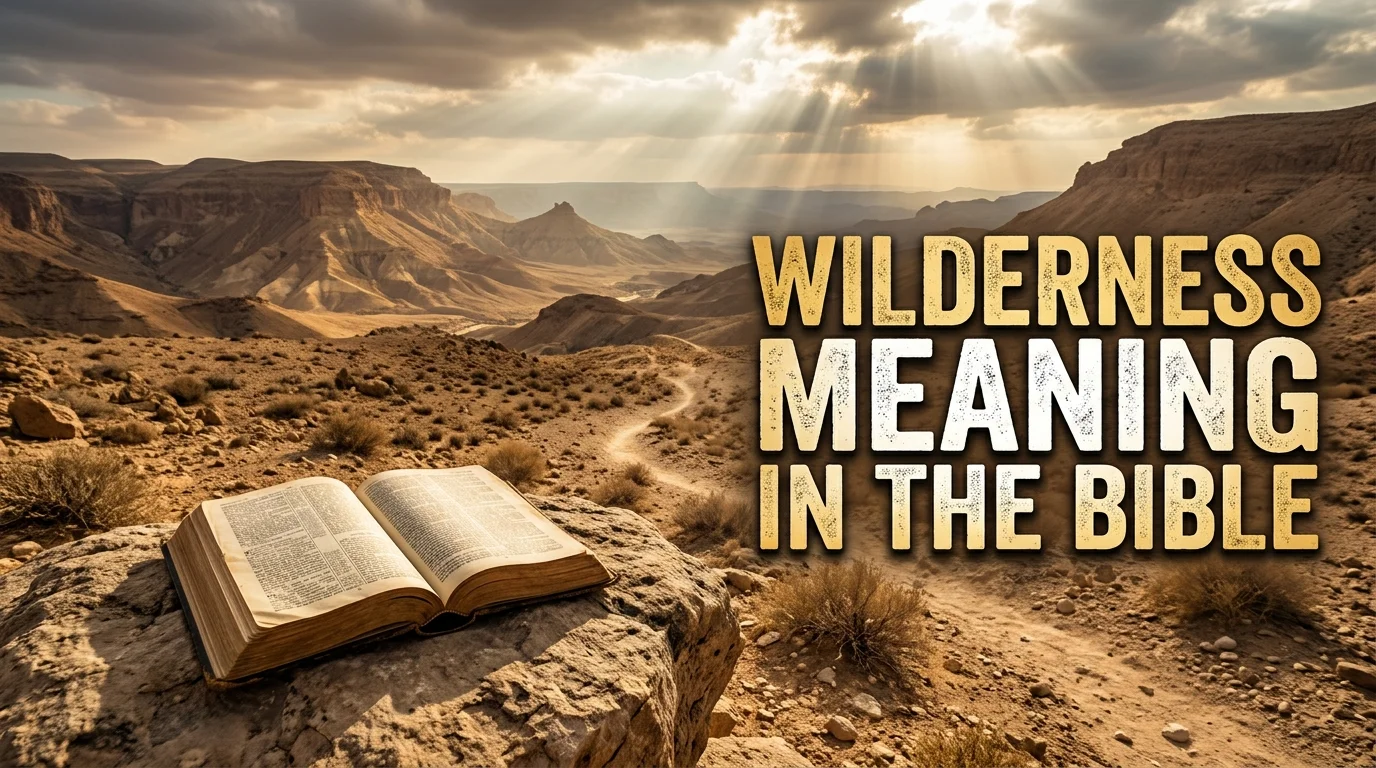
Have you ever felt like you were wandering through a season of life with no clear direction, no comfort, and no end in sight? If so, you’ve already tasted a small piece of what the Bible calls “the wilderness.” Understanding the wilderness meaning in the Bible isn’t just an academic exercise for theologians it’s a lifeline for anyone who has ever felt lost, tested, or forgotten by God.
The wilderness shows up again and again in Scripture, from the sandy dunes where Moses led the Israelites to the lonely stretches where Jesus faced temptation. But the wilderness is never just a place on a map. It’s a spiritual symbol packed with meaning about testing, transformation, dependence on God, and ultimately, redemption.
In this article, we’ll dig deep into the wilderness meaning in the Bible, explore its many layers, walk through real biblical examples, and uncover what this ancient symbol means for your life today. Whether you’re studying for a sermon, doing personal devotion, or just curious about biblical symbolism, this guide will give you everything you need.
What Does “Wilderness” Mean in the Bible?
At its most basic level, the wilderness in the Bible refers to a desolate, uninhabited, and often harsh geographical region typically desert terrain marked by scarcity of water, food, and shelter. The Hebrew word most commonly translated as “wilderness” is midbar (מִדְבָּר), which describes an open, untamed land, often associated with pastureland or desert.
In the New Testament, the Greek word eremos (ἔρημος) carries a similar meaning a solitary, desolate, or uninhabited place.
But here’s the thing: in biblical literature, wilderness is rarely just about geography. It’s a theological concept loaded with symbolic weight. The wilderness meaning in the Bible operates on at least four levels:
- A literal place actual deserts and wild regions like the Sinai Peninsula or the Judean wilderness.
- A place of testing where faith, character, and obedience are refined.
- A place of encounter where people meet God in profound, often unexpected ways.
- A metaphor for spiritual struggle representing seasons of doubt, waiting, or hardship in a believer’s life.
Understanding all four layers is key to grasping why wilderness imagery appears so often and why it still resonates with readers thousands of years later.
The Wilderness as a Place of Testing and Refinement
One of the clearest patterns in Scripture is that the wilderness is where character gets tested. It’s not a punishment so much as a proving ground.
The Israelites’ 40 Years in the Wilderness
The most famous wilderness narrative in the Old Testament is the story of the Israelites wandering the desert for 40 years after their exodus from Egypt. God didn’t lead them the short way to the Promised Land He led them into the wilderness on purpose.
Moses later reflected on this journey, explaining that the wilderness years were designed to humble the people, test their hearts, and reveal whether they would actually keep God’s commands. The wandering wasn’t random; it was formative. It stripped away Egyptian dependency and forced the nation to rely entirely on God for food (manna), water (from the rock), and direction (the cloud and fire).
This is one of the most important pieces of the wilderness meaning in the Bible: it’s often a place where God intentionally allows scarcity so that dependence on Him becomes unavoidable.
Why Testing Happens in Desolate Places
There’s something almost poetic about why testing happens in barren places rather than comfortable ones. In the wilderness:
- Distractions are stripped away.
- Self-sufficiency becomes impossible.
- Every provision has to come from somewhere outside yourself.
- Character flaws complaining, doubt, impatience surface quickly.
The Israelites complained about food, water, and leadership repeatedly during their wilderness years. Their failures weren’t hidden; the wilderness exposed them. In the same way, the wilderness seasons in our own lives often reveal what’s really going on beneath the surface of our faith.
The Wilderness as a Place of Divine Encounter
While the wilderness is a place of hardship, it’s also paradoxically one of the most common settings for profound encounters with God throughout Scripture.
Moses and the Burning Bush
Moses wasn’t in a temple or a palace when God first spoke to him from the burning bush he was tending sheep in the wilderness near Horeb, “the mountain of God.” It was in this remote, unremarkable setting that Moses received his life-changing call to lead Israel out of slavery.
Elijah’s Wilderness Retreat
After his dramatic victory over the prophets of Baal, the prophet Elijah fled into the wilderness, exhausted and afraid, even asking God to let him die. Yet it was there, in that isolated place, that God fed him, let him rest, and eventually spoke to him not in the wind, earthquake, or fire, but in a gentle whisper. This encounter reshaped Elijah’s entire outlook and renewed his sense of calling.
John the Baptist’s Wilderness Ministry
John the Baptist is described as a voice “crying in the wilderness,” preparing the way for the Messiah. He didn’t grow his ministry in Jerusalem’s temple courts he chose the wild, untamed regions along the Jordan River. His wilderness setting echoed the ancient prophetic tradition that God often speaks most clearly away from the noise of civilization.
Jesus in the Wilderness
Perhaps the most theologically rich wilderness account in the New Testament is Jesus’s 40 days in the wilderness immediately after His baptism. Led by the Spirit into the desert, Jesus fasted and faced direct temptation from the devil. This wasn’t a random detour it mirrored Israel’s 40 years of testing, except this time, the “true Israel” (Jesus) succeeded where the nation had failed.
This story reveals something powerful about the wilderness meaning in the Bible: it’s often the necessary precursor to public ministry, breakthrough, or a new calling. Before Jesus began His public work, He had to pass through the wilderness first.
The Wilderness as a Metaphor for Spiritual Struggle
Beyond literal desert stories, biblical writers frequently used “wilderness” as a metaphor for internal or spiritual desolation a season where God feels distant, life feels barren, and hope feels thin.
Poetic and Prophetic Wilderness Imagery
The Psalms are full of wilderness language describing feelings of abandonment, thirst for God, and longing for rescue. One psalmist compares his soul’s longing for God to a parched and weary land where there is no water a striking image of spiritual thirst.
The prophetic books also use wilderness imagery both as judgment (cities and nations reduced to desolation because of unfaithfulness) and as hope (the promise that the wilderness itself will one day “blossom” and become fruitful, a picture of restoration).
This dual use wilderness as judgment and wilderness as the setting for renewal is one of the richest layers of biblical symbolism. The same barren land that represents consequence can also become the backdrop for God’s most beautiful acts of restoration.
Modern-Day “Wilderness Seasons”
Many believers today talk about being in a “wilderness season” a period of:
- Grief or loss
- Unanswered prayer
- Career uncertainty
- Spiritual dryness or doubt
- Waiting for a promise to be fulfilled
- Feeling disconnected from community or purpose
This language draws directly from biblical wilderness symbolism. Just like the Israelites wandering before entering the Promised Land, or Jesus fasting before beginning His ministry, modern wilderness seasons often precede breakthrough, clarity, or a new chapter.
Key Themes Behind the Wilderness Meaning in the Bible
To summarize the recurring themes woven throughout Scripture, here are the core meanings behind wilderness imagery:
- Dependence Wilderness strips away self-reliance and forces trust in God’s provision.
- Testing Character and faith are refined under pressure and scarcity.
- Transition Wilderness often marks the space between an old identity and a new calling (slavery to freedom, private life to public ministry).
- Encounter Some of the most significant divine revelations happen in wilderness settings.
- Judgment Wilderness can symbolize consequences for unfaithfulness or rebellion.
- Hope and Renewal Prophetic writings promise that even the wilderness will one day flourish, symbolizing ultimate restoration.
These themes aren’t isolated they often overlap within a single story. The Israelites’ wilderness journey involved testing, judgment (for rebellion), divine provision, and eventually renewal as a new generation entered the Promised Land.
Real-Life Applications: What the Wilderness Teaches Us Today
Understanding wilderness symbolism isn’t just about ancient history it has practical, real-world application for anyone walking through a hard season.
1. Wilderness Seasons Aren’t Wasted Time
If you’re in a difficult, uncertain, or “dry” period of life, biblical wilderness stories remind you that these seasons often serve a purpose, even when that purpose isn’t immediately visible. Israel’s wilderness years shaped an entire generation’s faith and dependence on God, even though it didn’t feel productive at the time.
2. God Often Meets Us in Unlikely Places
Moses, Elijah, and John the Baptist all encountered God most powerfully away from comfort and routine. If you feel spiritually distant during a hard season, that distance doesn’t necessarily mean God is absent sometimes it means He’s working in ways that aren’t obvious yet.
3. Testing Reveals What’s Really There
Just as the wilderness exposed the Israelites’ complaints and doubts, personal wilderness seasons often reveal our own hidden fears, insecurities, or lack of trust. This can be uncomfortable, but it’s also an opportunity for real growth.
4. Every Wilderness Has an Exit
The Israelites eventually reached the Promised Land. Elijah eventually received new direction. Jesus emerged from His wilderness temptation to begin a transformative public ministry. Biblical wilderness stories consistently point toward an end a promised land, a renewed calling, a restored relationship with God.
Wilderness vs. Desert: Are They the Same Thing?
Many readers wonder whether “wilderness” and “desert” mean the same thing in biblical usage. The short answer: mostly yes, but with some nuance.
- Desert typically emphasizes dryness, heat, and lack of water.
- Wilderness (the Hebrew midbar) more broadly refers to any uninhabited, untamed region which could include desert terrain, but also rugged mountains, scrublands, or pastureland far from cities.
In most English Bible translations, the two words are used somewhat interchangeably, but “wilderness” carries a broader symbolic weight tied to isolation, testing, and divine encounter, while “desert” leans more toward the physical harshness of the terrain.
Notable Wilderness Passages Worth Studying
If you want to go deeper in your own study of the wilderness meaning in the Bible, here are some of the richest passages to explore:
- The Exodus narrative, covering Israel’s 40-year wilderness journey
- Moses’s encounter with the burning bush in the wilderness near Horeb
- Elijah’s flight into the wilderness and his encounter with God’s whisper
- The prophetic promise that the wilderness will one day rejoice and blossom
- The Gospel accounts of Jesus’s 40 days of temptation in the wilderness
- John the Baptist’s wilderness ministry along the Jordan
- Psalms expressing spiritual thirst using wilderness and desert imagery
Reading these passages side by side helps reveal just how consistent and intentional the wilderness theme is across both the Old and New Testaments.
Common Misunderstandings About Wilderness in Scripture
Because wilderness imagery is so widespread in the Bible, it’s easy to oversimplify what it actually means. Here are a few common misunderstandings worth clearing up.
Misunderstanding #1: Wilderness Always Means Punishment
It’s tempting to assume that if someone ends up in a wilderness season, they must have done something wrong. While Israel’s prolonged wandering was partly a consequence of unbelief, plenty of wilderness experiences in Scripture had nothing to do with punishment at all. Jesus was led into the wilderness by the Spirit, not as discipline, but as preparation. Elijah fled into the wilderness out of exhaustion and fear, not because he had sinned. The wilderness is better understood as a season with a purpose, not automatically a sign of failure.
Misunderstanding #2: Wilderness Is Only About Suffering
Yes, wilderness settings involve hardship thirst, hunger, isolation, uncertainty. But Scripture consistently pairs that hardship with provision and presence. Manna fell every morning. Water came from a rock. Ravens brought Elijah food. Angels ministered to Jesus after His temptation ended. The wilderness in the Bible is never depicted as a place where God abandons His people quite the opposite. It’s often where His care becomes most visible, precisely because there’s nothing else to rely on.
Misunderstanding #3: Wilderness Seasons Have No Timeline
Some readers assume that once you’re in a spiritual wilderness, it might last forever. But biblical wilderness stories almost always have a defined arc 40 years, 40 days, a specific stretch of testing before a new chapter begins. That doesn’t mean every real-life hardship resolves on a neat schedule, but it does mean the biblical pattern points toward wilderness as a passage, not a permanent state.
How Wilderness Imagery Connects the Old and New Testaments
One of the most fascinating aspects of biblical wilderness theology is how consistently New Testament writers echo Old Testament wilderness themes. This isn’t coincidental it’s intentional literary and theological continuity.
Consider how closely Jesus’s wilderness experience mirrors Israel’s:
- Israel spent 40 years in the wilderness; Jesus spent 40 days.
- Israel was tested with hunger and responded with complaint; Jesus was tested with hunger and responded with Scripture.
- Israel questioned God’s provision and protection; Jesus trusted both completely, even under direct temptation from the devil.
Where Israel repeatedly failed its wilderness test, Jesus succeeded. This connection reveals a deeper theological point: Jesus’s wilderness victory represents a kind of redo a faithful fulfillment of what Israel could not accomplish on their own. For readers of the New Testament familiar with the Exodus story, this parallel would have been immediately recognizable and deeply significant.
This pattern also reappears symbolically in the book of Revelation, where a woman representing God’s people flees “into the wilderness” for protection during a time of persecution once again portraying the wilderness as a place of divine shelter rather than abandonment.
FAQs
1. What is the spiritual meaning of wilderness in the Bible?
The spiritual meaning of wilderness in the Bible centers on testing, dependence on God, and transformation. It often represents a season of stripping away self-reliance so that faith and trust in God can grow stronger.
2. Why did God lead the Israelites into the wilderness?
God led the Israelites into the wilderness to humble them, test their obedience, and teach them complete reliance on His provision including daily manna, water from a rock, and guidance through a cloud and fire.
3. What does wilderness symbolize in the Bible?
Wilderness symbolizes several things depending on context: testing and refinement, transition between life stages, divine encounter, judgment for unfaithfulness, and ultimately hope for future restoration.
4. What happened to Jesus in the wilderness?
Jesus spent 40 days fasting in the wilderness after His baptism, where He was tempted by the devil three times. He resisted each temptation using Scripture, demonstrating obedience where Israel had previously failed during their own wilderness testing.
5. Is wilderness always a negative thing in the Bible?
No. While wilderness often involves hardship, it’s frequently the setting for some of the Bible’s most meaningful encounters with God, and prophetic writers even describe the wilderness eventually blossoming as a symbol of restoration and hope.
6. What is the difference between wilderness and desert in biblical terms?
Desert usually emphasizes physical dryness and harsh terrain, while wilderness (from the Hebrew midbar) more broadly describes any untamed, uninhabited region, carrying deeper symbolic weight tied to testing and encounter with God.
7. How can understanding wilderness in the Bible help me today?
Understanding biblical wilderness symbolism can offer comfort during hard seasons of life by reminding you that difficult, uncertain periods often serve a purpose, and that they typically lead toward growth, clarity, or a new calling just as they did for figures like Moses, Elijah, and Jesus.
Final Thoughts
The wilderness meaning in the Bible is far richer than a simple geographic reference. It’s a symbol of testing, dependence, transformation, and perhaps most importantly divine encounter. From Moses and the burning bush to Elijah’s whispered revelation, from Israel’s 40-year journey to Jesus’s own wilderness temptation, Scripture consistently shows that some of the most significant spiritual breakthroughs happen in the most desolate places.
If you find yourself in a wilderness season right now uncertain, weary, or waiting take heart. The biblical pattern is clear: the wilderness is rarely the destination. It’s the path that leads somewhere greater. Just as the Israelites eventually reached the Promised Land, and Jesus emerged from His wilderness testing to begin a world-changing ministry, your own wilderness season has the potential to become the very place where God does His deepest work in you.

Hi, I’m Daniel Foster, a writer at GrasePath.com. I enjoy exploring the deeper meanings of biblical words, names, symbols, and verses to help readers better understand Scripture. My goal is to present accurate, easy-to-read, and well-researched content that makes the Bible more accessible for everyone. Through every article, I strive to provide clear explanations, meaningful insights, and trustworthy information to support your faith and Bible study journey.